
Stablecoins could become the backbone of global payments, reaching $1.5 quadrillion by 2035.
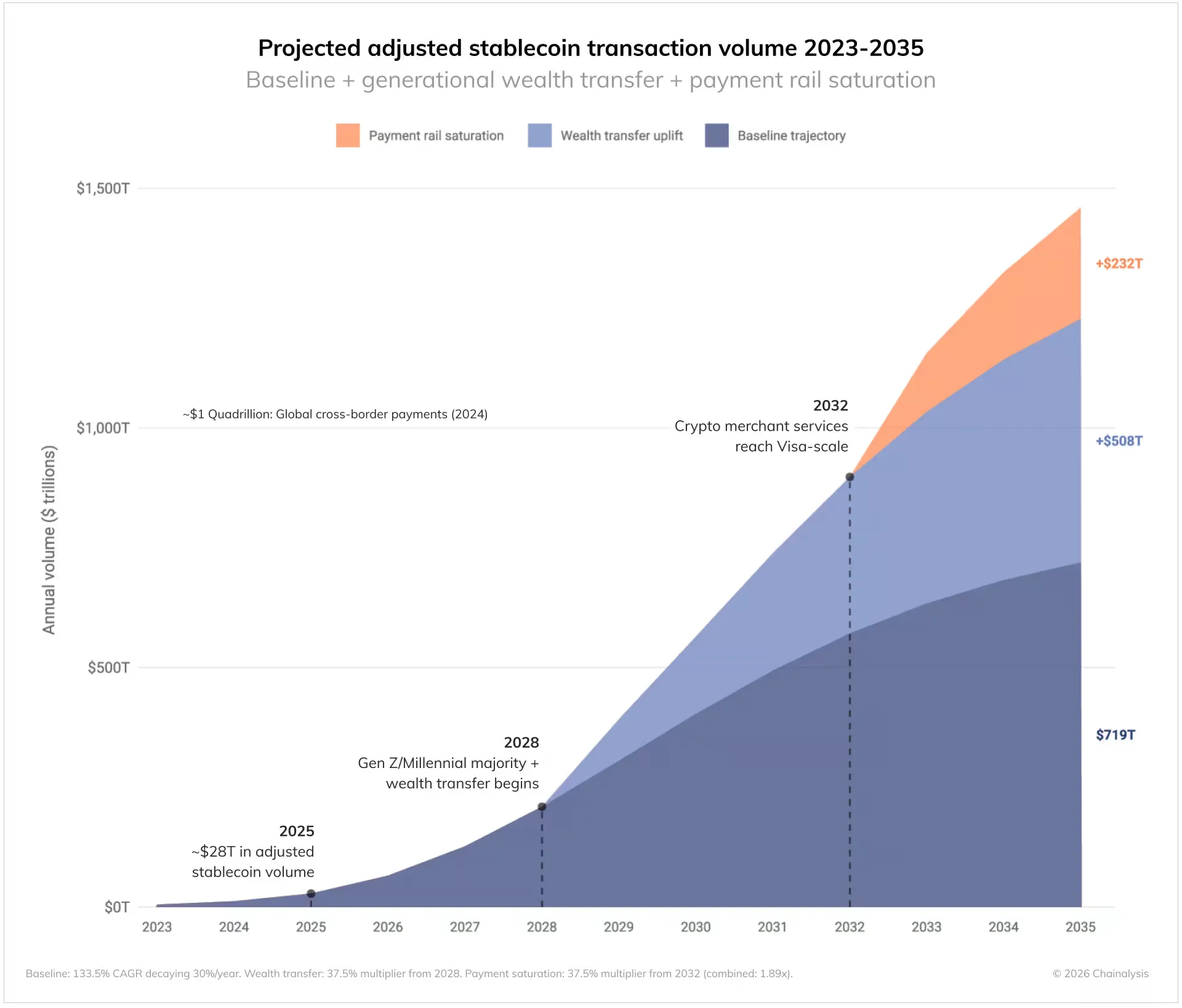
“Stablecoins” are gradually evolving from a niche tool into the backbone of global payments. Analysts at Chainalysis suggest that within the next decade, the volume of stablecoin transactions could reach $1.5 quadrillion.
The great wealth transfer is here, and it’s bringing crypto with it. Between 2028 and 2048, an estimated $100 trillion will likely move to younger, crypto-native generations. Our latest blog explores how stablecoin payment volumes are on pace to match Visa and Mastercard by the…
— Chainalysis (@chainalysis) April 8, 2026
Even the basic scenario anticipates an adjusted growth to $719 trillion. However, the influx of merchants and demographic shifts could significantly accelerate this trend.
Two Main Catalysts
In 2025, stablecoins facilitated around $28 trillion in “real economic activity” — experts deliberately excluded exchange trading volume, focusing only on direct payments and transfers.
Analysts expect this metric to grow significantly by 2035, driven by two structural factors:
- Generational Shift. Between 2028 and 2048, millennials and Gen Z are set to inherit up to $100 trillion. These demographic groups are much more rational in terms of storing and using digital assets.
- Widespread Distribution. The integration of stablecoins into merchant payment solutions will make their use almost invisible to consumers. Paying with cryptocurrency will cease to be a complex process and become a routine operation. An additional driver in this direction could be commerce based on the AI agent ecosystem.
Together, these trends will allow “stablecoins” to match the transaction volumes of Visa and Mastercard between 2031 and 2039. With accelerated technology adoption, parity could be achieved even sooner.
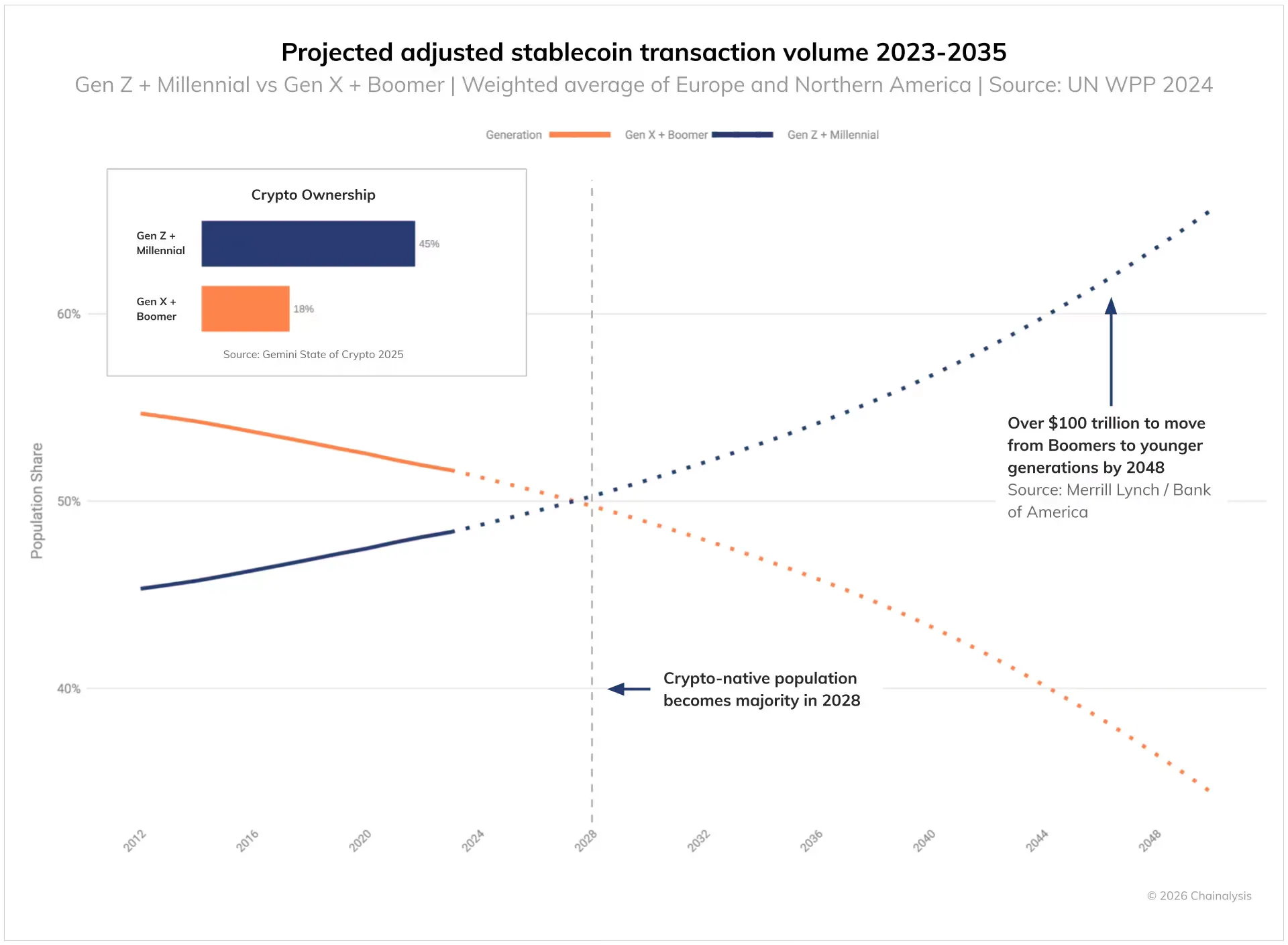
Millennials and Gen Z as drivers of stablecoin mass adoption. Source: Chainalysis.
Integration and Regulatory Stance
Changes are already noticeable: major financial players have begun adapting their strategies to stablecoins.
Stripe’s acquisition of Bridge and Mastercard’s purchase of BVNK indicate that “stablecoins” are becoming part of the core financial infrastructure.
Standard Chartered has also reported a leading growth in stablecoin usage due to new application scenarios. According to the bank’s estimates, the sector could generate demand for up to $1 trillion in US Treasury bonds, directly linking the payments industry with global capital flows.
Meanwhile, regulators continue to examine potential risks. A recent White House study found no substantial evidence of stablecoins negatively impacting bank lending. The document effectively dispelled concerns about a possible deposit outflow amid the development of a regulatory framework.
Many experts view the current trend not as a threat to the traditional financial system, but as a convergence. As noted by Patrick Witt, a cryptocurrency advisor to US President Donald Trump, “stablecoins” could channel additional funds into the US banking sector rather than withdraw them. The ultimate impact on the market will depend on the issuance structure and the quality of issuers’ reserves.
As reported, the prediction platform Polymarket announced a major infrastructure update and the launch of its own stablecoin.
Found a mistake? Select it and press CTRL+ENTER
Рассылки ForkLog: держите руку на пульсе биткоин-индустрии!