- April 10, 2026
- Olivia
- 0
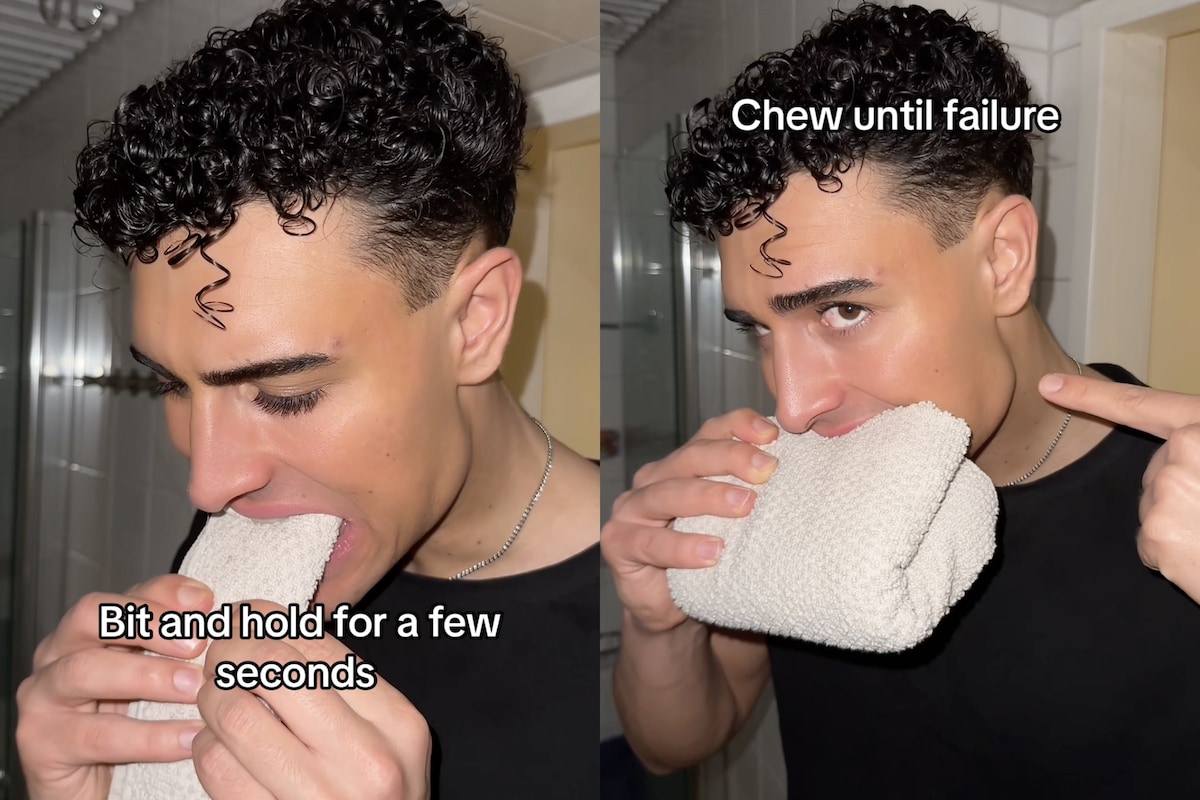
Step inside the looksmaxxing manosphere and you’ll be inundated with tips and tricks on how to become more attractive. Whether you want to achieve a chiselled jawline or obtain “hunter eyes”, the majority of this advice comes in the form of at-home, DIY hacks. There’s ‘towel biting’, which consists of chewing on a folded-up towel for approximately 15 minutes a day. Mewing, a tongue exercise used to improve the shape of the jaw. Facial exercises with names like “Zygopush” and “the Hunter Squeeze” aim to hollow out cheeks and make eyes more “wolf-like” in shape, respectively. And, of course, the infamous ‘bone smashing’, based on the idea that hitting one’s face with a household hammer will make the bones grow back ‘stronger’ and thus more defined.
Even when it comes to the more invasive techniques (i.e. steroids, fat dissolvers and testosterone injections), looksmaxxers tend to opt for more untraditional, unregulated or anti-establishment approaches. Clavicular has said he used meth in the past as an appetite suppressant, alongside Retatrutide, an experimental weight-loss drug not yet approved for use. He started ordering testosterone off the internet when he was 14 and shared during an interview that he has experimented with injecting dissolvable collagen threads into his penis for volume.
Manosphere influencers like Joe Rogan, meanwhile, claim the benefits of unregulated, experimental peptides (Rogan credited BPC-157 with healing a case of elbow tendonitis in two weeks), with many people turning to grey or even black-market suppliers to get their hands on them. While on sites such as Looksmxxing Forum, members encourage one another to pose as trans teenagers to learn roundabout ways of obtaining hormones through off-market channels. “Stay woke and don’t fall for scams, twin,” is the sign-off of a looksmaxxing video that recommends, among other things, humming for 24 hours a day to improve the jawline.
So why are looksmaxxers so obsessed with off-market hacks? According to Steven Roberts, a sociology professor at Monash University, it’s rooted in a desire to “signal that improvement is earned, not bought, which aligns with [the neoliberal masculine] ideals of independence and self-reliance”. Despite many of the manosphere values mirroring the language and models of the market economy, the community can often be very distrustful of the “establishment” and professional institutions. “In the manosphere, there’s sometimes a stated suspicion of commercial industries, [which] might even be situated as part of the exploitative or misleading ‘matrix’”, says Professor Roberts.
Just as masculine ideas around independence and self-reliance drive mistrust of the establishment, they also inform the reluctance of these men to see themselves as consumers. Their preference for DIY techniques stems in part from the perceived femininity of shopping and consumerism, particularly within the beauty industry. In her 1970s work, The Sociology of Housework, Ann Oakley argues that women’s exclusion from the workforce limited avenues for identity formation, which made consumption one of the few available means of self-expression. Over time, this contributed to a cultural framing of shopping as both feminine and a site of manipulation – an activity aligned with passivity rather than control.
As traditional masculinity defines itself in opposition to what it perceives as feminine, men seeking to embody it must distance themselves from practices culturally coded as feminine – and therefore “vain” and “frivolous” – such as dependency on consumer goods and beauty work. Instead, looksmaxxing reframes aesthetic improvements through perceived hypermasculine terms: autonomous, resourceful, disciplined – even dangerous.
This is why beauty brands geared towards men often align themselves with war: take male make-up brand War Paint or wellness brand Bravo Sierra, which collaborates with the US military to develop and test its products. It’s also why these men feel more comfortable turning to alternative or DIY practices, despite there being no guarantee of success or safety. “Following Clavicular’s lead towards a ludicrous beauty standard is without a doubt dangerous for your health,” as Dazed’s Laura Pitcher concluded in a recent article.
The irony of this DIY obsession is that, as Professor Roberts says, “many of these [looksmaxxing] spaces reproduce similar commercial dynamics in different forms.” That is, influencers profit from their audience’s insecurity and desire for self-betterment. In the end, when these DIY tricks offer little in the way of results, looksmaxxing content becomes just another lesson for young boys: the world cannot be trusted.