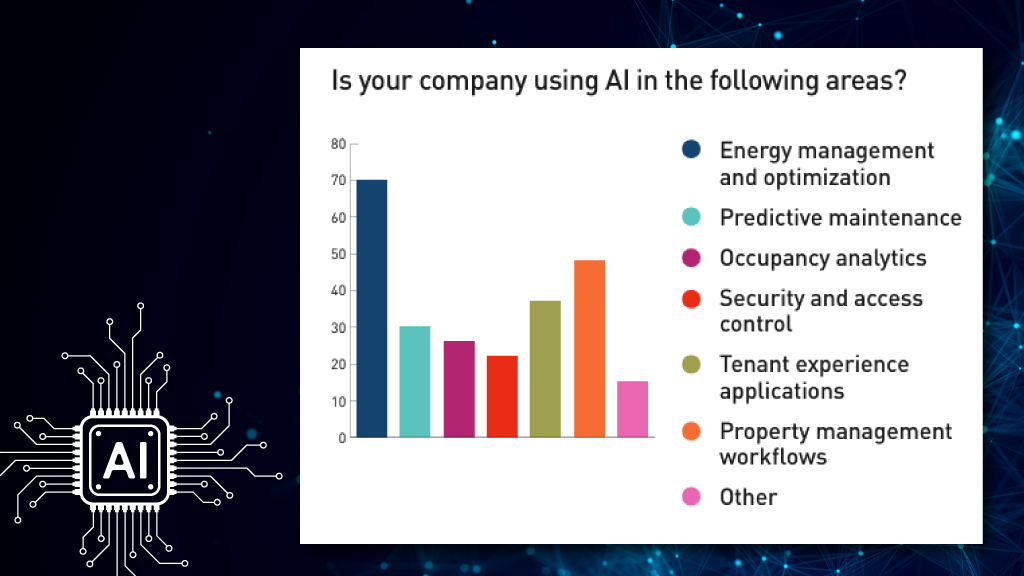
A recent BOMA Canada survey found there is “a really big gap” between awareness of AI and actual adoption for many of its members.
While 10 per cent of the survey’s 35 respondents indicate they are piloting AI or have operational systems in their buildings, many others remain on the sidelines, uncertain about whether AI will meet their Return on Investment (ROI) expectations, says Victoria Papp, BOMA Canada’s vice-president of strategy and innovation.
“The industry is really interested in AI and while there are a lot of expectations of what it can do, they still hesitate because they need proof of value.”
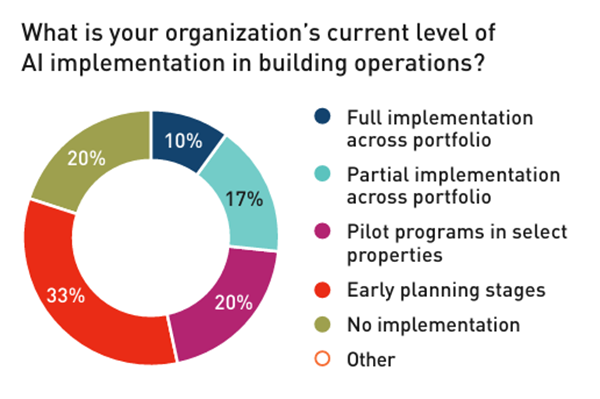
One reason AI is so slow to catch on is many buildings have aging infrastructure that needs upgrading to work with AI.

Papp, who led a BOMA team administering the report, says AI has primarily been integrated into larger office spaces. Owners and managers of historic or legacy properties face more challenges to AI integration.
“If you want to layer on a new technology that is AI-enabled, those two systems might not talk to each other.”
Older buildings often require a costly overhaul, “a big and ongoing challenge,” she says.
Another barrier is the lack of understanding what AI can do for a building. Having a dedicated technology adoption team helps owners and property managers weave through the process.
“If they don’t have the expertise in-house it can be quite costly to get consultants,” Papp says, adding government incentives such as preferred loans for retrofits and regulatory changes can be impetus for AI adoption.
For many of the BOMA survey’s respondents who embrace AI, energy management and optimization has been a priority.
HVAC and lighting controls are examples and, to a lesser degree, sensors that track movement in buildings and smart meters for building management, Papp says.
Of the survey’s respondents roughly 30 per cent were property managers, followed by asset managers and property owners at about 10 per cent. Most of those surveyed are commercial owners with portfolios of one million to 50 million square feet.
While dedicated tech teams on staff or consultants are often key to AI adoption, Papp says there are building programs such as BOMA’s Best Smart and its Artificial Intelligence for Commercial Real Estate program that provide guidance for building operators going through stages of technology adoption.
Critical, she says, for any investment in AI is to include a “rigorous” cyber security plan.
Sometimes cyber security is overlooked.
“We’ve seen instances where buildings have implemented AI-enabled HVAC systems and then been hacked.”
In one example, a building’s operators were locked out of their management system and faced a ransom demand to regain access, a reminder that skilled hackers can extract sensitive building information when security firewalls are weak or non-existent, Papp says.
While AI is in its infancy, many BOMA members will embrace it over time, she says, pointing out AI today is where sustainable design was 10 to 15 years ago.
“If I was to give advice to the industry it is to stay curious, stay educated.”
But she cautions owners and managers from working in silos on AI integration.
“Reports like this and case studies are really valuable because we can share findings and the risks that come with it.”
Seeing it “as a tool to help us manage buildings better,” Papp hopes in five years AI will help find ways to improve sustainable design and other management aspects of building operations.
BOMA Canada plans to do a follow-up AI survey in the next few months.
“Reports like this provide a good temperature check of what’s going on in the industry…so building owners and managers can take a look at what the AI landscape looks like and where it is moving.”