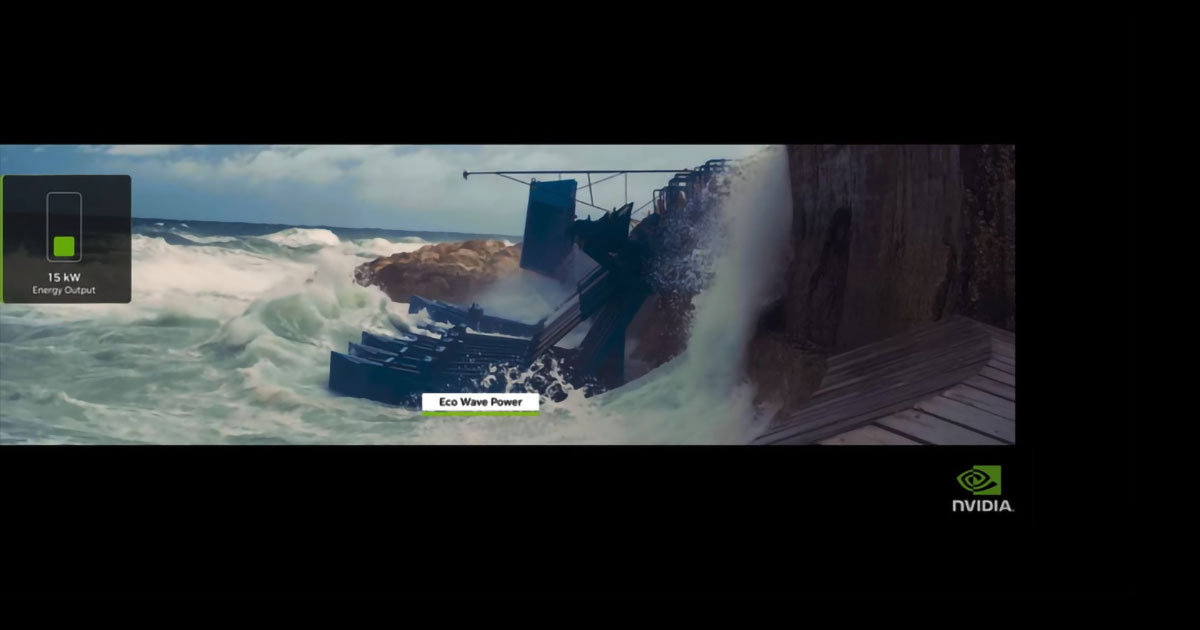
During March 2026, the system operated continuously, with approximately six days experiencing moderate wave conditions in the range of 1 to 2 meters. During these days, the project generated more than 1,200 kWh of clean, renewable electricity.
The March results are particularly notable as they reflect energy generation achieved during a limited number of operational days with moderate wave conditions, demonstrating the system’s ability to efficiently convert commonly occurring sea states into electricity.
Since the beginning of 2025, the EWP-EDF One system at Jaffa Port has maintained zero downtime, with stable operation recorded in wave conditions of 1 meter and above. The March performance further validates the resilience, safety mechanisms, and production scalability of Eco Wave Power’s proprietary onshore wave energy technology.
The ability to generate electricity under moderate and frequently occurring wave conditions also highlights the potential role of wave energy as a reliable power source for coastal infrastructure, including data centers.
As global demand for artificial intelligence infrastructure continues to accelerate, energy is increasingly emerging as a key constraint on growth. In a recent blog published ahead of NVIDIA’s GTC conference, Jensen Huang, CEO of NVIDIA, described AI as a “five-layer cake,” with energy forming its foundation. Every unit of intelligence generated in real time is ultimately dependent on a continuous electricity supply, as computation, cooling, and data processing all require significant power.
Following this publication, Eco Wave Power’s technology was also featured during NVIDIA GTC in the keynote presentation delivered by Jensen Huang, further highlighting the growing relevance of innovative renewable energy solutions within the AI ecosystem.
As AI models become more advanced and widely deployed, the limiting factor is no longer only algorithms or hardware, but increasingly the availability of scalable and reliable energy sources. The growing adoption of open-source models is further accelerating demand for energy across the entire AI infrastructure stack.
In this context, Eco Wave Power’s ability to generate clean electricity from moderate and predictable wave conditions near shorelines positions its technology as a logical and extremely relevant solution for powering coastal data centers and supporting the next generation of AI infrastructure.
The EWP-EDF One installation at Jaffa Port is a pilot-scale demonstration array, consisting of a limited number of small-scale floaters, designed primarily to validate system durability, grid integration, and real-world production performance under varying marine conditions.
Future commercial deployments are expected to utilize significantly larger floaters and a substantially greater number of units, which are anticipated to materially enhance energy capture and increase overall capacity factors compared to pilot-scale installations.
“March continued to demonstrate the consistency and efficiency of our system, even during a limited number of operational days under moderate wave conditions,” said Inna Braverman, CEO and Founder of Eco Wave Power. “The ability to generate meaningful electricity from common sea states strengthens our belief that wave energy can play an important role in supporting energy demand from rapidly growing sectors such as AI and data centers.”
Eco Wave Power continues to systematically collect and analyze real-world operational data at Jaffa Port to optimize system performance and support its global project pipeline.