In the ever-evolving landscape of energy technology, mechanical energy storage has emerged as a critical frontier with immense potential for transforming how we capture, store, and utilize energy. Researchers from Jiang, Yan, Nie, and their team have propelled this field forward by introducing innovative planar spiral structures engineered from two-dimensional nanomaterials, marking a significant milestone reported in their recent 2026 publication in Communications Engineering. Their pioneering work unveils new pathways toward ultra-efficient, high-capacity mechanical energy storage devices that could revolutionize industries ranging from electronics to large-scale power systems.
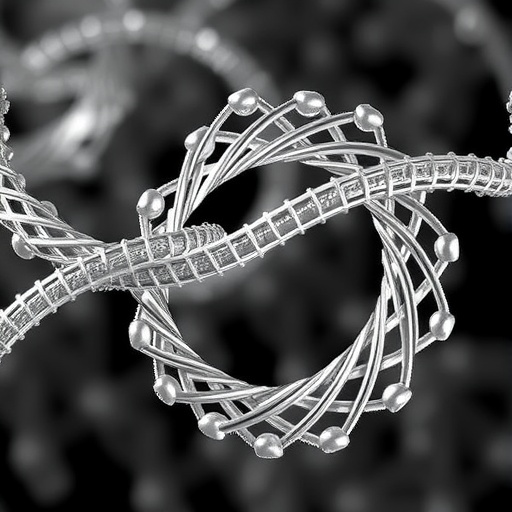
The crux of this research lies in the clever architectural design of planar spiral structures, utilizing the extraordinary physical properties of two-dimensional (2D) nanomaterials. These materials, which include graphene and transition metal dichalcogenides, possess remarkable strength, flexibility, and conductivity at the atomic scale. By carefully tailoring the geometry of spiral structures in a planar configuration, the team has created mechanical energy storage devices that defy the traditional constraints of size, weight, and efficiency that have historically hampered similar technologies.
One of the key breakthroughs highlighted in the study is the way these planar spirals store mechanical energy through elastic deformation. Unlike conventional mechanical energy storage systems that rely on bulk materials or complex configurations, the use of 2D nanomaterials enables energy to be stored densely within an ultrathin, lightweight structure. This high specific energy density derives from the intrinsic mechanical properties of the materials combined with the unique spiral design, which maximizes the elastic strain energy stored per unit volume.
A detailed analysis within the work delves into the strain distribution in these spirals under mechanical loading. Using state-of-the-art computational modeling and nano-engineering techniques, the team mapped how stress and strain propagate across the layers of 2D materials during twisting and bending. Such insights are crucial for optimizing the spirals to achieve maximum energy storage without material failure, ultimately extending the durability and cycling stability of these devices.
Moreover, the fabrication techniques developed for these planar spiral structures represent a major advance. The researchers employed scalable, precise lithography methods paired with chemical vapor deposition to synthesize high-quality 2D materials arranged as intricate spirals on flexible substrates. This manufacturing approach is not only compatible with existing semiconductor fabrication processes but also opens the door to mass production of mechanical energy storage devices that can easily integrate into wearable electronics, micro-robots, and flexible power systems.
Another compelling aspect of the research is the device’s ability to convert stored mechanical strain energy into electrical energy efficiently. By integrating piezoelectric or triboelectric nanomaterials in the spiral architecture, the system can function as both a mechanical energy reservoir and an energy harvester. This dual function is particularly promising for applications in remote sensing or autonomous devices where continuous energy replenishment from ambient mechanical vibrations or movement is essential.
From an applications perspective, the team envisions these planar spiral mechanical energy storage devices serving as critical components in the next-generation energy infrastructure. For example, their proposed devices could drastically enhance the performance of electric vehicles by offering lightweight alternatives to chemical batteries and supercapacitors, thereby improving driving range and reducing environmental impact. Similarly, the aerospace industry stands to benefit from compact, reliable energy storage mechanisms that sustain long-duration missions while maintaining minimal weight penalties.
The researchers also discuss the environmental implications of transitioning to mechanical energy storage systems based on abundant 2D nanomaterials. This approach reduces reliance on scarce or toxic materials typically used in conventional electrochemical storage, mitigating supply chain vulnerabilities and ecological risks. Furthermore, the long lifespan and recyclability of these mechanical devices align well with sustainability goals and the circular economy paradigm.
In describing the experimental validation of their concepts, the authors present meticulous mechanical characterization data verifying the robustness and repeatability of energy storage in their planar spiral configurations. The devices exhibited remarkable fatigue resistance, sustaining thousands of deformation cycles without significant loss of energy storage capacity. Such resilience is paramount for real-world deployment, ensuring consistent performance over extended operational periods in diverse environmental conditions.
The research also opens intriguing possibilities for customizing the energy storage properties by altering the spiral geometry or layering different 2D materials. By fine-tuning parameters such as spiral pitch, thickness, and interlayer interactions, tailored devices can be engineered to meet precise power and energy demands. This versatility positions the technology as a modular platform adaptable across industry needs, from micro-scale sensors to large-scale grid stabilization.
At the fundamental level, the team’s work enriches our understanding of nanoscale mechanics and energy transduction phenomena within complex material systems. Their multi-disciplinary approach, merging materials science, mechanical engineering, and nano-fabrication, exemplifies how convergent technologies can drive breakthroughs in energy solutions. This underscores the importance of collaborative research in addressing global energy challenges with innovative, cross-cutting strategies.
Looking forward, the authors advocate for further exploration into hybrid systems combining mechanical energy storage with other energy modalities, such as thermal or chemical storage, to harness synergies for enhanced efficiency and reliability. They also highlight the potential for integrating artificial intelligence and machine learning in device design and real-time performance optimization, enabling adaptive energy management in fluctuating usage scenarios.
Overall, this seminal study provides a compelling vision for the future of mechanical energy storage founded on planar spiral architectures and 2D nanomaterials. By transcending traditional limitations through nanoscale engineering and intricate design, Jiang, Yan, Nie, and their colleagues have charted a transformative path toward efficient, resilient, and sustainable energy storage systems that promise to reshape multiple technology sectors worldwide.
Subject of Research: Mechanical energy storage using planar spiral structures fabricated from two-dimensional nanomaterials.
Article Title: Mechanical energy storage of planar spiral structures based on two-dimensional nanomaterials.
Article References:
Jiang, S., Yan, J., Nie, Y. et al. Mechanical energy storage of planar spiral structures based on two-dimensional nanomaterials. Commun Eng (2026). https://doi.org/10.1038/s44172-026-00658-9
Image Credits: AI Generated
Tags: atomic-scale energy storage technologieselastic deformation in nanomaterialsflexible 2D nanomaterial energy systemsgraphene-based mechanical energy deviceshigh-capacity mechanical energy storageinnovations in mechanical energy capturemechanical energy storage with 2D nanomaterialsnanomaterial-based power systemsplanar spiral nanostructures for energy storagescalable mechanical energy storage solutionstransition metal dichalcogenides energy applicationsultra-efficient mechanical energy storage designs