The first quarter of
2026 – the opening of what has been described as a new era of the nation’s rise
– exhibited both bright spots and areas of concern in terms of Vietnam’s
economic performance and provide a basis for assessing prospects in the
quarters to come. Results in the quarter can be viewed from several angles.
Strong GDP growth
In terms of GDP, one
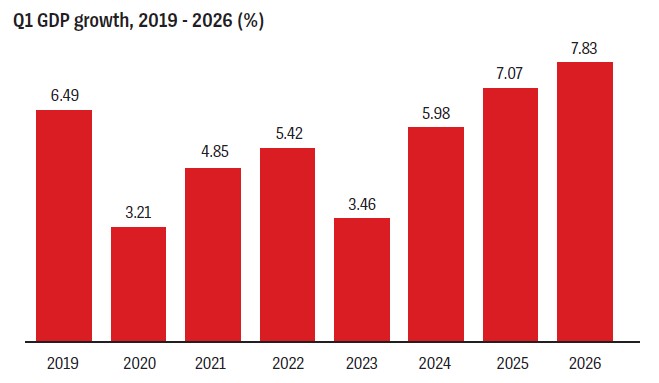
key bright spot in recent years has been the pace of growth. GDP growth in the
first quarter of 2026 ranked among the highest in the opening quarter for the
past seven years.
Notably, it not only
exceeded the levels recorded in the first quarter of 2020 and 2021, when growth
was affected by the Covid-19 pandemic, but also surpassed the first quarter of
2019, prior to the pandemic, as well as the first quarter of 2023, 2024, and
2025. It was lower only than the first quarter of 2022, when growth was partly
boosted by a very low comparison base in the first quarter of 2021. This
outcome reflected clear signs of recovery, supported by strong determination,
effective governance, and the efforts of businesses and the broader population.
The strong growth was
even more notable given the conditions under which it was achieved. The
comparison base in the first quarter of 2025 was already relatively high, while
exports to the US have faced increasing difficulties since the second half of
last year due to higher import tariffs.
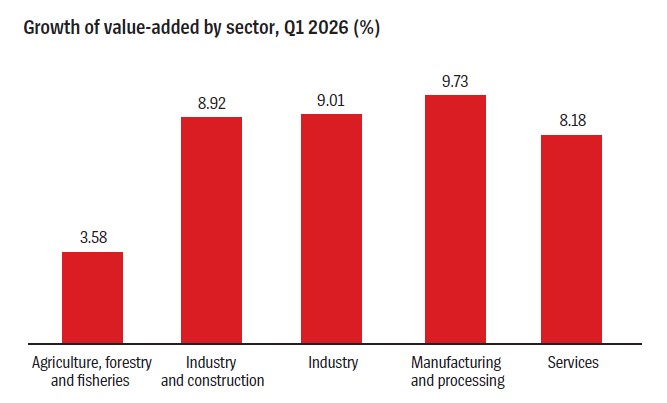
Growth in GDP has been
recorded across sector groups. Industry and construction, the largest segment
of the real economy, posted the fastest growth. Meanwhile, the services sector,
which absorbs the largest share of labor and capital, also expanded at a rate
above the overall average.
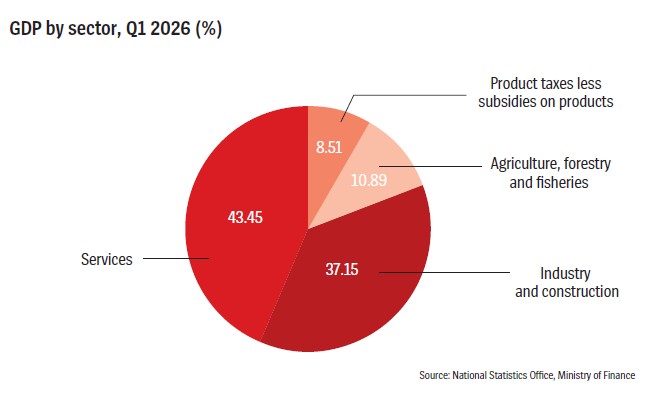
Differences in growth
rates have led to a positive structural shift. The share of agriculture,
forestry, and fisheries continues to decline and remains significantly lower
than its share of employment, indicating that workplace productivity in the
sector remains the lowest among the three major sectors. This underscores the
need not only to raise the share of trained workers but also to accelerate the
shift of workers from agriculture to higher productivity sectors such as
industry, construction, and services.
The share of
employment in industry and construction continued to rise and exceeded its
share of GDP, indicating that workplace productivity in the sector is above the
national average and the highest among the three sectors. This calls for
further improvements in workforce skills, a reduction in reliance on processing
and assembly, and faster modernization through the development of the digital
economy and high-tech industries such as semiconductors.
The services sector
also continued to expand its share and exceeded its contribution to GDP,
suggesting productivity above the national average and second only to industry
and construction. While this is a positive development, the share of services
in Vietnam’s GDP remains significantly lower than in many other countries and
continues to be a structural weakness.
Growth quality also
improved compared with the same period last year. The Index of Industrial
Production (IIP) rose 9 per cent, slightly below value-added growth of 9.01 per
cent. Manufacturing grew 9.7 per cent, lower than value-added growth but higher
than in the same period of last year, indicating a reduction in intermediate
input costs. The Incremental Capital-Output Ratio (ICOR) declined to below 5,
reflecting improved investment efficiency.
GDP growth outpaced
the increase in the number of employed workers (7.83 per cent vs. 1.3 per
cent), resulting in workplace productivity growth of an estimated 6.64 per
cent. As investment efficiency and workplace productivity improve, supported by
the application and upgrading of technology, the contribution of Total Factor
Productivity (TFP) to GDP growth is estimated at around 45 per cent; the
highest among the main growth drivers.
From the expenditure
perspective, several issues emerged. The growth of asset accumulation was lower
than GDP growth (7.18 per cent vs. 7.83 per cent), reducing the
accumulation-to-GDP ratio to about 23.7 per cent from 24 per cent a year prior.
As accumulation underpins investment, the investment-to-GDP ratio also
declined. This is a point of concern, as investment is a key driver of GDP
growth, and a lower ratio could make it more difficult to achieve this year’s
targets.
Final consumption grew
faster than GDP, at an estimated 8.45 per cent. The share of final consumption
in GDP increased compared with the first quarter of last year, making it an
important contributor to overall growth. Stronger domestic demand played a key
role in supporting this expansion.
However, despite the
increase in domestic demand (asset accumulation plus final consumption), the
goods trade balance shifted from a $3.17 billion surplus to a $3.64 billion
deficit.
Concerning
inflation signals
Inflation remains a
key macro-economic indicator closely linked to market participants, and the
first quarter exhibited both positive and concerning signals.
Average CPI rose 3.51
per cent, higher than the 3.13 per cent posted in the same period of 2025 but
still considered a positive outcome given stronger inflationary pressure.
Cost-push factors have intensified, with price increases occurring in earlier
stages of production. There are also emerging signs of imported inflation.
In the broader
relationship between production and GDP use, final consumption grew faster than
both GDP and in the same period of last year (8.45 per cent compared to 7.83
per cent), while the trade balance shifted from a $3.16 billion surplus to a
$3.64 billion deficit. Retail sales of goods and services rose 10.9 per cent,
higher than the 9.9 per cent recorded a year earlier, though real growth,
excluding price effects, was 7 per cent; slightly lower than previously.
On the monetary side,
growth in key indicators slowed compared to the same period last year. Money
supply increased by 1.04 per cent against 1.99 per cent, deposits rose 0.44 per
cent against 1.36 per cent, and credit grew 2.15 per cent against 2.49 per
cent. These developments helped contain inflation.
On the fiscal side,
revenue growth slowed, to 11.4 per cent compared to 29.3 per cent in the first
quarter last year, expenditure growth accelerated, to 23.1 per cent compared to
11.6 per cent, and the budget surplus narrowed to VND84.9 trillion ($3.27
billion), down from VND99.5 trillion ($3.83 billion).
Psychological factors
had a stronger impact than in the same period of 2025. Average gold prices
surged sharply, while the USD increased more modestly due to tighter exchange
rate management. The relatively stable exchange rate influenced trade flows and
contributed to the shift from surplus to deficit.
Q1 trade deficit
A trade deficit was
posted in the first quarter of 2026, reversing a trend seen in the opening
quarter for the past two years (the first quarter of 2024 saw a $8.7 billion
surplus and of 2025 a $3.16 billion surplus, while the first quarter of 2026
saw a $3.64 billion deficit).
Exports in the quarter
faced significant difficulties compared to a year earlier. In addition to a relatively
stable VND/USD exchange rate, higher US import tariffs and rising import prices
weighed on performance. Despite this, exports to the US still generated a large
surplus in absolute terms ($39 billion compared to $31.4 billion), while
imports from China rose sharply ($50.1 billion compared to $38.1 billion).
The services balance
remained in deficit. Compared with the same period last year, export growth
slowed (19.2 per cent compared to 21.8 per cent), while import growth also
eased (16.9 per cent compared to 18 per cent), resulting in a services deficit
of $1.68 billion in the first quarter compared to $1.64 billion last year.
Meanwhile,
international tourism continued to recover strongly, with Vietnam welcoming
6.67 million international visitors in the quarter, up 12 per cent year-on-year
and marking a new record. Two markets exceeded 1 million visitors, with China
contributing more than 1.4 million and South Korea nearly 1.33 million.
Outlook &
solutions
Based on first-quarter
results, including both bright spots and emerging concerns, along with factors
likely to influence the economy, what can be expected for Vietnam’s economy in
the quarters ahead under more ambitious targets?
GDP
First, GDP indicators remain the top
priority for this year and for the broader trajectory of the new era.
Following the pattern
observed in previous years, production GDP growth tends to accelerate from the
second quarter onwards through to the end of the year, as input factors –
including investment capital, labor, technology imports, monetary policy, and
fiscal spending – and output factors such as domestic consumption and exports
move from initial implementation into a phase of stronger expansion. On that
basis, GDP growth is expected to pick up in the second quarter, with the third
and fourth quarters potentially reaching double-digit levels.
This outlook could
materialize under the influence of several factors. Total social investment is
expected not only to increase in scale, reflected in a rising share relative to
GDP, potentially reaching 35 per cent, but also to improve in efficiency, as
the ICOR declines to below 4.5. Greater emphasis should be placed on channeling
capital into productive business activities, rather than speculative assets
such as gold, cryptocurrencies, and real estate.
The number of employed
workers is expected to rise as unemployment declines. More importantly,
workplace productivity growth could remain strong, supported by a higher share
of workers in more productive sectors such as industry, construction, and
services, as well as by the proportion of trained workers surpassing 30 per
cent for the first time.
The contribution of
TFP to GDP growth is expected to approach 50 per cent, exceeding the
contributions of capital and labor. This will be driven by improved investment
efficiency, rising workplace productivity, greater technological adoption, and
the expansion of enterprises with higher technological capabilities, alongside
the continued development of the digital economy.
An important driver of
both economic growth and social welfare is the development of businesses and
entrepreneurs. The number of enterprises entering the market in the first
quarter exceeded those exiting (96,000 vs. 91,800), pushing the total number of
active enterprises nationwide to above 1 million for the first time; a target
originally set for 2020 but only now achieved. Continued support for startups
and for businesses facing difficulties, to prevent market exit and enable
re-entry, remains essential. At the same time, it is important to reverse the
declining share of business owners within total employment, which has fallen
steadily over the years.
Concerns remain. The
investment-to-GDP ratio has for many years exceeded that of asset accumulation,
including in periods of budget deficits. This represents a potential risk,
particularly as corporate profitability remains low and many enterprises
continue to incur losses.
The longstanding issue
of reliance on processing and assembly has been widely recognized but improvements
remain tardy.
Overall, GDP growth in
2026 as a whole is expected to exceed the 8.02 per cent posted in 2025, but is
unlikely to reach the targeted double-digit level.
Inflation
Inflation remains a
key concern. From a conceptual standpoint, the view that inflation is not
driven by monetary factors is fundamentally flawed. At its core, inflation
reflects a depreciation of currency – when money supply exceeds goods supply.
Monetary policy affects not only inflation but also growth, requiring a balance
between tightening to control inflation and easing to support expansion.
To achieve higher GDP
growth, policymakers may aim to increase the investment-to-GDP ratio. However,
any move toward monetary easing must be carefully calibrated in light of current
economic conditions. A key issue is the relationship between the scale and
growth of money supply and the corresponding scale and growth of GDP.
A significant concern
is the allocation of capital into speculative assets such as gold, real estate,
and cryptocurrencies. While this has so far primarily driven price increases in
those markets, any correction could spill over into goods and services,
creating broader inflationary pressures. Gold prices have doubled or tripled
since mid-2020, while real estate prices have more than doubled since mid-2022,
with the upward cycle already lasting four to six years.
Cryptocurrencies
remain highly volatile, gold prices have diverged significantly from global
levels, and stock markets are vulnerable to speculation and market
manipulation.
Cost-push pressures
are also building. Though price increases in earlier stages of production have
not yet fully transmitted to consumer prices, they are likely to do so over
time through the production and distribution chain.
Imported inflation is
another major risk, particularly as global prices rise and higher US tariffs
drive up import costs.
Balance of
payments
The balance of
payments warrants close attention. Vietnam has recorded continuous trade
surpluses for decades. While this provides a strong foundation, it also
presents new challenges arising from domestic structural weaknesses and an
evolving global environment.
One of the most
prominent constraints is the continued reliance on processing and assembly,
which persists in both the domestic and foreign-invested sectors. This not only
limits national income – with gross national income remaining around 95 per
cent of GDP – but also contributes to rising imports. The trade surplus has
been narrowing in recent years and is expected to decline further in 2026, with
the first quarter already in deficit. The ratio of trade surplus to total
exports has also fallen sharply.
Exports have largely
depended on the foreign-invested sector, while the domestic sector continues to
run significant deficits. Improving export performance requires addressing
structural weaknesses, particularly low workplace productivity and
competitiveness that still relies heavily on low labor costs. The gap between
purchasing power parity and the official exchange rate remains large, exceeding
3.5-times.
Exchange rate policy
remains a critical lever. While depreciation could support exports, it would
also raise import costs, increase inflationary pressure, and create risks
related to external debt and trade disputes.
Though the exchange
rate rose significantly last year, it remained relatively stable in the first
quarter of this year. Import prices, however, especially for fuel, increased
sharply. There is a risk that imports will continue to rise in both volume and
value. If prices rise further and the VND depreciates, imported inflation could
return, as seen in previous periods.
Overall, the trade
balance is likely to weaken further this year and could shift into a full-year
deficit. Meanwhile, the services balance is expected to remain in deficit. This
combination will directly affect GDP growth from both the production and
expenditure perspectives and should be viewed as a significant warning sign.
The services deficit
has persisted for years, often reaching double-digit levels. It is most
pronounced in transport and other services, including insurance, finance, and
government services. Even tourism, which previously generated surpluses, has in
some years shifted into deficit.
The financial account,
meanwhile, has remained in surplus, driven mainly by FDI, while other forms of
investment have often recorded negative balances.