Dilmun-era tokens found in the kingdom have revealed ancient ties between civilisations in Bahrain, Kuwait and the Indus Valley, with extensive maritime trade during the Bronze Age leading to deep cultural ties across the region, according to recent archaeological research.
The findings were published this month in a study titled ‘Stamped Tokens with Cuneiform Inscriptions from Bahrain’ in the ‘Journal of Near Eastern Studies’, with research conducted by Steffen Terp Laursen from Al Ain Museum in Abu Dhabi, Nabiel Al Shaikh from Dammam Regional Museum in Saudi Arabia, Claire Reeler from University of Sydney, Pierre Lombard from the French National Centre for Scientific Research and Gianni Marchesi from University of Bologna.
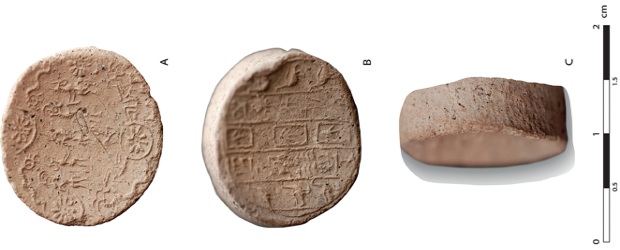
“The tokens that prompted this study were discovered at the site of Al Maqsha, located near the intersection of Avenue 50 and the Budaiya Highway,” researchers revealed.
“The place of discovery is located approximately 100 metres west of the Al Maqsha Royal Mound amidst a huge concentration of Bronze Age rockcut tombs, which collectively suggest that this area was of great significance in the Early Dilmun period.
“In 2009, the Bahrain Heritage authorities released the area to developers. At that time, Olga Ali Akbar Hassan, a keen amateur archaeologist, was browsing through the spoil heaps of the former archaeological excavations when she came across two small terracotta artifacts impressed with stamp seals.”
Another token found near Qal’at Al Bahrain in 1989 is included in the study because it bears the same seal of Yagli’el, a Dilmun king who ruled around 1,700BC, that is also seen on the first Al Maqsha token.
“While Qal’at Token only bears a single seal impression, Al Maqsha Tokens 1 and 2 with their two and three different seal impressions may indicate the involvement of a duo and a trio of countersigners,” researchers added.
The second Al Maqsha token is the most unique find amongst Dilmun-era seals uncovered so far.
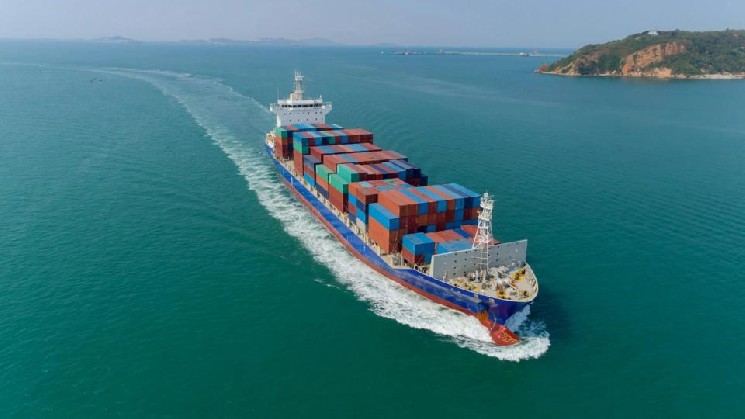
The tetrahedron-shaped find, with four triangular faces, combines administrative styles from Dilmun, Failaka Island (modern-day Kuwait) and the Indus Civilisation (modern-day Pakistan, northwest India, and northeast Afghanistan) to create a unique system of countersigned ‘identity tokens’ to track high-value cargo moving across the world’s earliest global trade routes.
This specific token also features a rare guilloche symbol, an elite motif from the Amorite kingdoms of Syria and Mesopotamia that represents water, fertility, and prosperity.
The researchers propose that these tokens represent an administrative technology transmitted from the Indus Civilisation to Dilmun, alongside stamp seals and standardised weights.
Nearly identical in shape and size to tokens found at the Indus site of Kanmer in Gujarat, India, these objects likely functioned as ancient ‘passports’ or identity credentials.
“The Kanmer tokens have been interpreted as ‘identity cards or passports for the Harappans or certain business families authorised by the head of the Harappan state or the ruler of Kanmer’, researchers explained.
“They are nearly identical in shape and size (about 3cm in diameter) to the Dilmun tokens,”
Issued to middlemen and transporters operating on long-distance maritime routes, the tokens provided a sophisticated way to verify the authority of those moving high-value goods between the major hubs of the Bronze Age.
Another interesting finding was the presence of seal impressions on Dilmun tokens which were previously thought to be exclusive to Failaka Island in modern-day Kuwait, with only one other example ever recorded in Bahrain.
Finding these high-quality, elite seals in Al Maqsha suggests that high-ranking officials from Failaka were actively involved in Dilmun administrative affairs, pointing to a more integrated and unified bureaucracy than previously understood.
Beyond trade and politics, the discovery of these tokens provides a rare biographical glimpse into the early life of King Yagli-’el.
While all other known royal inscriptions identify him as the ‘servant of the god Inzak of Agaš,’ these specific artifacts identify him as the ‘servant of the goddess Panipa’.
Because these two high-level titles appear to be mutually exclusive, researchers hypothesise that Yagli-’el served the goddess during a religious office or as a crown prince before he eventually ascended the throne.
This personal history is linked to the ‘divine duality’ of Inzak and Panipa, who are understood as the divine king and queen of the Dilmun civilisation. This relationship was so central to their culture that it was physically mirrored in their temple architecture.
The study identifies a repeated spatial pattern where a large primary temple, likely dedicated to Inzak, is paired with a smaller one presumably dedicated to Panipa.
This unique architectural signature can be seen today at the Barbar Temple complex in Bahrain and at the Tell F6 site on Failaka Island.
The existence of these twin-temple configurations across both islands serves as evidence of a shared religious and cultural identity during the Bronze Age.
naman@gdnmedia.bh