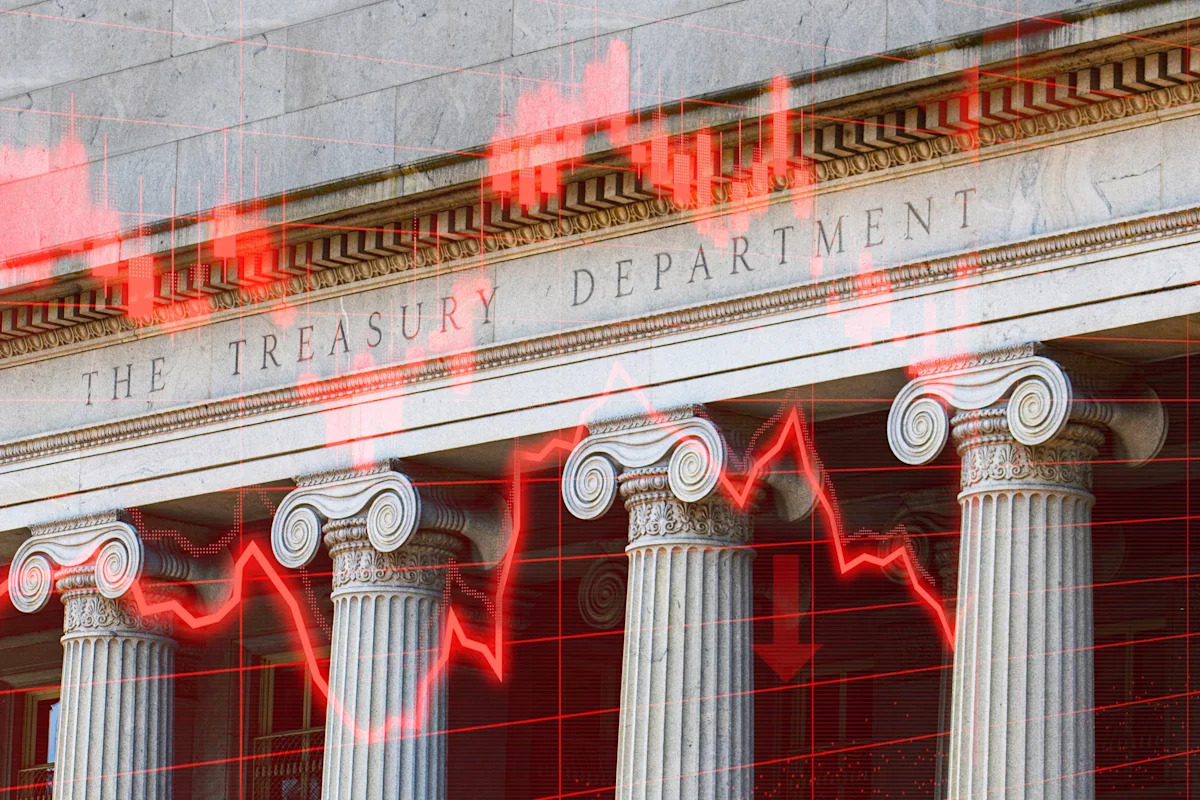
May 07, 2026 (MLN): The Government of Pakistan has fired a significant shot in its battle against financial fragmentation, issuing a landmark notification on Wednesday that dramatically extends the reach of the Treasury Single Account (TSA).
TSA is a mechanism designed to pool every rupee of federal money into one consolidated fund by the close of every banking day.
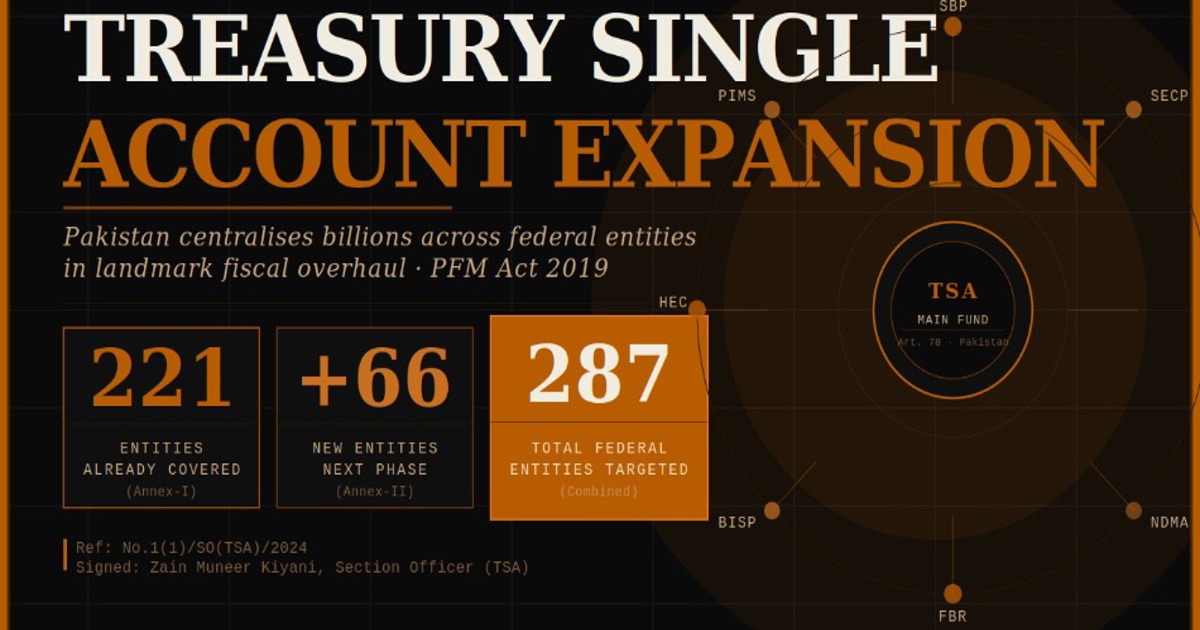
The notification, issued by the Ministry of Finance under reference No.1(1)/SO(TSA)/2024 and signed by Section Officer (TSA) Zain Muneer Kiyani, brings to 221 the total number of federal entities already brought under the TSA sweeping arrangement, while simultaneously identifying a fresh batch of 66 entities slated for the next phase of integration.
That number, combined, represents one of the most expansive reshaping of Pakistan’s public cash management architecture in a generation.
All revenues, loans and moneys received by the Federal Government shall form part of a consolidated fund, Article 78, Constitution of Pakistan.
How the “Sweeping Arrangement” Works
At the heart of this initiative lies a mechanism called the sweeping arrangement, introduced under the Cash Management & Treasury Single Account Rules notified in 2024.
The mechanism operates on a near-clockwork basis: funds sitting idle in the bank accounts of government entities are automatically swept out into the Federal Government’s consolidated fund at the close of banking hours each day, and swept back before banking hours resume the next morning.
Entities retain full operational liquidity for their day-to-day needs, but the overnight float, often hundreds of millions of rupees sitting unused in commercial banks, is recaptured by the state. This is not merely an administrative tidying exercise.
Idle government balances scattered across commercial bank accounts represent a significant drain on the state’s fiscal position, generating returns for banks rather than for the public treasury.
The TSA consolidation, by contrast, strengthens the government’s cash forecasting, reduces borrowing needs, and tightens control over public financial flows.
Constitutional Roots, Legal Architecture
The initiative traces its legal lineage directly to Article 78 of the Constitution of the Islamic Republic of Pakistan, which mandates that all revenues, loans and moneys received by the Federal Government form part of a consolidated fund.
The Public Finance Management Act of 2019 further defines the TSA framework and classifies public entities, ranging from commercial enterprises to non-commercial bodies that fall within its ambit.
Under Rule 5(1) of the Cash Management & Treasury Single Account Rules 2024, the Finance Division retains the authority to extend TSA coverage through formal notifications.
Rule 6(7) mandates a phased implementation, starting with current accounts, with extension to savings and other account types contingent on policy feasibility assessments.
The government has been careful to carve out entities linked to national defence and security from the sweeping arrangement, a sensitivity explicitly acknowledged in the notification.
However, all other public entities, irrespective of their nature, face mandatory coverage unless specifically exempted by law or by Finance Division approval under Rule 4(8).
Who Is Already In — And Who Comes Next
Annex-I of the notification lists the 221 entities already operating under the TSA framework.
The sweep is remarkable in its breadth: from the Federal Board of Revenue and the State Bank-linked Federal Treasury Offices to the Pakistan Institute of Medical Sciences (PIMS), Quaid-e-Azam University, the Higher Education Commission, Civil Aviation Authority, National Highway Authority, PEMRA, NEPRA, Pakistan Telecommunication Authority, and even the National Disaster Management Authority.
The Port Qasim Authority, Karachi Port Trust, Gwadar Port Authority, and several Frontier Corps units also feature on the list.Annex-II, the 66 new entities identified for imminent coverage, reads like a who’s who of Pakistan’s regulatory, research and social-sector landscape.
It includes the Securities & Exchange Commission of Pakistan (SECP), the Benazir Income Support Programme (BISP), the Drug Regulatory Authority of Pakistan (DRAP), the Pakistan Engineering Council, the Privatization Commission, the Indus River System Authority, the Pakistan Medical & Dental Council, and the Wafaqi Mohtasib (Federal Ombudsman), among others.
The Cashless Economy Push: A Parallel Revolution
Running alongside the TSA expansion is the government’s Cashless Economy Initiative, which the notification describes as a complementary drive.
Under this programme, all government-to-person and person-to-government transactions, including salary disbursements, pensions, social protection transfers, vendor payments, tax collections, and utility bills, are being shifted to digital channels under strict timelines.
Perhaps most significantly, the Cashless Economy framework proposes the eventual opening of sub-accounts for all public entities directly at the State Bank of Pakistan, eliminating the need for these bodies to maintain accounts with commercial banks at all.
If fully realised, this would fundamentally alter the relationship between the state and the commercial banking sector when it comes to government liquidity.
Principles Guiding Future Expansion
The notification is explicit that the extension will be systematic and principled, not ad hoc.
Going forward, all public entity current accounts will be brought under the TSA unless explicitly exempted by law, by Federal Government approval, or specifically permitted by Finance Division under Rule 4(8).
The consultation architecture involves both the State Bank of Pakistan and the Controller General of Accounts, suggesting a coordinated inter-institutional approach rather than a unilateral Finance Division initiative.
With 221 entities already brought to heel and 66 more on the threshold, Pakistan’s Treasury Single Account initiative is steadily transforming from a policy aspiration into an operational reality, one whose full fiscal impact, as the government centralises billions in overnight public funds, is only beginning to be felt.
Copyright Mettis Link News