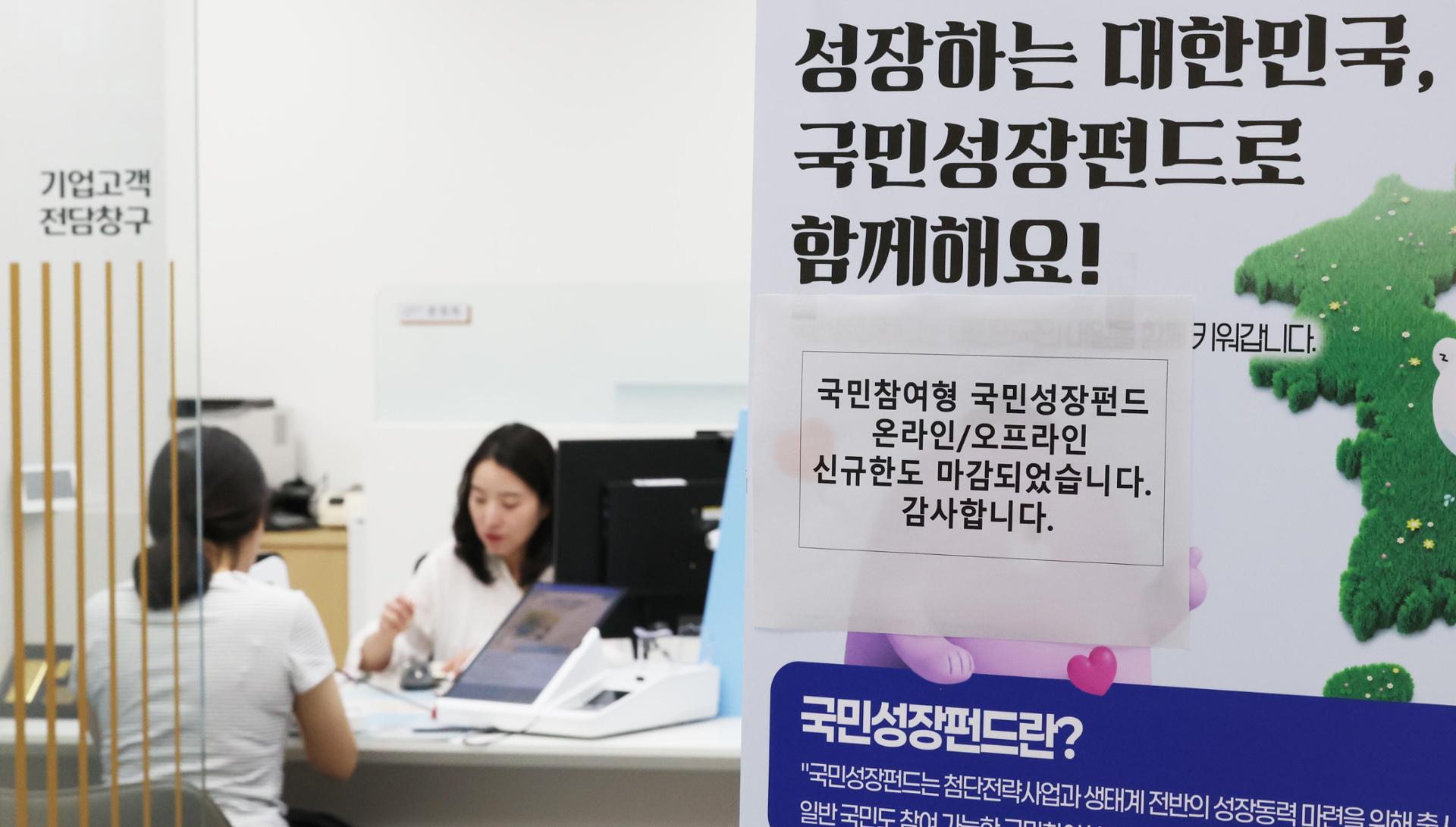
A notice at the main branch of Shinhan Bank headquarters in Seoul announces that both online and offline subscription quotas for the state-backed Public Growth Fund had sold out, Friday, the opening day of retail subscriptions. Newsis
Korea’s state-backed investment fund targeting next-generation industries such as artificial intelligence (AI) drew strong investor interest on Friday, the first day of public subscriptions, as investors flocked to banks and brokerages to secure allocations.
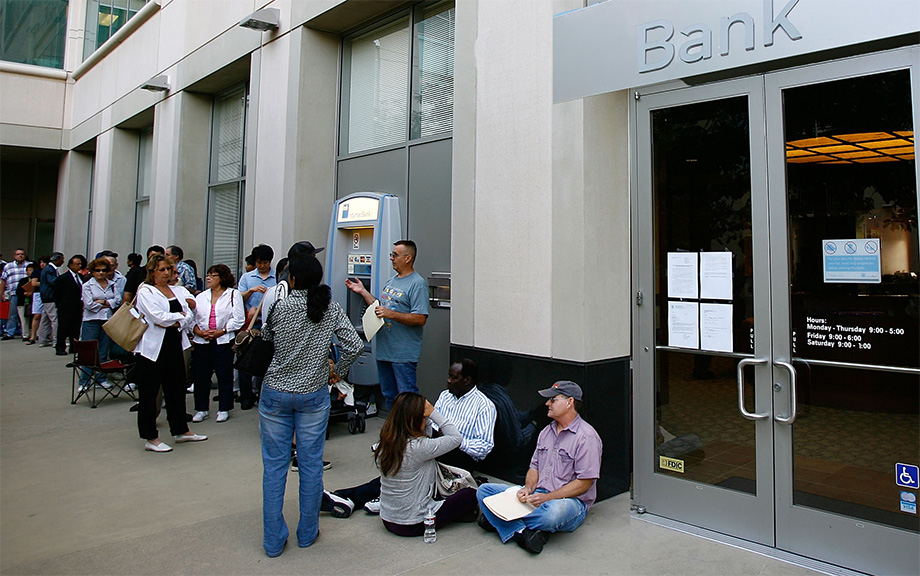
Within hours, online quotas at major platforms were fully subscribed, with some selling out just 10 minutes after subscriptions opened at 8 a.m.
Yet despite the buying rush, experts warn that the fund’s eventual returns remain far from guaranteed as its structure effectively locks investors’ money away for five years — a lengthy commitment in fast-moving technology sectors. They echoed earlier policy funds that delivered underwhelming returns.
The fund is part of the Korea National Growth Fund launched late last year, one of President Lee Jae Myung’s key economic initiatives aimed at fostering advanced industries, including AI, semiconductors, biotechnology, robotics and rechargeable batteries.
The new fund is designed as a fund-of-funds structure, where 3 trillion of the broader 150 trillion won ($99 billion) program has been earmarked for public participation. The fund aims to raise 600 billion annually over the next five years by pooling retail investors’ capital into three master funds, which will subsequently invest in 10 subfunds.
Subscriptions are being offered on a first-come, first-served basis until June 11 through 10 banks and 15 brokerages, although sales will close early once all available allocations run out.
Two features appear to have fueled much of the early investor rush.
Subscribers are eligible for tax breaks, including income deductions of up to 40 percent and preferential taxation on dividend income.
The structure also includes a built-in downside buffer, with the government set to absorb up to 20 percent of losses incurred by subfunds before private investors take any losses.
Financial Services Commission Chairman Lee Eog-weon subscribes to the state-backed investment fund at an NH NongHyup Bank branch inside Government Complex Seoul, Friday. Joint Press Corps
But those benefits are accompanied by equally significant risks, with growing skepticism over the fund’s profitability.
Most notably, the fund comes with a five-year lockup period. While holdings can technically be sold on the exchange, limited liquidity could force investors to exit at prices below the fund’s net asset value. And selling within three years would trigger a clawback of much of the tax benefit.
In technology industries, five years is an extremely long time, according to Hong Ki-yong, a business administration professor at Incheon National University.
“Technology cycles move incredibly fast. Just because a sector is booming today does not mean it will still dominate five years from now,” he said, pointing to how even established technologies can quickly lose momentum as shifts in cost efficiency and market demand reshape the competitive landscape.
Additional concerns stem from the fund’s investment structure itself. At least 30 percent of each subfund must be invested as fresh capital into unlisted companies or tech-focused firms listed on the Kosdaq, making returns heavily dependent on the ability of smaller growth companies to survive in highly volatile industries.
“The idea seems to be to nurture smaller, unlisted firms almost like venture-backed startups, helping them grow into future IPO candidates capable of generating outsized returns. But the key question lies in how high their actual success rate will be,” Hong said. “In advanced technology industries, the market often ends up dominated by a handful of large players that continue consolidating power, rather than creating an environment where many smaller firms grow together.”
Similar concerns have shadowed past state-backed retail investment funds in Korea.
In many ways, the new fund resembles the New Deal Fund launched under the Moon Jae-in administration. That fund also led to rapid sellouts thanks to a structure in which the government absorbed part of the downside risk.
At the time, the fund invested in sectors ranging from gaming and next-generation mobility to biotech materials, immersive content, aerospace and smart farming. But the timing coincided with the U.S. Federal Reserve’s aggressive monetary tightening cycle, which dealt a heavy blow to growth stocks globally.
Annualized returns ultimately remained in the low-2 percent range — roughly in line with bank deposit products — while some funds posted outright losses amid limited exit opportunities.
However, the Financial Services Commission (FSC), the country’s top financial regulator, has stressed that the new fund is designed specifically to address many of those shortcomings as it offers greater portfolio flexibility and a more balanced risk-sharing structure.
“Unlike in the past, subfunds will be diversified across large-, mid- and small-scale strategies, allowing asset managers to leverage their expertise across a wider range of portfolios,” said Na Hye-young, an official from the FSC.
She added that asset managers will have greater investment autonomy under the new structure. So long as investments remain within designated advanced sectors, fund managers could theoretically allocate up to half of assets into blue-chip stocks such as Samsung Electronics.