At Sunnybrook Research Institute (SRI), multidisciplinary teams work collaboratively to accelerate the journey from scientific discovery to clinical application. With support from the in-house Technology Transfer Office, groundbreaking research makes its way from the lab to the bedside.
“Our role is to support, guide, and enable innovation so that it has the best chance to positively impact patients and achieve Sunnybrook’s vision to invent the future of health care.” says Drishi Vilkhu, Senior Manager, Intellectual Property and Technology Transfer.
To date, more than 30 companies have successfully launched through Sunnybrook, and to celebrate World Intellectual Property (IP) Day, we sat down with founders from three of these companies at different stages of the commercialization process to learn what it takes to scale medical innovation impact and invent the future of health care.
Visualsonics

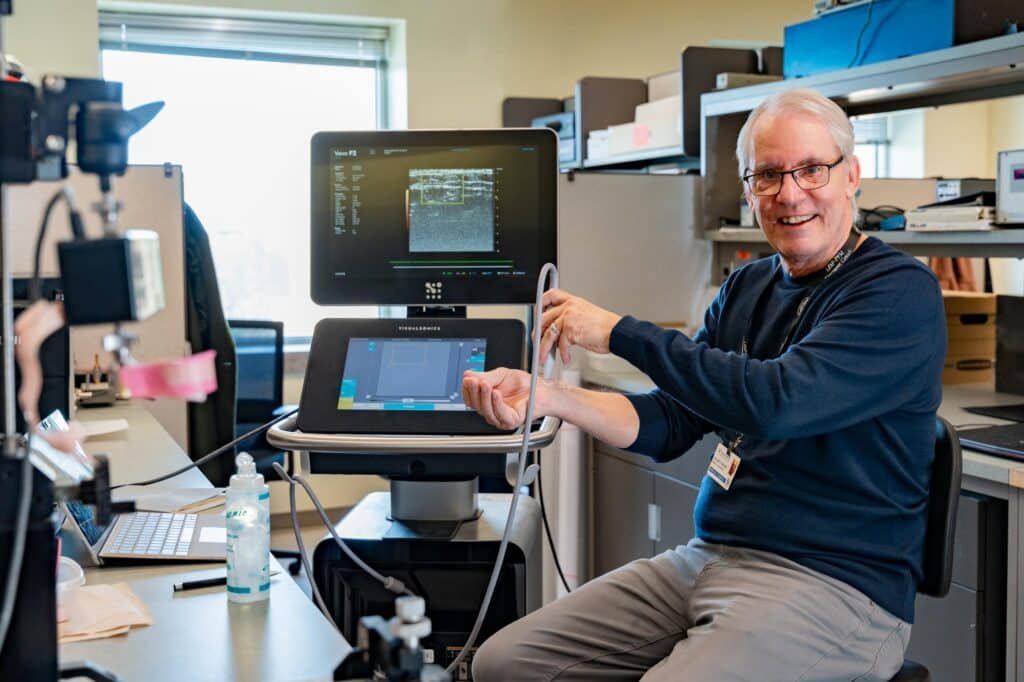
VisualSonics, now Fujifilm VisualSonics, is a global commercialization success story that emerged from Sunnybrook beginning in the early 2000s. Dr. Stuart Foster, Senior Scientist in the Physical Sciences Platform and the Odette Cancer Research Program at Sunnybrook, and Officer of the Order of Canada, started the company to scale his work in developing high frequency micro-ultrasound and photoacoustic imaging systems, which created possibilities to examine small structures like hearts, embryos, and tumors in pre-clinical models. This technology was groundbreaking in helping scientists observe gene expression related to human disease in small animals.
Dr. Foster’s imaging systems were popular with researchers looking to:
- Track the same animal over a long period of time non-invasively
- View real-time images of the heart, brain, and tumour anatomy
- Measure functional characteristics of tissue such as blood flow, oxygenation and molecular expression
- Have access to immediate visualization instead of waiting for post-mortem analysis
Through better imaging capabilities, this technology has helped further cancer research, cardiovascular studies, developmental biology, and drug development in thousands of research organizations.
When asked about commercializing his work at Sunnybrook, Dr. Foster says, “At the time, there was no Technology Transfer Office. Sunnybrook still owned the intellectual property, but they were open to sharing in the innovation process. I had to figure out commercialization myself and negotiate the terms before I could keep developing the technology.”
Today, Dr. Foster emphasizes the importance of accessing commercialization resources like the Technology Transfer Office for more structured guidance through the commercialization process: “When you work in research, you’re bound to discover something that can be scalable or have clinical impact. Scientists working at organizations like Sunnybrook where commercialization is encouraged and aided are extremely lucky.”
Calavera Surgical Design

Calavera Surgical Design develops custom facial implants using computer modeling and rapid prototyping technology for application in craniomaxillofacial (CMF) surgery, often used for cancer or trauma cases. The company, founded by Dr. Oleh Antonyshyn, Plastic Surgeon and Affiliate Scientist at Sunnybrook in the Tory Trauma Program; James Mainprize, Imaging Physicist and Research Associate at Sunnybrook, and Glenn Edwards, Consultant for Plastic Surgery at Sunnybrook, emerged from a need to develop affordable custom facial implants that met the need of plastic and maxillofacial surgeons, otolaryngologists, and neurosurgeons around the world for a faster, simpler, and more accurate method of restoring facial anatomy.
“There were some companies in the private market that were scratching at the surface of custom craniomaxillofacial implants, but they were expensive, making it difficult for Sunnybrook to afford them,” says Dr. Antonyshyn.
Instead, the team decided to develop the technology in-house.
“We ended up inventing a process which shapes any two-dimensional sheet of implantable material, into a patient-specific three-dimensional implant to fit that particular patient defect, which is superior to most options available on the market currently,” says Glenn.
Calavera has been helping patients with their technology for over a decade. Because the team includes Dr. Antonyshyn, who specializes in plastic surgery, the company gets direct patient and surgeon feedback, which positions Calavera in the unique place to continue perfecting their invention based on easily accessible feedback that would not be available outside of a hospital setting. The team is also involved in humanitarian surgical missions in Ukraine, where they support facial reconstruction for civilian and military casualties of war.
“When you invent something at Sunnybrook, it’s important to inform the Technology Transfer Office,” says Dr. Antonyshyn. “They’ve been especially helpful in guiding us towards support for product development and marketing research.
When asked for advice for aspiring health care inventors, Glenn says, “Be ready for the long haul. Commercialization in health care is complicated and can take decades, but the right support can guide you through the process.”
ProTgen

Dr. Juan Carlos Zúñiga-Pflücker is a Senior Scientist in the Biological Sciences Platform and the Odette Cancer Research Program at Sunnnybrook, and the Scientific Founder of ProTgen, Inc. The company is an early-stage start-up focused on restoring immune competence through targeted Notch activators, a crucial cell-to-cell communication mechanism regulating cell fate and tissue development. ProTgen’s technology takes stem cells from the bone marrow and turns them into T-cells, specialized white blood cells that fight infection and cancer, to establish immunity against these diseases. T-cell function deteriorates with age, which is why older adults sometimes don’t respond well to flu vaccines and are vulnerable to cancers and infections.
“We discovered the Notch pathway when we were studying the thymus, a small organ over the heart where T-cells are generated” says Dr. Zúñiga-Pflücker, who is also a Professor at Department of Immunology, University of Toronto.
The company has received funding from the Boehringer Ingelheim Venture Fund, a venture capital company in Germany, and is currently working toward FDA approval for clinical trials.
Dr. Zúñiga-Pflücker advises other health care inventors looking to protect and scale their inventions by engaging the Technology Transfer Office early.
When asked about what challenges health care inventors pursuing commercialization should expect, Dr. Zúñiga-Pflücker explains, “trying to convince investors to fund the research and share your vision for the company can be tricky. Especially for the relatively new field of medical cellular therapies.”
“Reach out to the Technology Transfer Office as soon as you have something that could be commercialized or have clinical impact,” he says. “The team is helpful in identifying next steps, no matter what stage your discovery is at.”
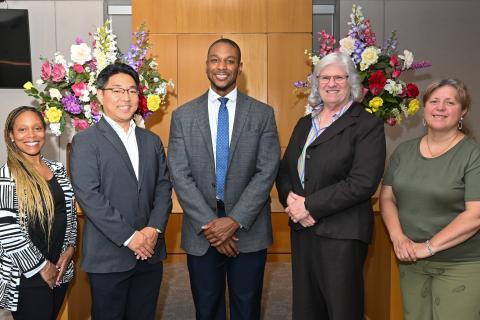
Learn more about the team behind Sunnybrook’s Technology Transfer Office.