The Dow Jones Industrial Average closed higher on Thursday, 9 July 2026, adding 139.02 points, or 0.27%, to finish the session at 52,487.41.
While the blue-chip index posted a more modest gain than the technology-heavy Nasdaq Composite, Thursday’s advance nonetheless represented a constructive session for US equities, as investors looked past a paused ceasefire between the United States and Iran to focus on a powerful rebound in semiconductor stocks.
The session’s gain, while positive, was insufficient to pull the 30-stock average into positive territory for the week as a whole, leaving the Dow on track to potentially snap a four-week winning streak that would have marked its longest positive run since late 2024.
Dow Jones Closing Levels and Session Range
The Dow Jones Industrial Average opened Thursday’s session at 52,249.44, which also proved to be the day’s low, before climbing steadily through the morning and early afternoon to a session high of 52,574.89. The index eased somewhat from that peak into the close, finishing at 52,487.41, still comfortably above Wednesday’s close of 52,348.39.
The session’s trading pattern, a steady morning and midday climb followed by a modest afternoon pullback from the day’s highs, left the Dow’s 0.27% gain notably more restrained than the advances recorded by the S&P 500 and Nasdaq Composite on the same day, a divergence that reflects the blue-chip index’s comparatively limited exposure to the semiconductor and technology names that drove Thursday’s broader market rally.
Why the Dow Lagged Its Broader Market Peers
The Dow Jones Industrial Average’s more modest 0.27% gain, against the S&P 500’s 0.81% advance and the Nasdaq Composite’s 1.30% surge, illustrates the structural difference in composition between the price-weighted, 30-stock blue-chip index and its more technology-concentrated peers. With Thursday’s rally concentrated heavily in semiconductor manufacturers and equipment makers, sectors in which the Dow carries comparatively limited direct exposure relative to industrials, financials, healthcare and consumer names, the index was less able to fully participate in the day’s dominant market theme.
This dynamic has been a recurring feature of trading through 2026, with the Dow periodically outperforming during episodes of technology sector weakness, as was the case in early July when the index notched a series of record closes even as the Nasdaq struggled with chip-sector selling, only to lag during sessions such as Thursday’s when semiconductor and AI infrastructure stocks are the primary driver of market gains.
Weekly Performance and Sherwin-Williams Weakness
Despite Thursday’s gain, the Dow Jones Industrial Average remained down approximately 1% for the week as a whole heading into the session’s close, putting the index at risk of snapping a four-week positive streak that would have represented its longest winning run since late 2024. Paint and coatings company Sherwin-Williams and home improvement retailer Home Depot were identified as the principal drags on the index for the week, each declining around 5% over the period.
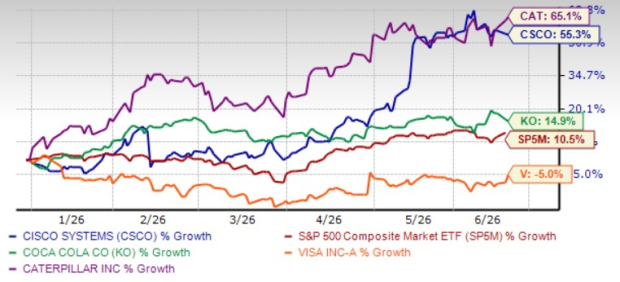
Providing some offset to those declines, networking equipment maker Cisco Systems and chipmaker Nvidia both advanced more than 4% on a week-to-date basis, with Nvidia’s inclusion in the Dow’s more recent composition changes providing the index with at least partial participation in the broader semiconductor sector rally that has otherwise been more fully captured by the Nasdaq Composite.
Macro Backdrop: Iran Tensions and Housing Data
Thursday’s session unfolded against a backdrop of renewed uncertainty in the Middle East, with market observers describing the ceasefire between the United States and Iran as having been paused following fresh hostilities earlier in the week. Despite the geopolitical uncertainty, oil prices slid during Thursday’s trading, removing a source of inflationary pressure and providing support for the broader equity market advance, including the Dow’s more modest but still positive session.
On the domestic data front, the National Association of Realtors reported that existing home sales fell 2.4% in June to a seasonally adjusted annualised rate of 4.9 million units, well short of consensus expectations for a modest increase. The disappointing housing data added to the mosaic of economic indicators that investors continue to weigh in assessing the Federal Reserve’s likely policy path under Chair Kevin Warsh, with the Dow’s heavy weighting toward housing-sensitive and cyclical names, including Home Depot, leaving the index particularly attuned to shifts in the domestic real estate market.
Corporate Earnings Season Begins
Thursday marked the unofficial start of second-quarter corporate earnings season, with Dow component and consumer staples giant PepsiCo delivering results that prompted its shares to dip approximately 3% despite 6% year-over-year sales growth, as the company flagged weaker US consumer spending tied to higher gasoline prices and broader macroeconomic volatility. As a bellwether for consumer spending trends, PepsiCo’s cautious commentary carries particular relevance for the Dow’s substantial weighting toward consumer-facing companies.
With earnings season set to move into full swing over the coming weeks, investors will be watching closely for signals from the Dow’s other major constituents regarding the health of the broader US consumer and corporate sector, particularly given the index’s comparatively defensive composition relative to the more growth-oriented S&P 500 and Nasdaq Composite.
The Dow’s Recent Record-Setting Run
Thursday’s session followed a period of exceptional strength for the Dow Jones Industrial Average, which had notched a record closing high of 52,900.07 on 2 July, its best first-half performance since 2021 with an 8.9% gain over the opening six months of 2026. That record-setting run was driven in significant part by a weaker-than-expected June non-farm payrolls report, which had bolstered expectations that the Federal Reserve would refrain from raising interest rates in the near term, a dynamic that has historically supported the Dow’s more rate-sensitive industrial and financial constituents.
The index’s subsequent pullback from those record levels, including Thursday’s more modest gain relative to its broader market peers, illustrates the shifting sector leadership that has characterised US equity markets through the first half of July, with the technology and semiconductor-led rally evident in Thursday’s session standing in contrast to the broader-based, defensively tilted advance that had propelled the Dow to its record close just a week earlier.
Outlook for the Dow Jones Industrial Average
With the Dow Jones Industrial Average sitting roughly 1.5% below its 52-week high of 53,289.30, investors will be assessing whether Thursday’s gain represents the beginning of a renewed advance or merely a modest bounce within a broader period of weekly consolidation. The index’s ability to close the week in positive territory will depend heavily on the performance of its largest constituents over the final trading sessions of the week, alongside the evolving trajectory of the paused US-Iran ceasefire.
Looking further ahead, the continued rollout of second-quarter corporate earnings, together with growing market commentary regarding the possibility of a Federal Reserve interest rate increase later in 2026, are likely to remain the dominant themes shaping the Dow’s performance through the remainder of the third quarter, alongside the index’s ongoing, more limited participation in the semiconductor-led rally that has driven much of the broader market’s gains in recent sessions.