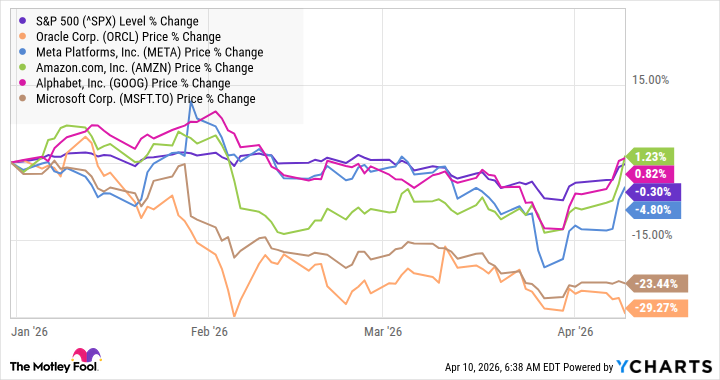
The technology sector started 2026 with a whimper, but after shaking off the cobwebs, tech stocks have gone back to doing what they’ve been doing for so long: growing.
Tech stocks have been one of the best sources of equity growth for literally decades, but investing in the sector doesn’t come without the occasional case of nausea. And rightly so: Technology is constantly in a state of flux. Businesses that make their money by innovating … well, those innovations have a tendency to upend their very own industry again and again. Some companies are better than others at rolling with the punches, but others are unable to avoid the steamroller of progress.
The good news? The world is plenty large enough for the tech sector to produce numerous winners. You can’t exactly throw a dart at the board and know you’ll pick a winner. But understanding what technologies are emergent, who’s leading the way, which businesses are best capturing opportunities, and which executives are best at managing resources can go a long way in separating the wheat from the chaff.
Today, we’re going to lean on Wall Street’s analyst community to light the way. The following are some of the best tech stocks to buy now—a group of companies that currently enjoy extremely high marks from the research professionals who cover them.
Disclaimer: This article does not constitute individualized investment advice. Individual securities, funds, and/or other investments appear for your consideration and not as personalized investment recommendations. Act at your own discretion.
The Best Tech Stocks to Invest In
Some of the best-performing tech stocks are very recognizable names. But before you buy any of them, don’t forget that investing is fundamentally about the future. That means learning about the product pipeline and R&D beyond what’s on the surface.
Leading tech firms are often the parent company of lesser-known products or services that could be just as interesting. Particularly when it comes to entrenched mega-cap tech stocks, their future potential depends on revenue streams that have yet to be fully realized yet—not the big-name products consumers currently use.
Every stock on this list also has a favorable view from Wall Street’s analyst community. The consensus analyst rating, courtesy of S&P Global Market Intelligence, is the average of all known analyst ratings of the stock, boiled down to a numerical system where …
- Less than 1.5: Strong Buy
- 1.5-2.5: Buy
- 2.5-3.5: Hold
- 3.5-4.5: Sell
- More than 4.5: Strong Sell
In short, the smaller the number, the better the overall consensus view on the stock. In the case of this list, I’ve included only stocks that have received a 2 or lower—in other words, clear-cut Buys in the analysts’ eyes.
Let’s take a look at three picks from my larger list of the best tech stocks to buy now. The names below are listed in reverse order of their consensus rating, so from the “worst”-rated to the best-rated.
Jabil
- Industry: Electronic components
- Market capitalization: $32.6 billion
- Dividend yield: 0.1%
- Consensus analyst rating: 1.40 (Strong Buy)
Jabil (JBL) is a global supplier of engineering, supply chain and manufacturing solutions that help companies across numerous industries get new products off the ground quicker, reduce costs, or simply do what they do better.
It does this through a trio of segments: Intelligent Infrastructure (cloud and datacenter infrastructure, networking and communications, capital equipment), Regulated Industries (automotive and transportation, healthcare and packaging, renewables and energy infrastructure), and Connected Living & Digital Commerce (consumer-driven smart products, digital commerce, warehouse automation).
While Jabil doesn’t necessarily have the immediate shelf appeal of semiconductor stocks, it’s still a vital cog in the advancement of numerous tech trends.
Related: The 13 Best Mutual Funds for the Rest of 2026
“Considering Jabil’s exposure to several highgrowth, AI-driven end markets—such as cloud/DC infrastructure, EV/ADAS, and industrial automation—we see the firm as a longer-term beneficiary of the emergence of accelerated compute technology.” say Stifel analysts Ruben Roy and Sahej Singh, who rate the stock at Buy.
UBS analyst David Vogt recently joined the bull camp, upgrading JBL stock to Buy “on a multiyear growth cycle fueled by AI investment from Amazon, Meta, and Google, rising healthcare demand as capacity comes online, and scaling automation and robotics markets.” They see the company’s diversified portfolio and newer offerings driving at least 20% annual earnings growth over the next three fiscal years.
Jabil doesn’t have a particularly large analyst following, but those that do follow the stock are overwhelmingly bullish. Right now, JBL stock has nine Buy ratings against just one Hold and no Sells. And as a group, the pros see Jabil driving almost 30% average annual earnings growth over the next three to five years.
Related: The 16 Best ETFs to Buy for the Rest of 2026
Monolithic Power Systems
- Industry: Semiconductors
- Market capitalization: $64.4 billion
- Dividend yield: 0.6%
- Consensus analyst rating: 1.31 (Strong Buy)
Semiconductor stocks will always feature prominently in any list of the best tech stocks, but Monolithic Power Systems (MPWR) isn’t your average chip company.
MPWR designs, produces, and sells power circuits found in the automotive, enterprise data, consumer, communications, industrial, and other markets worldwide. These systems help convert and control voltages of a wide array of electronic systems, from servers, apps, and notebooks to home appliances and satellite communications. That’s a big change from where Monolithic used to be.
“MPS is one of the best-positioned semiconductor names for upside this year,” say Oppenheimer analysts, who rate the stock at Outperform. “A deep product pipeline and steady flow of design wins have steadily diversified MPWR away from traditional consumer products and into the communications, industrial, automotive, and networking markets. MPWR sets up well to outperform the broader semiconductor market with both an improving margin profile and an accelerating top-line outlook.”
Monolithic’s boffo 2026 calmed down during the summer months, though it’s still up 40% year-to-date as I write this. You can thank a couple of solid quarterly earnings reports and a 28% hike to the dividend, to $2 per share quarterly.
Invest With CIBC
CIBC Investor’s Edge lets you trade U.S. and Canadian stocks and ETFs, options, mutual funds, and bonds through registered accounts like FHSAs, TFSAs, RRSPs, and RESPs, as well as non-registered accounts.
Sign up with our link today and use promo code EDGE2026 to get 200 free trades with CIBC Investor’s Edge.
“Monolithic Power reported another strong beat-and-raise quarter as AI infrastructure demand pulls through significant power silicon content,” say William Blair’s Sebastien Naji and Ana Bilbao, who rate the stock at Buy. “An even stronger third-quarter guide calls for higher growth in the back half of 2026 as new generation GPU and ASIC programs ramp up. MPS’s continued technology leadership, strong alignment to AI spending, and diverse set of growth vectors position it well to maintain its track record of outperformance.”
MPWR isn’t as well covered as many of the other tech stocks on this list, but it’s one of the best rated. Currently, Monolithic Power Systems’ stock enjoys 15 Buys versus just one Hold and no Sells.
Looking forward, analysts expect revenues to improve by a little less than 40% annually over the next two years, and longer-term estimates peg profit growth at 34% per year on average.
Related: The 10 Best Vanguard Index Funds You Can Buy
Nvidia
- Industry: Semiconductors
- Market capitalization: $5.5 trillion
- Dividend yield: 0.5%
- Consensus analyst rating: 1.28 (Strong Buy)
Nvidia (NVDA) is the world’s top chip stock thanks to its dominance in semiconductors that are used in cutting-edge technologies. Applications for this firm’s hardware include self-driving cars, cryptocurrency mining, and other in-demand and growth-oriented areas of the 21st century economy.
But No. 1 with a bullet is the artificial intelligence market.
On the one hand, Nvidia believes AI infrastructure can become a $3 trillion to $4 trillion opportunity over the next half-decade. On the other hand, many investors are starting to wonder whether AI is in a bubble, and they keep waiting for each Nvidia earnings report for signals that the technology is slowing down.
They’ll have to keep waiting.
Related: 10 Best Low-Cost Fidelity Index Funds to Buy Now
“This was the quarter you’ve been waiting for,” Truist Managing Director William Stein wrote after the company’s recently announced fiscal Q2 report. “In several recent quarters, NVDA delivered a beat-and-raise, and investors shrugged it off,” he said. “This quarter, NVDA also noted that demand supports 100% sales growth next year, but that supply constraints will limit growth to 70% (consensus was +47%). We expect this strong statement will allow NVDA to extend its after-hours rise, and that the broader AI trade (suppliers with high AI concentration) will begin to recover.”
That’s not to say there won’t be bumps. Indeed, NVDA nearly fell into bear-market territory in late 2025, though the stock has since recovered somewhat and finished the year up nearly 40%. This year has been up-and-down, too, though the post-earnings surge has NVDA trading just below previous all-time highs and up 20% year-to-date.
Wall Street’s pros remain unflinchingly optimistic about the stock, with NVDA boasting a whopping 58 Buy calls, two Holds and one Sell. They largely expect AI’s specialization to continue the red-hot growth at Nvidia. Analysts see revenue growth averaging roughly 65% across the next two years, and long-term earnings growth at a clip of more than 45%. Indeed, NVDA sits on our list of the market’s best growth stocks right now, too.
One last thing to note: Nvidia has paid a dividend since November 2012. However, for most of that time, it was a nominal penny per share quarterly that yielded less than a tenth of a percent. But in May 2026, the company unleashed a massive 2,400% increase to the distribution, to 25¢ quarterly. While the yield is still only 0.5%, consider this: An investor who bought the stock at around $29 per share near the start of 2022 is now enjoying a yield of more than 3%.
What If I Need Help Picking Stocks?
Motley Fool Epic is a bundled selection of four popular Motley Fool stock recommendation products:
- Stock Advisor: Buy-and-hold stock picks designed to deliver consistent performance with less volatility.
- Rule Breakers: Stocks that have massive growth potential, whether they’re at the forefront of emerging industries or disrupting the status quo in long-established businesses.
- Hidden Gems: Stocks of medium-to-large businesses, selected by Fool CEO and co-founder Tom Gardner for their “all-in, visionary leadership teams.”
- Dividend Investor: Companies that deliver above-average yields and dividend growth, with the hope of producing both competitive total returns and an income stream that should carry you through retirement.
Epic members will get five new picks per month across the various services, can access all active recommendations, and also view Cautious, Moderate, and Aggressive strategies including specific stock allocations. They also get access to the Fool IQ+ data service, GamePlan+ retirement and financial planning hub, and the Epic Opportunities podcast.
Sign up for Motley Fool Epic today and receive a discount on your first-year membership, outlined below.