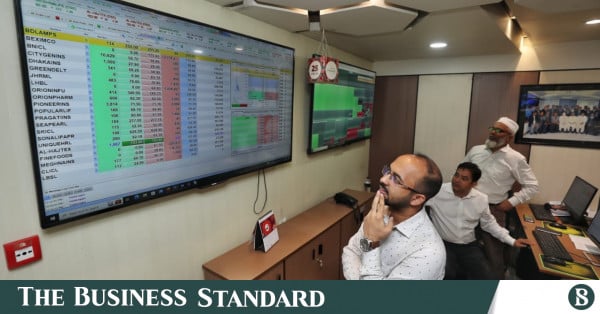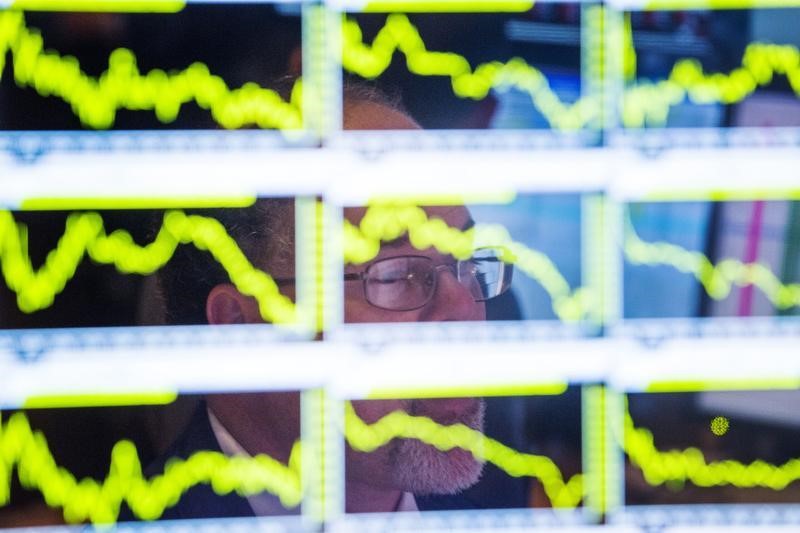
Foreign investors continue to pull out of the local stock market due to a mix of nearly half a dozen reasons, including policy and regulatory uncertainty, weak corporate earnings and banking-sector problems, currency risks and overall negative sentiment.
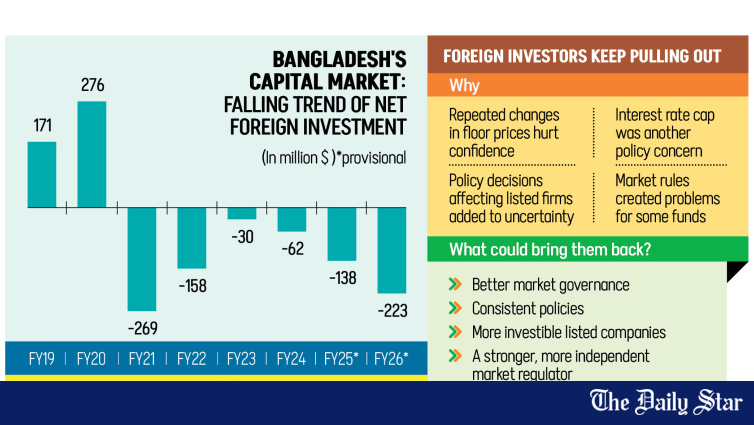
In the last fiscal year 2025-26, foreign investors withdrew a net $223 million from the stock market. The outflow in FY26 was higher than the $138 million recorded a year earlier, according to Bangladesh Bank data.
Net foreign portfolio investment has been in negative territory since FY21, meaning investors have sold more shares and other securities than they have bought.
Market insiders say the experience of past policy interventions, particularly the repeated use of floor prices, has left foreign investors wary of the market.
A floor price sets a minimum level at which a share can be traded, restricting normal price movements.
“Besides, the interest rate cap in the banking sector was another reason,” said Kazi Monirul Islam, CEO of Shanta Asset Management.
The Bangladesh Securities and Exchange Commission (BSEC) introduced floor prices for the first time in 2020 to halt a fall in share prices during the Covid-19 pandemic. The regulator began lifting them in phases in 2021.
But the measure returned the following year. The BSEC lifted the floor price for 169 companies, while the remaining companies stayed under the restriction.
In 2023, the regulator again imposed floor prices on the 169 companies. A year later, the restriction was lifted from all but 35 companies.
After the fall of the Awami League government in August 2024, the floor price was lifted from all but two companies. After taking office in February this year, the BNP government lifted the floor price on the remaining two in June.
“There were some serious bad policies; the floor price was just one of them,” said Saiful Islam, president of the DSE Brokers Association of Bangladesh (DBA).
He said even MSCI (Morgan Stanley Capital International) had paused regular index reviews of Bangladesh after the floor price. It has now announced that it will resume regular index reviews from November this year following the withdrawal of the floor price.
The repeated intervention also damaged confidence because foreign investors compare Bangladesh with other markets when deciding where to put their money.
“Foreign investors invest in a country compared with other countries, so, if they find any country more suitable than Bangladesh, they shift,” said Monirul.
He said the country’s macro situation has improved and policy problems are no longer on the table, but it will take time to rebuild investor confidence. “Once investors burn their finger in a place, they cannot forget it easily.”
The banking sector has also weighed on sentiment. Previously, there were rate caps both on deposits and borrowing. The interest-rate caps raised concerns among investors about banks’ profitability and the predictability of financial-sector policy.
The cap has been lifted. But currently many banks have been under visible stress, while private-sector credit growth has weakened sharply, raising concerns about corporate investment, profitability and asset quality.
Both Monirul and Saiful pointed to banking-sector problems as another reason for the decline in foreign portfolio investment.
Regulatory decisions affecting individual companies have added to those concerns. One example was the Bangladesh Telecommunication Regulatory Commission’s (BTRC) decision to designate Grameenphone as a significant market power, a status that curtailed the company’s earning capacity in several ways.
“Following GP’s SMP categorisation, foreign investors started selling in the Bangladesh market heavily,” said Saiful.
Weak liquidity is another problem. There are relatively few large, liquid companies with strong governance and consistent earnings that global funds can invest in comfortably.
Foreign investors also have to weigh returns against currency risk. A weakening taka can reduce the value of their returns when they convert their investments back into dollars or other hard currencies.
Saiful said the sharp depreciation of the taka had been a problem for foreign investors.
Tax and repatriation concerns have also reduced the appeal of the market, as capital-gains taxes, transaction costs and uncertainty over taking money out of the country can affect overall returns.
Yet the market is not completely off the radar of foreign funds.
“Although net foreign investment is in the negative, new investors are interested in the Bangladesh market,” said Saiful.
He said positive developments, including a credible national election, the reconstitution of the BSEC and the new leadership’s quick decision to lift the floor price, have attracted some interest.
“Now, the market needs to ensure governance and bring investable stocks. Without these, foreign investors will not come to the market.”
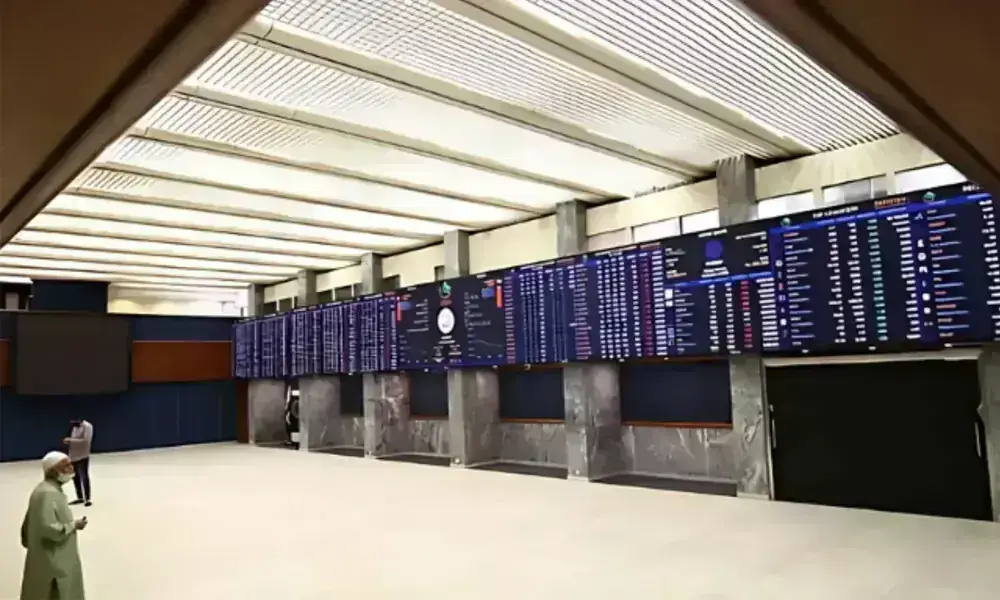
The Dhaka Stock Exchange has 395 listed companies, of which 195 are in the A category, 74 in the B category and 126 in the Z category, according to DSE data.
“A collective responsibility is necessary to ensure governance in all spheres of the market and listing good stocks,” Saiful added.