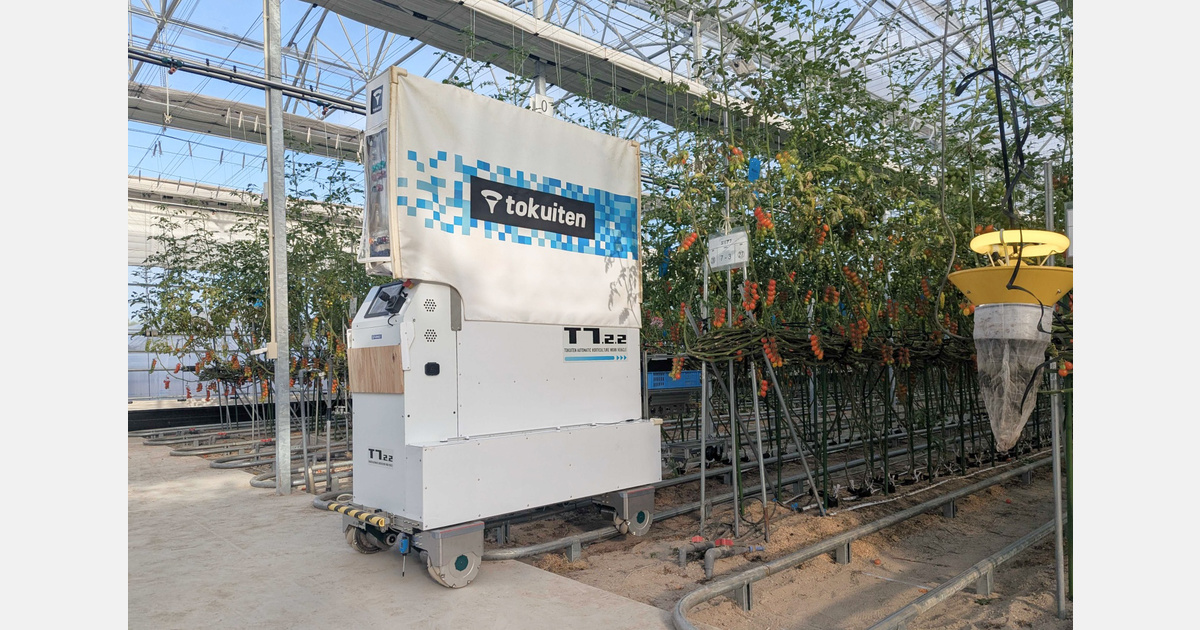
Tokuiten Inc., a Japanese agricultural technology company, announced that its proprietary suction-type cherry tomato harvesting robot has completed the pilot phase and entered full production use at the company’s 2,000 m² organic JAS-certified cherry tomato farm in Chita city, Aichi Prefecture, as of May 25, 2026. Farm staff now operate the robot as part of their regular workflow — one of the first such deployments in Japan, and among only a handful worldwide in which a harvesting robot for fruit vegetables is used in ongoing commercial production.
Suction-type harvesting robot
Tokuiten began developing its current suction-type harvesting robot in 2023. After approximately three years of iterative testing and improvement, the robot achieved an automated harvest of 31 kg of cherry tomatoes per day with a single unit in April 2026. Internal quality evaluations confirmed that robot-harvested tomatoes meet the same standard as hand-picked fruit, and all harvested produce is shipped through regular commercial channels.
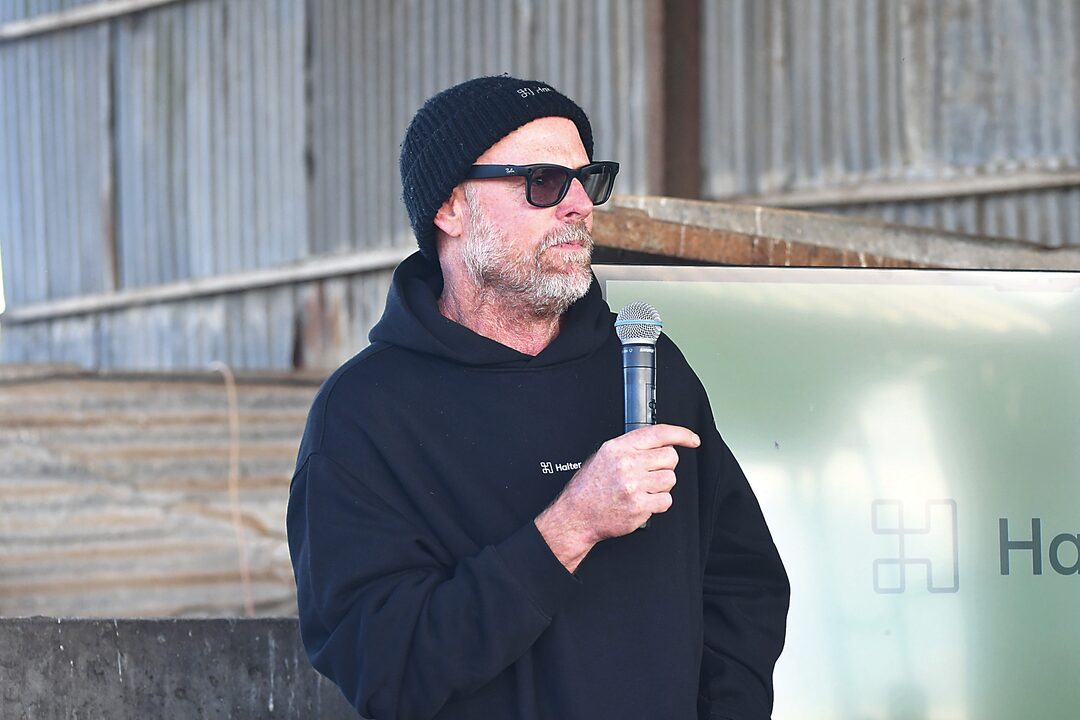
“I’m very happy that our robot has entered operational use. This fulfills one of the goals we set at founding — automating agriculture starting with cherry tomato harvesting. Very few cherry tomato harvesting robots in the world have reached this stage of real commercial operation, and we believe world-leading performance is now within reach”, says Tokuiten CEO Ryuichiro Toyoshi
 © Tokuiten
How it works
The robot operates twice a week, on the evenings before scheduled harvest days by human laborers (Tuesday and Thursday). After the day’s work is done, a staff member presses the start button. The robot then spends approximately five hours autonomously navigating the greenhouse rows, picking only ripe cherry tomatoes. The following morning, staff collect the harvested fruit for sorting and shipment.
– Frequency: twice per week (Tue/Thu)
– Harvest volume per session: approximately half the output of one human picker
– Operating time: approximately 5 hours per session
Technology
The robot is built around Tokuiten’s proprietary “suction-type harvesting” mechanism. Leveraging the stem characteristics of the company’s own cherry tomato varieties, the system uses gentle suction to detach fruit from the calyx without damage — a method covered by patents held by Tokuiten. An onboard camera and AI system assess fruit maturity in real time, enabling selective picking of only harvest-ready tomatoes.
The robot travels autonomously on rails installed between crop rows. To move between aisles, it uses Mecanum wheels to traverse from one rail to the next, allowing it to navigate the entire greenhouse without human intervention.
Multiple prototypes
Director Hiroki Mori recalls it took about three years from when the team started work on the suction-type harvesting method in 2023, building multiple prototypes and running farm tests twice a week, to finally reach the point where they could hand operations over to the cultivation team.
“Keeping a robot running reliably in a real farm — not a lab — every week required steady, incremental improvements not just in harvest accuracy, but in stability and ease of operation. Next, we are working toward a six-unit fleet at the new farm, focusing on improving harvest performance, multi-robot coordination, maintainability, and fault tolerance — all under the concept of ‘a harvesting robot built for everyday use.'”
Call for joint pilot partners
Tokuiten is seeking joint pilot partners among operators of large-scale cherry tomato greenhouses. The goal is to deploy the operational framework established at the company’s own farm in different growing environments and with different varieties, further improving harvest performance and operational efficiency. Interested parties are invited to contact Tokuiten.
 © Tokuiten
New facility in construction
Tokuiten has been selected for the Ministry of Agriculture, Forestry and Fisheries’ SBIR program and is currently constructing a new 1-hectare greenhouse facility in Chita city, Aichi Prefecture, scheduled for completion in March 2027. The new facility will deploy six harvesting robots with the aim of automating the entire harvest operation. The company also plans to extend automation to other cultivation tasks such as leaf and shoot pruning, and to conduct trials in carbon-neutral greenhouse horticulture.
“At our new farm in 2027, we will scale this effort further, building a facility where multiple harvesting robots support cherry tomato production”, says Ryuichiro. “We will continue combining the appeal of farming with the power of technology to shape a new model for organic agriculture. None of this would have been possible without the cultivation staff who work the farm every day and the development team who kept improving the robot through years of steady iteration.”
Farming workforce
Japan’s core farming workforce has declined from approximately 2.4 million in 2000 to just 1.02 million in 2025, with an average age of 67.7, according to the Ministry of Agriculture, Forestry and Fisheries, Japan. In tomato cultivation, harvesting and sorting account for a significant share of total labor hours and are among the operations most exposed to labor shortages. Cherry tomatoes are particularly labor-intensive due to their small fruit size and high picking frequency.
While R&D on harvesting robots for greenhouse-grown fruit vegetables is advancing globally, most projects remain at the research or pilot stage. Cases in which farm staff routinely operate a harvesting robot in commercial production are still rare.
For more information:
Tokuiten Inc.
Contact form
https://tokuiten.jp/