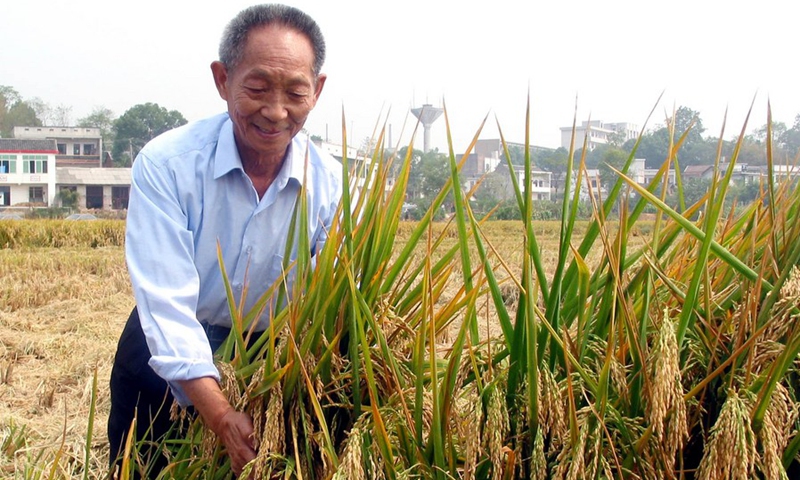
Late Yuan Longping appraises rice in an experimental plot of super hybrid rice in Xiangtan county, Central China’s Hunan Province, October 9, 2003. File Photo: Xinhua
Recently, Guinean Prime Minister Amadou Oury Bah, who came to China to attend the Summer Davos 2026, shared a moving story. In April of this year, during a visit to an agricultural processing factory in Koba, Guinea, he was presented with a bag of locally produced hybrid rice. This easy-to-promote, high-yield rice cultivation technology was developed under the leadership of the late academician Yuan Longping. In gratitude for the Chinese agricultural technology that has benefitted the people of Guinea, the Guinean prime minister specifically entrusted someone to deliver this bag of rice to China as a gift for Yuan’s wife.
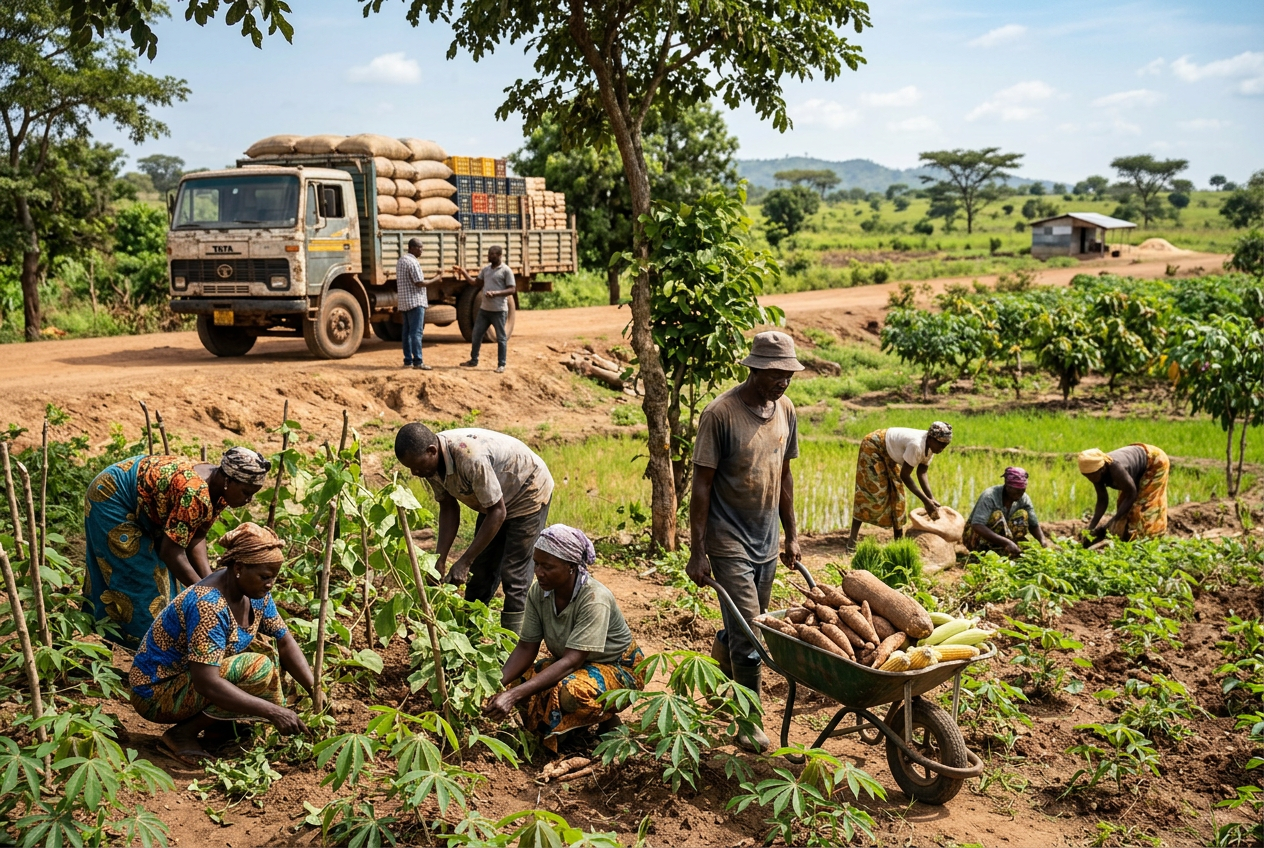
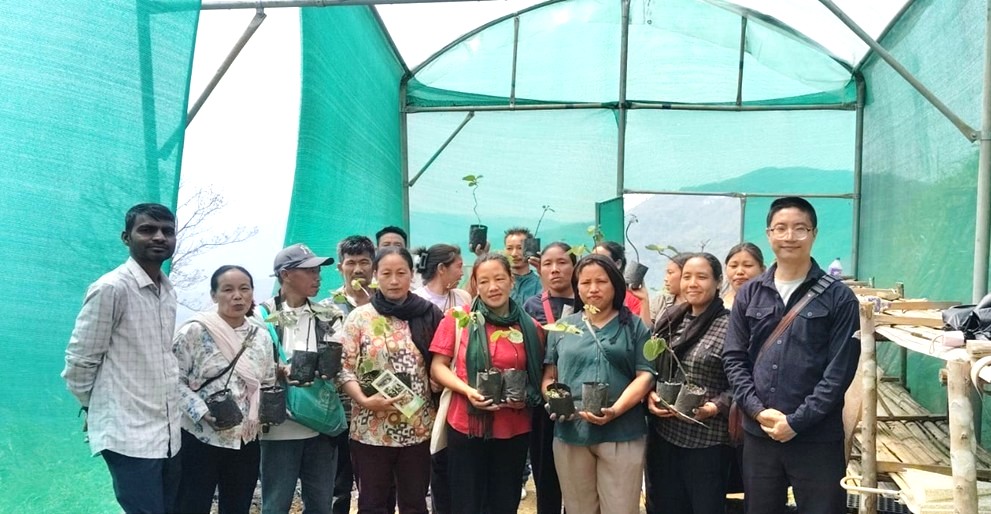
This bag of rice carries gratitude and respect. It is not an ordinary gift; it represents the heartfelt thanks of the Guinean people for China’s hybrid rice technology. Although Guinea has favorable conditions for agricultural development with fertile land and abundant water resources, the country has long relied on rice imports. Since the launch of the China-Guinea pilot hybrid rice project in 2019, Chinese experts have not only brought high-yield seeds but have also personally taught supporting techniques such as seedling cultivation, transplanting, and fertilization. Today, the highest yield per hectare of hybrid rice at the demonstration base has reached 9 tons, with the planting benefits generally increased by more than two times. This bag of rice embodies the hope of the local people to achieve food self-sufficiency.
Just as the story of China-Guinea rice friendship was unfolding, an absurd and false online remark surfaced. A Chinese internet influencer with over 2 million followers, capitalizing on the gimmick of so-called “protecting old seeds” to gain attention and traffic, stigmatized the “three-line hybrid technology” and even twisted the meaning of “male sterility,” absurdly claiming that “eating it will make you infertile like a mule.” This irresponsible statement, utterly devoid of scientific basis, severely misled the public and caused a very negative impact. On Sunday, the relevant account was permanently banned following complaints from users.
Science must not be hijacked by internet traffic, and agricultural technology must not be maliciously slandered. Hybrid rice has been promoted in China and abroad for decades, benefiting hundreds of millions of people, and its safety and effectiveness have stood the test of time and practical application. Denying modern breeding is pseudo-science; on the surface, it stems from ignorance and a thirst for online attention, but at a deeper level, it profanes the hard work of numerous scientific researchers and grassroots agricultural technicians, thereby eroding the social foundation of national food security.
Hybrid rice is a crucial guarantee for China’s food security. Western scholars once raised the question, “Who will feed China?” However, China has given a resounding answer by feeding nearly one-fifth of the world’s population with less than 9 percent of the world’s arable land. Hybrid rice is the powerful support behind this miracle. It is through the perseverance and dedication of generations of agricultural researchers over many years that the Chinese people have been able to hold their rice bowls firmly in their own hands, providing the most solid foundation of confidence for maintaining strategic composure amid the ongoing global changes. Today, China’s total grain output has remained stable at over 700 billion kilograms for two consecutive years, far exceeding the internationally recognized safety line of 400 kilograms per capita. China’s large-scale and sustainable capacity for food self-sufficiency is crucial for global food security and stabilizing inflation levels worldwide.
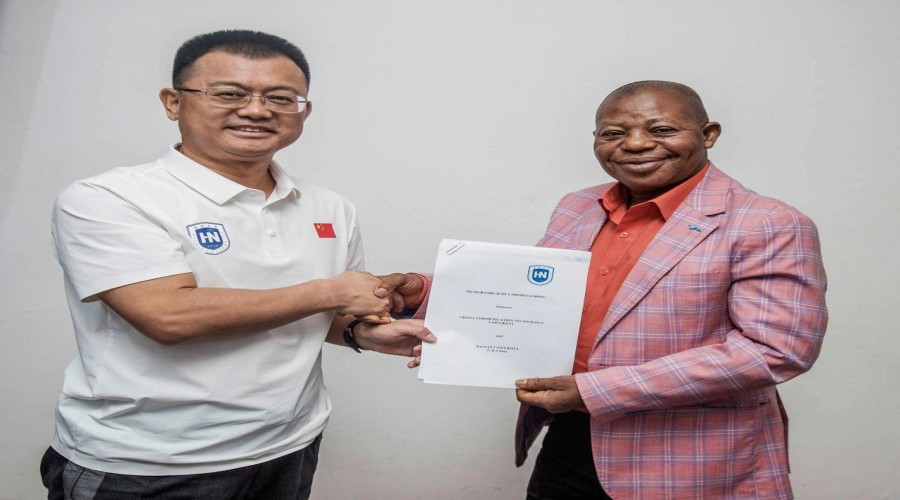
China has not only secured its own food supply but has also brought its food bowl to the world’s table. Open information shows that Chinese hybrid rice has been introduced to nearly 70 countries across five continents, with overseas planting areas approaching 8 million hectares.
As early as 1980, the cultivation technology of hybrid rice was transferred to the US as a patented Chinese agricultural technology. In recent years, Chinese hybrid rice has withstood the high temperatures of Pakistan, enabled the long-term food-deficient Chad to begin discussing the possibility of exporting grain to generate income, and has been featured on Madagascar’s currency … China does not just solve its own problems; it shares solutions with the world, transforming the story of a single seed into a chorus of shared destiny for humanity. This bag of rice stands as a testament to China’s agricultural modernization reaching beyond its borders and benefiting the world.
The people of Africa are well aware of the pangs of hunger, and therefore cherish Chinese rice with deep gratitude. Yet here is a Chinese influencer with millions of followers, who while enjoying the benefits of a well-fed life, utters disrespectful words about the scientists who dedicated their entire lives to working the fields. The contrast between these two stories is deeply thought-provoking.
This bag of rice is not heavy, only a few kilograms, yet it is also profoundly heavy, heavy enough to carry the priceless legacy left by a Chinese scientist to the entire world. That video is “light,” merely a few minutes long, yet it is also exceedingly “heavy,” heavy enough to betray a nation’s scientific spirit and its sense of gratitude. The distance between delivering rice from thousands of miles away and making reckless, unfounded statements is not just a gap in scientific understanding; it also reflects whether one possesses a sense of reverence for food, for life, and for national strategy.
“Chinese people should hold their rice bowls firmly in their own hands, with grains mainly produced by themselves.” This important statement serves as both strategic guidance rooted in national conditions and a developmental principle that must be internalized and put into action. Today, “China’s grain” not only fills the bowls of the Chinese people but also fills the bowls of many other countries, contributing to global poverty reduction and the realization of the United Nations’ 2030 Sustainable Development Goals.
Nowadays, in a moderately prosperous society in all respects, we must continuously reinforce the bottom-line thinking regarding food security, ensuring that holding the “Chinese rice bowl” firmly becomes a strong cornerstone for national rejuvenation and peaceful global development.