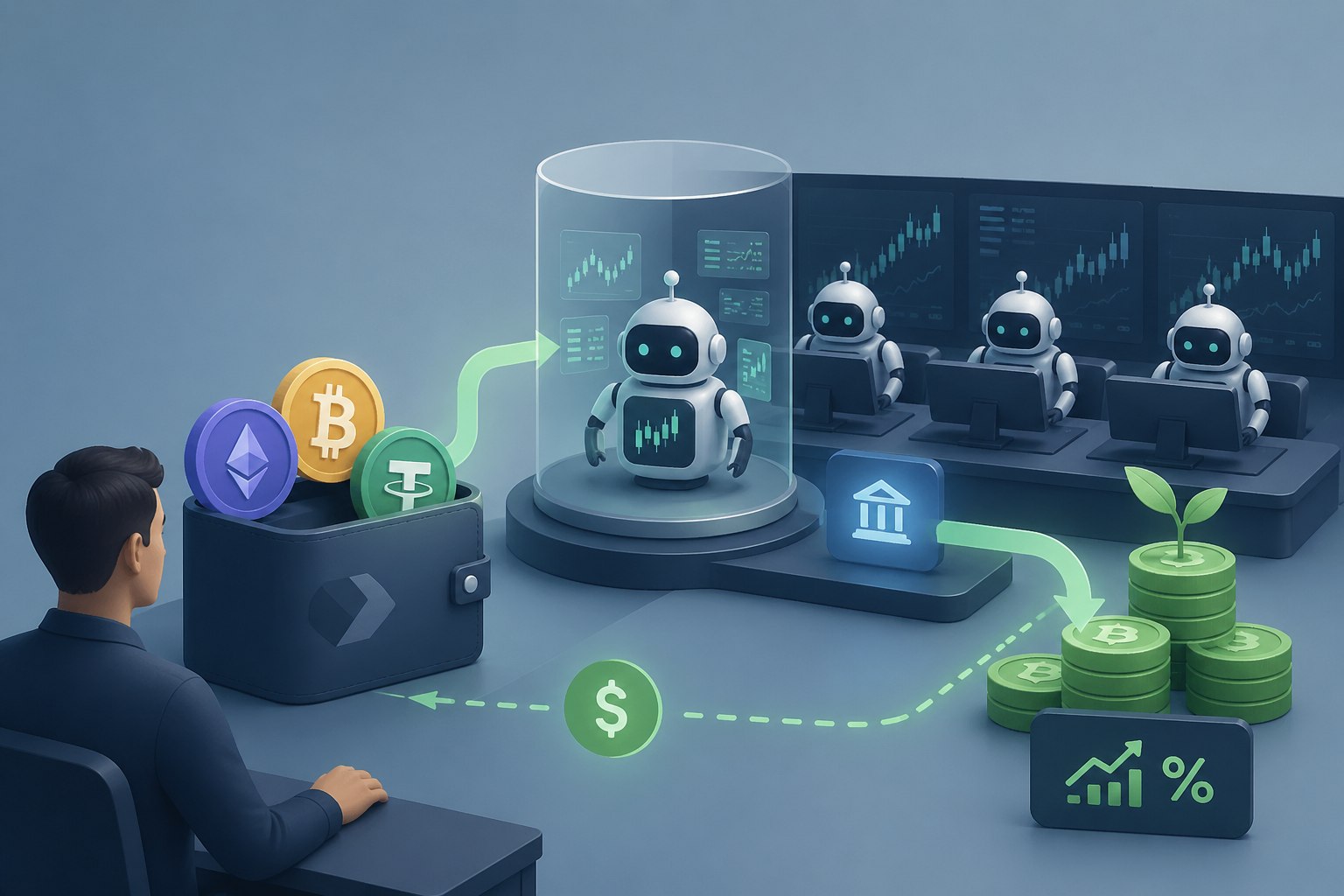
A growing share of on-chain activity is now driven by autonomous systems that can analyze data, execute trades, and rebalance capital in real time. These systems are reshaping how yield is generated in decentralized finance (DeFi).
Instead of manually staking or farming, investors can now lend their tokens to high-frequency trading (HFT) bots that actively deploy capital across markets. This model, often described as agentic yield, blends lending, automation, and algorithmic trading into a single strategy.
This article explains how you can earn from agentic yield just by lending your tokens.
Key Takeaways
- Agentic yield allows you to earn returns by lending your tokens to AI-driven HFT bots that actively deploy capital across markets
- HFT bots generate profits by exploiting short-term inefficiencies through arbitrage, market making, and real-time data analysis
- Returns can outperform traditional DeFi yields, but they depend on market conditions, strategy performance, and effective risk management
What is Agentic Yield?
Agentic yield is the return earned when you deposit tokens into a protocol that assigns an autonomous AI agent to manage or deploy that capital on your behalf. These agents can monitor multiple blockchains, compare yields, and allocate capital without human input.
Unlike traditional yield farming, where funds sit in liquidity pools or lending markets, agentic systems actively move funds the moment a better opportunity appears.
How HFT Bots Generate Yield
HFT bots execute trades within seconds or milliseconds, capturing small price differences repeatedly. Here are the primary strategies they use:
1. Arbitrage Across Markets
Bots compare prices on different exchanges and chains for opportunities. Once bots spot a difference in prices of tokens on two exchanges, they buy low and sell high almost instantaneously.
2. Establish a Market
The bots create liquidity by placing simultaneous buy and sell orders. They benefit from the difference between the asking and bidding price.
3. News and Sentiment Analysis
Modern bots use AI models to analyze news, social sentiment, and on-chain signals, reacting faster than human traders.
4. Cross-Chain Liquidity Routing
Autonomous AI agents can move assets between chains to maximize efficiency, cost savings, and profitability, which is difficult for humans to achieve manually.
These strategies are effective because crypto markets remain fragmented and volatile, creating constant micro-opportunities.
How to Earn by Lending to HFT Bots
You can earn agentic yield through the following flow:
Link your wallet: The supported wallets include MetaMask, Coinbase Wallet, and other ERC-4337-compatible smart account providers. No private key is exposed to the protocol.
Deposit tokens: Stablecoins such as USDC are the most widely used because there are no fluctuations in value. Some platforms also support ETH and other assets.
Set your parameters: Define your risk boundaries, which protocols the agent can access, maximum slippage tolerance, and whether cross-chain deployment is permitted.
Deploy agents: The platform assigns your funds to trading bots or AI agents. The bots execute trades continuously across markets, aiming to generate profits from volatility and inefficiencies. For instance, the ARMA agent from Giza scans every lending pool in real time for APR shifts and gas cost changes, scores potential moves by calculating post-fee yield, executes withdrawals and redeposits atomically, and compounds returns inside a self-custodial smart account.
Collect yield: Earnings are shared with liquidity providers after fees. This may be structured as periodic payouts or auto-compounding returns.
Why This Model Is Gaining Traction
Several market trends are driving the adoption of agentic yield:
Always-on Markets: Crypto trades 24/7, making automation essential. Bots can capture opportunities that humans would miss.
Declining Traditional Yields: Standard DeFi yields have stabilized, typically ranging from 5% to 20% annually across major assets. Agentic strategies aim to outperform these benchmarks.
AI Advancements: AI-powered trading systems have demonstrated the ability to outperform manual trading in certain conditions, with some strategies delivering significantly higher short-term returns.
Complexity of DeFi: With multiple chains, protocols, and liquidity pools, manual optimization is inefficient. Autonomous agents solve this by continuously reallocating capital.
Possible Risks
The use of trading bots depends on models that may not perform well if market behavior changes. Trading bots can suffer rapid losses due to improper strategies when their models fail.
There is also market risk as high-frequency strategies depend on volatility and price inefficiencies. If markets become efficient, opportunities shrink, and profit margins decrease due to excessive trading.
In addition, bots require deep markets to execute trades efficiently. In low-liquidity conditions, trades may be filled at unfavorable prices, reducing returns or causing losses.
Smart contracts can expose funds to vulnerabilities, hacks, or system failures. Weak security or unreliable data feeds can disrupt trading and lead to capital loss.
Finally, profitable approaches may lose effectiveness as competition increases, while limited visibility into how platforms operate makes it harder to assess performance and risk in real time.
Best Practices for Getting Started
If you are considering earning agentic yield by lending your tokens to HFT, then you should employ the following strategy.
- Begin with stablecoins to limit your exposure to market volatility
- Choose platforms that have clear performance metrics and auditable contract codes
- Diversify across multiple strategies instead of relying on a single bot
- Do not take an entirely passive approach to monitoring its performance
An agentic system can be very effective, but it still requires oversight.
Bottom Line
Agentic yield offers a new way to earn returns by putting your tokens to work through autonomous, HFT systems rather than leaving them idle in traditional DeFi protocols. By lending capital to AI-driven bots, investors gain exposure to strategies that can capture market inefficiencies in real time and potentially outperform conventional yields.
However, this approach shifts the risk profile from passive exposure to active, algorithm-driven execution. Performance depends on the quality of the trading models, market conditions, and the reliability of the underlying infrastructure. For investors, success lies in combining the efficiency of automation with careful platform selection, risk controls, and ongoing monitoring.