[Sportschosun Jang Jong-ho] As the idea of viewing personal health as a ‘Health Asset’ with investment value that can create economic growth and social value draws attention, a majority of South Korean workers also appear to agree with the concept and are willing to pay for managing it. In particular, willingness to pay was more closely tied to mental and spiritual health than to income.
A research team led by Professor Yoon Young-ho of the Department of Family Medicine at Seoul National University Hospital and the SNU Center for Health Culture published its findings in the online edition of the international journal Scientific Reports. The study examined perceptions of and potential uses for ‘Health Asset Value (HAV)’ among 1,000 office workers in their 20s to 40s nationwide.
‘Health Asset’ refers to all factors and resources that contribute to maintaining the health of individuals, communities and social systems. Unlike conventional approaches that focus only on whether a disease is present, the concept takes a broad look at the factors supporting health across genetics, medicine, behavior, society and the environment. In a previous study, the team developed a method for measuring an individual’s Health Asset Value by combining a subjective assessment of current health with annual income. The goal was to encourage people to manage their own health and help reduce health inequality across social classes.
To apply the concept in real life, the team conducted an online survey of office workers in their 20s to 40s living in all 17 cities and provinces nationwide and analyzed responses from 1,000 people. The survey asked respondents to rate their agreement, on a four-point scale, with five items related to Health Asset: willingness to estimate its economic value, usefulness for health management, willingness to use an assessment program, willingness to take part in personalized health improvement activities, and willingness to pay.
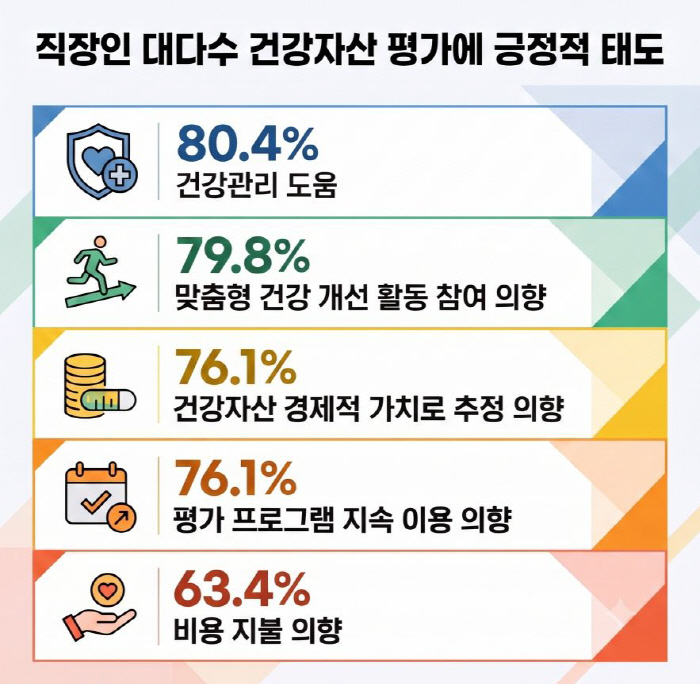
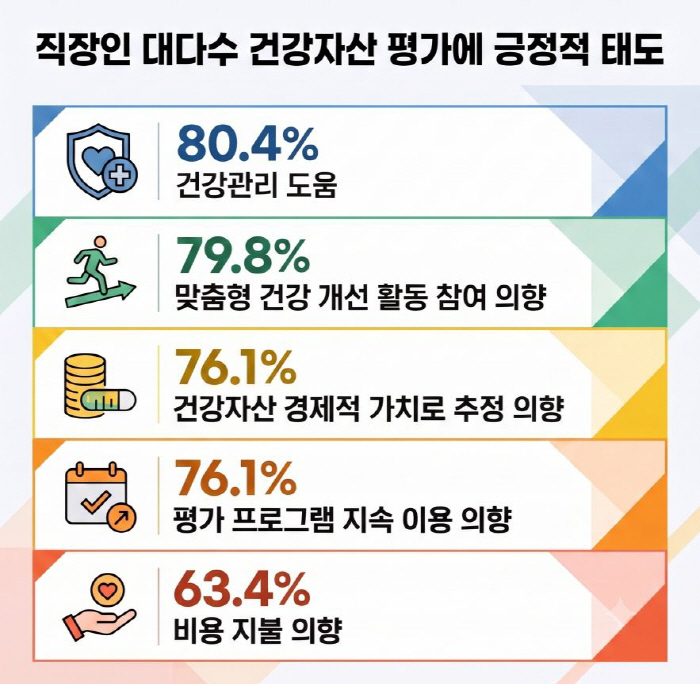
The survey found that most workers held a positive view of systematically assessing Health Asset. Some 80.4% of respondents said such an assessment would be ‘helpful for actual health management.’ More than 70% agreed on most items, including willingness to take part in personalized health improvement activities (79.8%), willingness to estimate economic value, and willingness to continue using the assessment program (76.1% each). The share of respondents willing to pay for it was also 63.4%. The results were consistent with a 2021 survey of the general public, in which 66.0% to 85.8% of respondents gave positive answers to all five items.
The team also examined self-rated physical, mental, social and spiritual health, as well as overall health, along with personal information such as education and income, to analyze how attitudes toward Health Asset assessment vary depending on health status and socioeconomic characteristics.
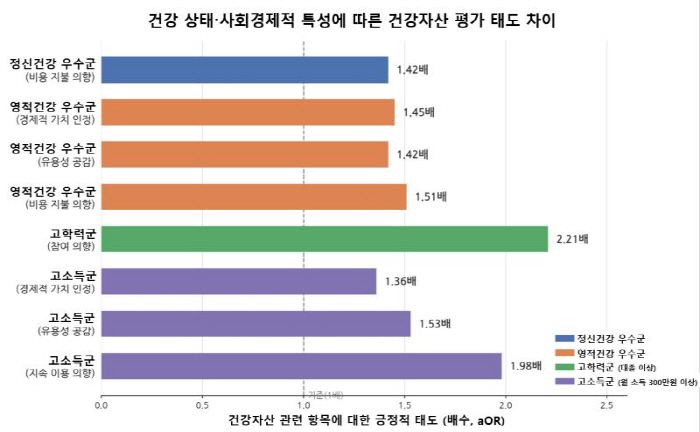
The results showed that mental and spiritual health were linked to attitudes toward Health Asset. Those in the ‘excellent mental health’ group, who cope well with stress and remain emotionally stable, were 1.42 times more likely than others to be willing to pay for a health improvement program. Those in the ‘excellent spiritual health’ group, who find meaning in life through volunteer work, religion or meditation, showed significantly higher levels of recognition of Health Asset’s economic value (1.45 times), agreement on its usefulness for assessment (1.42 times), and willingness to pay (1.51 times). The team interpreted this as meaning that workers who put more effort into intangible inner dimensions of health, such as mental and spiritual well-being, showed greater interest in evaluating and using Health Asset Value. By contrast, physical health, social health, and overall health showed no clear relationship.
Socioeconomic factors also played a role. Those with a college degree or higher were 2.21 times more likely to want to participate in personalized health improvement activities. Workers with higher incomes were more likely to recognize the economic value of Health Asset (1.36 times), feel that systematic assessment helps health management (1.53 times), and want to continue using the assessment program (1.98 times). By contrast, gender, age and company size, whether large or small, showed no clear relationship.
Professor Yoon Young-ho, director of the Gangnam Center at Seoul National University Hospital, said, “Because workers’ environments are directly linked to health, the government and companies need to recognize workers’ health not simply as a welfare expense, but as an asset with investment value.” He added, “I hope this study will serve as a basis for developing customized health programs based on multidimensional Health Asset measurement, as well as for policies aimed at reducing health inequality across social classes and regions.”
Jang Jong-ho, bellho@sportschosun.com

This article has been translated by GripLabs Mingo AI.