Assessing Saudi special education teachers’ preparedness to support the mental health of students with intellectual disabilities: contributions of awareness, self-efficacy, and school support
Special educators play a pivotal role in supporting the mental health of students with intellectual disabilities, yet their preparedness remains understudied in the Saudi context. This study examined the levels of awareness, self-efficacy, and perceived school support among special education teachers in Saudi Arabia and identified factors influencing their capacity to address students’ mental health needs. A total of 443 special education teachers across Saudi Arabia participated in a cross-sectional survey assessing their awareness, self-efficacy for supporting mental health, perceived school support, and attitudes toward student mental health. Descriptive analyses revealed high levels of self-reported awareness and generally positive attitudes, although perceived school support was comparatively lower. The results revealed that both awareness of student mental health and perceived school support were significant predictors of teachers’ attitudes toward supporting student mental health. Furthermore, self-efficacy for supporting mental health partially mediated the relationship between awareness, school support, and teachers’ attitudes. Significant differences were also observed in awareness, self-efficacy, and perceived school support based on teachers’ gender, academic qualifications, and teaching experience. The study highlights the need for targeted professional development, culturally responsive training, and stronger institutional support systems to empower teachers in promoting student well-being.
Introduction
The mental health of students with intellectual disabilities is an increasingly important yet underexplored dimension of special education (). Research consistently highlights that students with intellectual disabilities are disproportionately affected by mental health challenges, including anxiety, depression, and behavioral disorders, at rates three to four times higher than their neurotypical peers (; ). These challenges not only impede academic achievement but also hinder social integration and long-term quality of life (). Despite this, mental health support for this population often falls short, partly due to gaps in teacher preparedness, cultural stigma, and uneven institutional policies ().
In school settings, special education teachers serve as frontline observers and responders to students’ emotional and behavioral needs (). Their ability to recognize and address mental health concerns is critical, yet many teachers report lack of preparedness to differentiate between symptoms of mental illness and manifestations of intellectual disability itself (). Such misinterpretations can delay interventions, exacerbating students’ struggles and perpetuating cycles of academic and social exclusion ().
Cultural and institutional barriers further complicate the role of teachers. In a society like Saudi Arabia where mental health literacy is low, talking about psychological well-being is considered to be stigmatized (). This leads teachers not to discuss mental health issues in fear that they might step beyond their professional boundaries or due to unclear responsibilities (). Most teacher training programs in the region do not include comprehensive modules on mental health, thus leaving teaching professionals to apply makeshift strategies that depend largely on individual intuition (; ).
The expansion of inclusive education in Saudi Arabia has increased the presence of students with intellectual disabilities in mainstream and special education settings. While policy developments have emphasized access and participation, considerably less attention has been given to the mental health needs of these students and the preparedness of teachers to address them. Students with intellectual disabilities experience disproportionately high rates of emotional and behavioral difficulties (; ), yet the capacity of Saudi special education teachers to recognize and respond to such needs remains largely undocumented.
Existing research in the Saudi context has focused primarily on inclusive pedagogy, technology integration, and classroom management (e.g., ), with limited empirical attention to teachers’ mental health literacy, self-efficacy, and perceived institutional support. As a result, it remains unclear how personal competencies and school-level factors interact to shape teachers’ readiness to support student mental health. This gap is particularly significant in a cultural context where mental health stigma and unclear professional boundaries may influence educators’ engagement with psychological concerns (; ).
The present study addresses this gap by examining Saudi special education teachers’ awareness of student mental health, their self-efficacy for providing support, and their perceptions of school support, and by analyzing how these factors jointly influence attitudes toward engaging in mental health support. By situating these variables within a social-cognitive framework, this study aims to clarify the mechanisms underlying teacher preparedness and to inform culturally responsive professional development and policy initiatives.
Theoretical framework
This study draws on psychological and educational theories explaining how individual competencies, institutional resources, and perceptions shape teacher engagement in student mental health support. The conceptual model combines Bandura’s Social Cognitive Theory with Mental Health Literacy, highlighting personal factors (self-efficacy, awareness) and contextual factors (school support) that influence readiness. emphasizes the interaction of personal, environmental, and behavioral factors, with self-efficacy (belief in one’s ability to achieve outcomes) linked to motivation, commitment, and proactive teaching behaviors ().
Self-efficacy and mental health engagement
Self-efficacy is crucial for effective teacher support of student mental health. Teachers with higher self-efficacy show greater confidence in identifying and addressing emotional needs. A survey of secondary teachers found that greater confidence correlated with more frequent interactions, familiarity with mental health professionals, and higher intervention rates. Such teachers tend to hold positive attitudes toward mental health support and implement related practices (). Self-efficacy, however, is influenced by both personal knowledge and environmental support.
Evidence from school-based training studies shows that teacher confidence can be boosted through targeted professional development. In a UK trial, primary-school teachers and assistants reported significantly greater confidence and preparedness in identifying and responding to pupil mental health difficulties after a brief online training (). Similarly, educators who received trauma-informed training reported improved self-efficacy and reduced burnout in supporting student well-being. These findings imply that teacher self-efficacy can grow with appropriate training and supports. In essence, when teachers feel equipped and confident (through training, resources, and positive school culture), they are more able and willing to address students’ mental health. Conversely, reported that Saudi special education teachers generally had only low-to-moderate self-efficacy for implementing social-emotional learning to support students with learning disabilities.
The role of environmental influences: perceived school support
Within Social Cognitive Theory, self-efficacy is shaped not only by individual knowledge and mastery experiences but also by environmental conditions that enable or constrain action. In school settings, institutional structures influence whether teachers can translate their competencies into practice. The present study focuses specifically on perceived school support as a contextual factor because it reflects teachers’ evaluations of available resources, administrative encouragement, collaborative practices, and formal procedures related to student mental health. Unlike broader environmental variables, perceived support captures the immediate organizational climate within which teachers operate and therefore represents a proximal influence on both efficacy beliefs and attitudes.
Empirical research supports this focus. Studies have shown that teachers who perceive stronger institutional backing report greater engagement in student mental health practices and higher professional efficacy (). From a social cognitive perspective, supportive school environments may function as sources of verbal persuasion, shared mastery experiences, and reduced psychological strain, all of which contribute to stronger efficacy beliefs (). Thus, while individual knowledge remains central, perceived school support represents a theoretically grounded environmental mechanism that interacts with personal competencies in shaping teachers’ attitudes and actions.
Research questions
This study focused on the following four research questions:
What are the perceptions and attitudes of special education teachers toward addressing mental health challenges in students with intellectual disabilities?
What are the relationships among teachers’ awareness of student mental health, self-efficacy for supporting mental health, perceived school support, and their attitudes toward addressing mental health challenges among students with intellectual disabilities?
To what extent do self-efficacy mediate the relationship between both (a) awareness of student mental health and attitudes, and (b) perceived school support and attitudes?
How do demographic characteristics such as gender, academic qualifications, and years of teaching experience significantly influence teachers’ awareness, self-efficacy, perceived school support, and attitudes toward addressing students with intellectual disabilities?
Drawing on Social Cognitive Theory, which emphasizes the interplay of personal, behavioral, and environmental factors, this study proposed following hypothesis:
H1: There will be statistically significant relationships between teachers’ awareness of student mental health, self-efficacy for supporting mental health, perceived school support for mental health, and their attitudes toward supporting student mental health.
H2: Teachers’ awareness of student mental health and perceived school support for mental health will significantly predict their attitudes toward supporting student mental health.
H3: Teachers’ self-efficacy for supporting student mental health will significantly mediate the relationship between both (a) awareness of student mental health and attitudes, and (b) perceived school support and attitudes.
H4: Teachers’ demographic characteristics (gender, academic qualification, and teaching experience) will significantly influence their awareness, self-efficacy, perceived school support, and attitudes toward supporting student mental health.
Methodology
The research design, sample, instrument, study measures, procedures, and ethical issues for the current study are all included in this section.
Research design
This study employed a cross-sectional, explanatory survey design to examine relationships among teachers’ awareness of student mental health, self-efficacy, perceived school support, and attitudes toward supporting students with intellectual disabilities. A cross-sectional approach was appropriate because the study aimed to assess naturally occurring variations in these constructs at a single point in time and to test predictive and mediational relationships among them (). The design enabled the use of correlational, regression, and structural equation modeling techniques to evaluate both direct and indirect effects among variables within a theoretically specified framework.
Population and sample
The study targeted special education teachers who work with students with intellectual disabilities in schools under the General Directorate of Special Education, Saudi Ministry of Education. To capture diverse perspectives, participants were drawn from different regions of the country. Using a cluster sampling method, regions served as the primary clusters, with schools under the General Directorate of Special Education selected within sampled regions to ensure geographic coverage across the Kingdom. A total of 443 teachers currently teaching students diagnosed with intellectual disabilities were ultimately included, providing sufficient statistical power for reliability and generalizability. Recruitment relied in part on school principals and administrative coordinators to circulate the survey link, which may have introduced some selection bias or perceived coercion despite assurances of voluntary participation and anonymity.
The majority of the participants were male teachers (74.3%, n = 329), while female teachers accounted for 25.7% (n = 114) of the sample. In terms of age distribution, 29.3% of the participants were 30 years or younger (n = 130), 40.4% were aged between 31 and 40 years (n = 179), and 30.2% were between 41 and 50 years (n = 134). Notably, no participants were aged over 50 years, reflecting the relatively young workforce within special education settings in Saudi Arabia. Regarding academic qualifications, as shown in Table 1, a substantial proportion of the participants held a Master’s degree (44.0%, n = 195), followed by those with a Bachelor’s degree (29.1%, n = 129) and those with a PhD (26.9%, n = 119). With respect to teaching experience, 32.1% of the participants reported having 1–5 years of experience (n = 142), 44.2% had 6–10 years of experience (n = 196), and 23.7% had 11–15 years of experience (n = 105). No participants reported more than 15 years of teaching experience.
Demographic character like
n
Percentage
Age
30 years or younger
130
29.3%
31–40 years
179
40.4%
41–50 years
134
30.2%
51+ years
0
0.0%
Gender
Male
329
74.3%
Female
114
25.7%
Qualification
Bachelor’s degree
129
29.1%
Master’s degree
195
44.0%
Ph.D.
119
26.9%
Teaching experience
1–5 years
142
32.1%
6–10 years
196
44.2%
11–15 years
105
23.7%
16+ years
0
0.0%
Demographic analysis of participants (N = 443).
Study measures
Data were collected using a structured questionnaire developed specifically for this study, with items primarily newly created but informed by and partially adapted from validated measures in the teacher mental health domain. For awareness and self-efficacy items, wording drew from scales like the School Mental Health Self-Efficacy Teacher Survey () and elements of mental health literacy tools (e.g., ), adapted to focus on students with intellectual disabilities in the Saudi context. School support items were newly developed based on conceptual literature (e.g., ) to capture perceived institutional resources and climate.
To establish content validity, the initial item pool was reviewed by four experts in special education and educational psychology who evaluated item relevance, clarity, and construct alignment. Based on their feedback, several items were refined for conceptual precision and cultural appropriateness. A pilot study was subsequently conducted with 20 special education teachers who were not included in the final sample. The pilot aimed to assess item clarity, internal consistency, and preliminary construct functioning. Minor wording adjustments were made following pilot feedback.
Internal consistency reliability was assessed using Cronbach’s alpha in the main study sample. All scales demonstrated acceptable reliability (α = .79–.83), exceeding the recommended threshold of .70 for social science research (). These findings provide evidence of satisfactory content validity and internal consistency reliability for the instruments used in this study. Table 2 lists the details of the study constructs, and the measure of their internal consistencies calculated in the current study.
Constructs measured
Brief description and a sample item
Cronbach’s α
Awareness
Awareness of student mental health: “I know how to recognize early signs of student mental distress.”
0.81
Attitude
Attitudes toward supporting mental health: “I consider supporting student emotional needs part of my professional duty.”
0.79
Self-efficacy
Self-efficacy for supporting mental health: “I feel skilled in detecting early signs of student mental health problems.”
0.80
School Support
Perceived school support for student mental health: “My school provides sufficient mental health training and resources.”
0.83
Measurement constructs, description, and reliability.
All construct-items were measured on a 5-point Likert scale (1 = Strongly disagree to 5 = Strongly agree).
To examine factorial validity, confirmatory factor analysis (CFA) was conducted in AMOS on the four main constructs (awareness, attitudes, self-efficacy, school support). The model showed acceptable fit [e.g., χ2/df = 2.8, CFI = .95, TLI = .94, RMSEA = .07], supporting the hypothesized four-factor structure. In addition to Cronbach’s α (all ≥.79), composite reliability (CR) ranged from .82 to .88, and average variance extracted (AVE) values were .52–.61, exceeding recommended thresholds () and indicating adequate convergent validity.
Study procedures
Following ethical approval from the Institutional Review Board at Prince Sattam bin Abdulaziz University, Alkharj, Saudi Arabia, data were collected via an anonymous, self-administered online survey distributed through official email channels, educational networks, and social media groups for special education teachers. Potential participants received a cover letter mentioning the study’s purpose, procedures, voluntary nature, and potential minimal risks. Informed consent was obtained from all participants. Participants could withdraw at any time by closing the browser without submitting data, with no consequences. Confidentiality and anonymity were maintained throughout data handling, with responses stored securely on password-protected servers accessible only to the research team. Data collection was conducted over a three-week period in March 2025.
Data analysis techniques
Data was analyzed to answer specific research questions of the study using descriptive and inferential statistical methods. Data analysis was conducted using IBM SPSS Statistics version 26, AMOS, and the PROCESS macro for mediation analysis (). Statistical significance was established at p < 0.05 for all inferential tests. Descriptive statistics, including means, standard deviations, and frequency distributions, were computed to summarize the demographic characteristics of the sample and the main study variables.
Before running inferential analyses, preliminary data screening was conducted to ensure the dataset’s quality and integrity (; ). The data were checked for missing values, outliers, and violations of statistical assumptions. Cases with incomplete responses were removed using listwise deletion. Normality was assessed through skewness and kurtosis, and all continuous variables met acceptable thresholds for parametric tests. Standardized residuals and boxplots showed no significant outliers. The internal consistency of multi-item scales covering constructs such as awareness, attitudes, self-efficacy, and perceived school support was evaluated using Cronbach’s alpha. Alpha values of 0.70 or higher were considered indicative of acceptable reliability ().
To test the hypothesized indirect effect of self-efficacy on attitudes through perceived school support, mediation analysis was conducted using the PROCESS macro (Model 4) with 5,000 bootstrap resamples (). The significance of indirect effects was determined using bias-corrected 95% confidence intervals. A mediation model was considered significant if the confidence interval for the indirect effect did not contain zero. Independent samples t-tests and one-way analyses of variance (ANOVA) were employed to explore potential differences in awareness, attitudes, self-efficacy, and perceived school support based on demographic variables, including gender, age group, and years of teaching experience. Where significant group differences were identified, post hoc analyses using the Bonferroni correction were conducted to determine the nature of these differences.
Ethical considerations
The study adheres to ethical research guidelines, including obtaining approval from the Committee of Bioethics Research (Application No. SCBR-521/2025), at Prince Sattam bin Abdulaziz University in accordance with the local and international ethical norms, regulations and guidelines. Participants were clearly informed about the voluntary nature of the investigation and their right to withdraw from the study at any time without any consequence. All data of the study was stored securely and used only for research purposes. Findings were reported in aggregate form, ensuring individual responses cannot be identified and participants’ privacy is not hurt.
Results
Perceptions of mental health challenges in students with intellectual disabilities
The first research question of the study focused on investigating special education teachers’ perceived awareness, attitudes, self-efficacy, and school support toward addressing mental health challenges in students with intellectual disabilities. Descriptive statistics were computed for all primary study variables, including Awareness of Student Mental Health, Attitudes Toward Supporting Student Mental Health, Self-Efficacy for Supporting Mental Health, and Perceived School Support for Mental Health. The results are presented in Table 3.
Variable
Minimum
Maximum
Mean
SD
Skewness
Kurtosis
Awareness
2.00
5.00
3.36
0.82
0.01
−1.12
Attitudes
1.00
5.00
3.57
0.99
−0.97
0.34
Self-Efficacy
1.29
5.00
3.65
1.01
−1.07
0.13
School Support
1.00
5.00
3.43
0.91
−0.66
0.16
Descriptive statistics of study variables (N = 443).
The mean scores for all variables ranged from 3.36 to 3.65, indicating moderately positive perceptions among teachers regarding their awareness, attitudes, self-efficacy, and perceptions of school support in addressing student mental health. The standard deviations, ranging from 0.82 to 1.01, reflect acceptable variability in responses, suggesting a reasonable spread of scores across the sample.
An assessment of normality was conducted by examining skewness and kurtosis values. Skewness values for all variables ranged from −1.072 to 0.015, while kurtosis values ranged from −1.120 to 0.337. As a general rule, skewness values between −2 and +2, and kurtosis values between −2 and +2, are considered acceptable indicators of normality in social science research (). The results indicate that all study variables exhibited acceptable levels of skewness and kurtosis, demonstrating approximately symmetric distributions without significant departure from normality. These findings satisfy the assumption of normality required for subsequent parametric analyses, including correlation, regression, and mediation tests.
Relationships among awareness, attitude, self-efficacy, and school support
Pearson’s product-moment correlation coefficients were computed to examine the relationships among the key study variables, including Awareness of Student Mental Health, Attitudes Toward Supporting Mental Health, Self-Efficacy for Supporting Mental Health, and Perceived School Support for Mental Health. The results are presented in Table 4.
Correlation is significant at the 0.01 level (2-tailed).
All correlations were positive, statistically significant at the p < .01 level, and in the expected directions. Specifically, Awareness of Student Mental Health demonstrated moderate positive correlations with Attitudes (r = .346, p < .01), Self-Efficacy (r = .337, p < .01), and Perceived School Support (r = .422, p < .01). These findings indicate that higher levels of awareness are associated with more favorable attitudes, greater confidence in supporting student mental health, and more positive perceptions of school support. Similarly, Attitudes Toward Supporting Mental Health were positively correlated with Self-Efficacy (r = .469, p < .01) and Perceived School Support (r = .591, p < .01), suggesting that teachers with greater self-efficacy and stronger perceptions of institutional support tend to hold more favorable attitudes toward addressing student mental health needs.
The strongest bivariate relationship was observed between Self-Efficacy and Perceived School Support (r = .625, p < .01), highlighting the critical role of institutional support in fostering teachers’ confidence to engage with student mental health challenges. To assess potential issues of multicollinearity, the correlation matrix was examined for excessively high intercorrelations. All correlation coefficients fell well below the commonly accepted threshold of r = .80, indicating that multicollinearity is unlikely to pose a concern for subsequent regression or mediation analyses (). Overall, the results demonstrate theoretically coherent and statistically significant associations among the study variables, providing initial support for the hypothesized relationships.
Mediation of self-efficacy in the relationship between awareness and attitude
The third research question aimed to examine the mediation role of self-efficacy in the relationship between both (a) awareness of student mental health and attitudes, and (b) perceived school support and attitudes. A standard multiple regression analysis was performed to examine the extent to which Awareness of Student Mental Health and Perceived School Support for Mental Health predict teachers’ Attitudes Toward Supporting Student Mental Health. The overall model was statistically significant, F(2, 440) = 123.96, p < .001, indicating that the combination of awareness and school support significantly explained variance in teachers’ attitudes. The model accounted for approximately 36.0% of the variance in attitudes (R2 = .360, Adjusted R2 = .357), suggesting a substantial predictive effect of these factors on teachers’ attitudes toward supporting student mental health.
As shown in the coefficients table, both awareness and perceived school support made significant unique contributions to predicting attitudes. Awareness of Student Mental Health was a significant positive predictor (B = .143, SE = .051, β = .118, t = 2.81, p = .005), indicating that teachers with higher levels of awareness reported more favorable attitudes toward addressing student mental health challenges. Similarly, Perceived School Support for Mental Health was also a significant and strong positive predictor (B = .586, SE = .046, β = .541, t = 12.86, p < .001), highlighting the critical role of institutional resources, supportive policies, and school climate in shaping teacher attitudes(see Table 5).
Predictors
Unstandardized coefficients
Standardized coefficients
t
Sig.
F
Sig.
R
R2
B
Std. Error
Beta
(Constant)
1.07
0.18
5.93
0.000
123.96
<.001
0.6
0.36
Awareness
0.14
0.05
0.12
2.81
0.005
School Support
0.59
0.05
0.54
12.86
0.000
Regression analysis results.
Note: Dependent Variable: Attitudes.
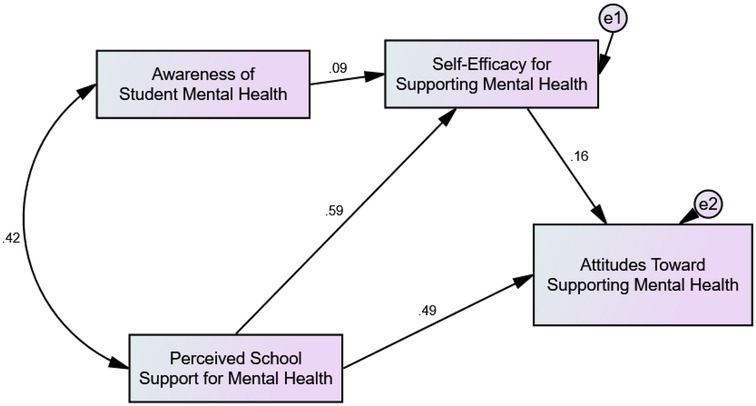
A mediation analysis was conducted using AMOS to examine whether Self-Efficacy for Supporting Mental Health mediates the relationship between Awareness of Student Mental Health, Perceived School Support for Mental Health, and Attitudes Toward Supporting Student Mental Health. The hypothesized model and standardized path coefficients are presented in Figure 1.
The overall fit of the hypothesized mediation model was assessed using several widely accepted model fit indices (see Table 6). The chi-square goodness-of-fit test was statistically significant, χ2(1) = 6.24, p = .012. While a significant chi-square often suggests some degree of model misfit, it is well-established that this test is highly sensitive to sample size and often significant in larger samples (). The ratio of chi-square to degrees of freedom (CMIN/DF) was 6.24, which exceeds the conventional threshold of 3.0 for a good fit. However, given the simplicity of the model and the small degrees of freedom, such values can still be considered acceptable (). Other key fit indices indicated an overall acceptable to excellent model fit. The Goodness-of-Fit Index (GFI) was .993, and the Adjusted Goodness-of-Fit Index (AGFI) was .930, both exceeding the commonly recommended cut-off of .90, suggesting that the model provides a good representation of the data. The Root Mean Square Residual (RMR) was .022, indicating an excellent fit, as values below .05 are desirable. The Comparative Fit Index (CFI) of .990 and the Tucker–Lewis Index (TLI) of .938 also exceeded conventional cut-offs for good model fit, further supporting the adequacy of the hypothesized model.
Fit index
Value
Interpretation
Chi-square (CMIN)
6.24
Significant (p = .012), expected with large N
CMIN/DF
6.24
Above ideal <3.0, but acceptable with saturated model
Goodness-of-Fit Index (GFI)
.993
Excellent model fit
Adjusted GFI (AGFI)
.930
Acceptable model fit
Root Mean Square Residual (RMR)
.022
Excellent model fit
Comparative Fit Index (CFI)
.990
Excellent model fit
Tucker–Lewis Index (TLI)
.938
Acceptable model fit
Root Mean Square Error of Approximation (RMSEA)
.109
Slightly above ideal <.08, but acceptable given model simplicity
Model Fit indices results.
The standardized direct effect from Awareness to Self-Efficacy was statistically significant (β = .089, p = .030), indicating that higher awareness is associated with greater self-efficacy for supporting mental health. Additionally, Perceived School Support demonstrated a strong, positive, and statistically significant direct effect on Self-Efficacy (β = .587, p < .001) and Attitudes (β = .488, p < .001), suggesting that institutional support plays a critical role in enhancing both teacher confidence and attitudes toward student mental health. Finally, Self-Efficacy had a significant direct effect on Attitudes (β = .164, p < .001), indicating that teachers with higher confidence in supporting mental health hold more favorable attitudes.
The model revealed statistically significant indirect effects of both Awareness and Perceived School Support on Attitudes, mediated through Self-Efficacy. Specifically, the standardized indirect effect of Awareness on Attitudes was β = .015, while the standardized indirect effect of School Support on Attitudes was β = .096, both statistically significant. These findings support the mediating role of self-efficacy in the relationships between both awareness and school support with teachers’ attitudes. The total effects further confirm these relationships, with Perceived School Support exerting the strongest overall influence on Attitudes (total standardized effect β = .585), followed by Self-Efficacy (β = .164), while the total effect of Awareness on Attitudes remained small but positive (β = .015).
The results of the mediation analysis provide empirical support for the hypothesized relationships among the key study variables. The model demonstrated that Awareness of Student Mental Health significantly predicted Self-Efficacy for Supporting Mental Health, while Perceived School Support for Mental Health exerted both direct and indirect influences on teachers’ attitudes toward supporting student mental health.
Specifically, awareness exhibited a small but statistically significant positive effect on self-efficacy (β = .089, p = .030), suggesting that teachers with greater awareness of student mental health challenges tend to feel more confident in their ability to provide appropriate support. Additionally, perceived school support was a strong and significant predictor of both self-efficacy (β = .587, p < .001) and attitudes (β = .488, p < .001), underscoring the critical role of institutional support structures in shaping teachers’ attitudes and confidence to address student mental health needs. Furthermore, self-efficacy was found to significantly predict attitudes toward supporting student mental health (β = .164, p < .001), and mediation analysis revealed significant indirect effects of both awareness and perceived school support on attitudes through self-efficacy. The total standardized indirect effect of perceived school support on attitudes was β = .096, while the indirect effect of awareness on attitudes was β = .015, indicating that self-efficacy serves as a key mechanism through which both personal and environmental factors influence teachers’ attitudes.
The effect of demographic characteristics
The fourth research question of the study focused on examining the effect of demographic characteristics on awareness, attitude, self-efficacy, and perceived school support. An independent samples t-test was conducted to examine whether there were statistically significant differences in Awareness of Student Mental Health, Attitudes Toward Supporting Mental Health, Self-Efficacy for Supporting Mental Health, and Perceived School Support for Mental Health based on gender. The results revealed a significant difference in awareness scores between male and female teachers, t(441) = −2.53, p = .012, with female teachers (M = 3.53, SD = 0.78) reporting significantly higher levels of awareness than their male counterparts (M = 3.31, SD = 0.82). Similarly, significant gender differences were found in self-efficacy, t(441) = −2.79, p = .005, with female teachers (M = 3.87, SD = 0.92) reporting significantly higher self-efficacy than male teachers (M = 3.57, SD = 1.03). Additionally, perceived school support was significantly higher among female teachers (M = 3.65, SD = 0.95) compared to male teachers (M = 3.36, SD = 0.89), t(441) = −2.91, p = .004. However, no significant gender difference was observed in attitudes toward supporting student mental health, t(441) = −0.92, p = .359. These results indicate that while female teachers report higher levels of awareness, self-efficacy, and perceptions of school support for mental health, both male and female teachers hold comparable attitudes toward supporting student mental health (see Table 7).
Testing variables
Gender
M
SD
t
df
Sig. (2-tailed)
Mean Difference
95% confidence interval of the difference
Lower
Upper
Awareness
Male
3.31
0.82
−2.53
441
0.012
−0.22
−0.40
−0.05
Female
3.53
0.78
Attitudes
Male
3.54
0.97
−0.92
441
0.359
−0.10
−0.31
0.11
Female
3.64
1.05
Self-efficacy
Male
3.57
1.03
−2.79
441
0.005
−0.30
−0.52
−0.09
Female
3.87
0.92
School support
Male
3.36
0.89
−2.91
441
0.004
−0.29
−0.48
−0.09
Female
3.65
0.95
A one-way Analysis of Variance (ANOVA) was conducted to determine whether teachers’ levels of Awareness of Student Mental Health, Attitudes Toward Supporting Student Mental Health, Self-Efficacy for Supporting Mental Health, and Perceived School Support for Mental Health differed significantly based on academic qualification. The results revealed a statistically significant effect of qualification on Awareness, F(2, 440) = 3.75, p = .024, Self-Efficacy, F(2, 440) = 3.79, p = .023, and School Support, F(2, 440) = 5.76, p = .003. No significant differences were found for Attitudes, F(2, 440) = 1.28, p = .281. Post hoc comparisons using the Bonferroni test indicated that participants with a PhD qualification reported significantly higher awareness than those with a Master’s degree (p = .019), significantly higher self-efficacy compared to Bachelor’s degree holders (p = .019), and significantly higher perceptions of school support compared to both Bachelor’s (p = .009) and Master’s degree holders (p = .008). These findings suggest that teachers with higher academic qualifications, particularly those holding doctoral degrees, possess greater awareness, self-efficacy, and perceive stronger institutional support for addressing student mental health. Figure 2 visualize the mean scores of all study variables based on participants qualification.
A one-way Analysis of Variance (ANOVA) was conducted to explore whether teachers’ Awareness of Student Mental Health, Attitudes Toward Supporting Mental Health, Self-Efficacy for Supporting Mental Health, and Perceived School Support for Mental Health differ significantly based on years of teaching experience. The results revealed statistically significant differences across all four variables. Specifically, significant effects of teaching experience were found for Awareness, F(2, 440) = 7.91, p < .001; Attitudes, F(2, 440) = 12.72, p < .001; Self-Efficacy, F(2, 440) = 12.45, p < .001; and School Support, F(2, 440) = 32.62, p < .001.
Post hoc comparisons using the Bonferroni test indicated that teachers with 11–15 years of experience consistently reported significantly higher awareness, attitudes, self-efficacy, and perceived school support compared to those with fewer years of experience. For instance, teachers with 11–15 years of experience had significantly higher awareness than both the 1–5 year group (p < .001) and the 6–10 year group (p = .241, not significant for this comparison). Similar patterns were observed for attitudes, self-efficacy, and school support, with the 11–15 year group consistently outperforming their less experienced counterparts. These findings suggest that more experienced teachers, particularly those with over a decade of teaching experience, possess greater awareness, more favorable attitudes, stronger self-efficacy, and perceive higher levels of institutional support for addressing student mental health (see Figure 3).
Discussions
This study examined teacher preparedness to support the mental health of students with intellectual disabilities through the lens of Social Cognitive Theory. Consistent with the triadic model proposed by , the findings suggest that cognitive factors (awareness), personal belief systems (self-efficacy), and environmental conditions (perceived school support) operate in interaction rather than isolation. Teachers’ attitudes toward supporting student mental health appear to emerge from this dynamic interplay.
The study data reveal that special educators’ awareness of mental-health challenges faced by students with intellectual disabilities was modest rather than comprehensive. Teachers in in this study generally recognized some common emotional or behavioral issues but often lacked detailed knowledge of specific mental-health needs. This aligns with other regional findings that educators frequently have gaps in knowledge about developmental and psychological disorders. For example, a recent Jordanian study found that even well-trained teachers often did not recognize key features of common disabilities (). This limited awareness may stem from a lack of formal training: Saudi teacher-preparation programs and continuing education have historically emphasized academic instruction over mental-health literacy. This deficit is consistent with the notion from SCT that cognitive factors such as knowledge and beliefs shape behavior. Specifically, conceptualized self-efficacy as rooted in individuals’ cognitive processing of information and experiences. If a teacher does not fully comprehend a student’s mental-health condition, that teacher will likely feel less confident (lower self-efficacy) in intervening effectively. Indeed, the correlational analysis showed a positive association between awareness and self-efficacy: teachers who demonstrated higher awareness scores also reported significantly greater confidence in addressing those issues. In SCT terms, enhanced awareness acts like a “mastery experience” or informational basis that strengthens efficacy beliefs.
The mediation findings provide particularly strong theoretical support for Social Cognitive Theory. Self-efficacy functioned as a psychological mechanism linking both awareness and school support to teachers’ attitudes. This reflects argument that environmental and informational inputs do not influence behavior directly but are filtered through efficacy beliefs. In this study, perceived school support exerted both direct and indirect effects on attitudes, suggesting that institutional structures shape teachers’ readiness partly by strengthening their confidence to intervene. Awareness showed a smaller but significant indirect effect, reinforcing the idea that cognitive understanding becomes influential when translated into perceived capability.
From a theoretical standpoint, these self-efficacy results reinforce and extend SCT. identified mastery experiences (successful practice), vicarious experiences (observing peers), verbal persuasion, and physiological states as sources of self-efficacy. The finding that academic qualification of teachers correlates with higher teacher efficacy directly supports this. Higher qualification can provide both mastery (through guided practice) and vicarious learning (via role models or mentors). Indeed, other research confirms that training boosts efficacy. documented significant gains in teachers’ confidence after training courses. The current study therefore adds to Bandura’s model by emphasizing the domain-specificity of these efficacy beliefs. It shows that mastery needs to occur specifically around students with intellectual disabilities and mental-health concerns, not just general teaching. Another theoretical insight comes from the role of teachers’ attitudes. found that among Saudi special-ed teachers, positive attitudes toward student transition strongly predicted higher self-efficacy. The present study suggests a similar effect. Teachers who more strongly believe in the importance of mental health tended to report higher efficacy. This aligns with SCT’s reciprocal nature. If attitudes (a personal/cognitive factor) fuel effort and engagement, they bolster the sense of competence when successes follow.
The third key finding concerned school support. Teachers’ perceptions of support from their schools, including resources, administrative backing, and collegial assistance, varied but on average were only moderate. Importantly, higher perceived support was strongly associated with higher teacher self-efficacy and awareness. This pattern resonates with literature review, which noted a positive correlation between teachers’ sense of resource availability and their self-efficacy. In SCT terms, school support is a vital environmental factor influencing personal belief. The suggest that when principals actively cultivate a supportive climate, for example, by allocating time for mental-health meetings or facilitating training, teachers feel more capable. Conversely, schools lacking such structures leave teachers feeling isolated and less efficacious. The importance of leadership and policy is underscored by Saudi educational guidelines. The explicitly states that teacher acceptance of students with disabilities “is the most important factor” in their success. Likewise, school principals are charged with flexible, adaptive management to support students facing difficulties. In other words, the finding that school support bolsters teachers echoes national policy.
This study makes several important contributions to the field of educational psychology and mental health. It extends existing research by focusing on special education teachers working with students with intellectual disabilities, a population often underrepresented in mental health research. In addition, it applies a robust theoretical framework, integrating Social Cognitive Theory and mental health literacy to explain the mechanisms influencing teacher attitudes. Together, the findings suggest a dynamic reciprocity between awareness (cognition), self-efficacy (personal belief), and support (environment). Teachers with greater awareness tend to draw on available support more effectively, which in turn reinforces their sense of efficacy. This fits Bandura’s triadic model. It appears that improving one component (e.g., raising awareness through training) can catalyze gains in the others (through emerging confidence and demand for resources). In this sense, this study makes a theoretical innovation by treating awareness of mental health as a cognitive construct within SCT. While Bandura discussed beliefs and attitudes, prior research seldom frames factual awareness as a separate factor. This study shows that explicit knowledge about student mental health is not just background; it interacts with self-beliefs and context in ways SCT predicts. Thus, this work refines SCT for special education: it highlights that teacher training and information-sharing are forms of social influence that strengthen self-efficacy, and that institutional backing amplifies these effects.
Practical implications follow from these insights. First, for teacher training, the findings confirm that incorporating mental-health content into special-education preparation and professional development is crucial. Specialized workshops on recognizing and managing anxiety, depression, and other conditions could create the very mastery experiences that SCT deems necessary for efficacy. Indeed, showed that a focused PD program on emotional and behavioral disorders significantly improved Saudi teachers’ knowledge and self-efficacy. The results suggest similar programs targeting intellectual disabilities and mental health would be beneficial. Training should also address attitudes: exposure to positive outcomes (vicarious experience) and discussion of stigma can reshape perceptions. In practice, collaboration with psychologists can provide concrete strategies. By increasing teacher awareness and skills, such training will likely reduce anxiety among educators and encourage early identification of student needs. For school leadership, the implications are equally clear. Principals and administrators must actively signal that student mental health is a priority. This can take many forms: allocating time for mental health team meetings, hiring counselors, or simply encouraging teachers to discuss concerns without penalty.
Finally, at the policy level, the findings reinforce the momentum of Saudi national initiatives while suggesting areas for enhancement. Vision 2030 and the National Transformation Program have committed to expanding educational services for people with disabilities (). As inclusion grows, teacher preparedness must keep pace. Policymakers could mandate mental health modules in teacher-certification standards and fund continuing education in this area. The Ministry of Health and Education might collaborate on campaigns to destigmatize mental health in schools, complementing global movements by WHO and UNESCO on child well-being.
Limitations and future directions
While this study offers valuable insights, several limitations should be acknowledged. First, the use of self-report measures may introduce social desirability bias, particularly given the sensitive nature of mental health topics. Second, the cross-sectional design limits the ability to draw causal inferences about the relationships among variables. Future research could observe actual classroom practices or student outcomes to enrich these findings. Moreover, longitudinal studies could test whether interventions (e.g., new training programs) produce the predicted boosts in awareness and efficacy. Furthermore, the sample consisted solely of teachers working with students with intellectual disabilities in Saudi Arabia, which may limit the generalizability of findings to other educational contexts or cultural settings. Future research should consider Expanding the sample to include teachers from mainstream schools or other educational settings.
Conclusion
This study set out to illuminate how special education teachers in Saudi Arabia perceive their readiness to support the mental health of students with intellectual disabilities, and how personal and institutional factors shape that readiness. The findings portray a professional community that is committed to student well-being but often constrained by limited awareness, varying levels of self-efficacy, and uneven school support. The findings indicate that while teachers generally hold positive attitudes and report a strong awareness of mental health issues, their levels of preparedness and participation in professional development programs remain uneven. Demographic factors such as age and teaching experience were found to influence perceptions, underscoring the importance of designing targeted, stage-appropriate training opportunities. Future research should investigate the specific barriers that prevent teachers from engaging in mental health-focused professional development and assess the effectiveness of various training models. This study contributes to the growing body of knowledge on mental health in special education and highlights both the progress and the continuing needs within the Saudi educational context.
Statements
Data availability statement
The raw data supporting the conclusions of this article will be made available by the authors, without undue reservation.
Ethics statement
The studies involving humans were approved by The Committee of Bioethics Research (Application No. SCBR-521/2025), at Prince Sattam bin Abdulaziz University. The studies were conducted in accordance with the local legislation and institutional requirements. The participants provided their written informed consent to participate in this study.
The author declares that financial support was received for this work and/or its publication. This study is supported via funding from Prince Sattam bin Abdulaziz University project number (PSAU/2026/R/1447).
Conflict of interest
The author declares that this work was conducted in the absence of any commercial or financial relationships that could be construed as a potential conflict of interest.
Generative AI statement
The author declares that generative AI was not used in the creation of this manuscript.
Any alternative text (alt text) provided alongside figures in this article has been generated by Frontiers with the support of artificial intelligence and reasonable efforts have been made to ensure accuracy, including review by the authors wherever possible. If you identify any issues, please contact us.
Publisher’s note
All claims expressed in this article are solely those of the authors and do not necessarily represent those of their affiliated organizations, or those of the publisher, the editors and the reviewers. Any product that may be evaluated in this article, or claim that may be made by its manufacturer, is not guaranteed or endorsed by the publisher.
References
AhmadS. S.KoncsolS. W. (2022). Cultural factors influencing mental health stigma: perceptions of mental illness (POMI) in Pakistani emerging adults. Religions13 (5), 401. 10.3390/rel13050401
AlaliS.Al KaiedZ. S.AlyamaniA. H.Abu AwadF. (2020). In-service teachers’ knowledge of common features associated with disorders and developmental disabilities. Soc. Sci. Hum. Open. 2(1), 100046. 10.1016/j.ssaho.2020.100046
AlbashN. I. A. (2024). A survey of special education teachers and specialists in Saudi Arabia on the use of collaborative practices to support the mental health of students with disabilities. Educ. Inf. Technol.29 (15), 20031–20053. 10.1007/s10639-024-12667-2
AlkahtaniK. D. F. (2022). Professional development: improving teachers’ knowledge and self-efficacy related to emotional and behavioral disorders. J. Emot. Behav. Disord.32 (1), 14–23. 10.1177/10634266221130049
AlsalamahA. A. (2023). Special education Teachers’ self–efficacy in implementing social–emotional learning to support students with learning disabilities. Learn. Disabil. Res. Pract.38 (3), 209–223. 10.1111/ldrp.12318
AlshehriM. (2025). Examining Saudi teachers’ professional competency and attitudes toward technology-integrated teaching for students with intellectual disabilities. Discov. Educ.4 (1). 10.1007/s44217-025-00966-w
AvramidisE.NorwichB. (2002). Teachers’ attitudes towards integration/inclusion: a review of the literature. Eur. J. Spec. Needs Educ.17 (2), 129–147. 10.1080/08856250210129056
BanduraA. (1977). Self-efficacy: toward a unifying theory of behavioral change. Psychol. Rev.84 (2), 191–215. 10.1037/0033-295X.84.2.191
BanduraA. (2014). “Social-cognitive theory” in An introduction to Theories of Personality. (Psychology Press), 341–360.
BinammarS.AlqahtaniA.AlnahdiG. H. (2023). Factors influencing special education teachers’ self-efficacy to provide transitional services for students with disabilities. Front. Psychol.14, 1140566. 10.3389/fpsyg.2023.1140566
BourneJ.BrownC.CorriganD.GoldblattP.HackettS. (2022). Advances for future working following an online dramatherapy group for adults with intellectual disabilities and mental ill health during the COVID-19 pandemic: a service evaluation for cumbria, northumberland Tyne and wear NHS foundation trust. Br. J. Learn. Disabil.10.1111/bld.12462
BrannK. L.BooneW. J.SplettJ. W.ClemonsC.BidwellS. L. (2021). Development of the school mental health self-efficacy teacher survey using Rasch analysis. J. Psychoeduc. Assess.39 (2), 197–211. 10.1177/0734282920947504
ByrneB. M (2016). Structural Equation Modeling With AMOS. (3rd ed.). Abingdon, Oxfordshire: Routledge. 10.4324/9781315757421
ChaoC. N. G.ChowW. S. E.ForlinC.HoF. C. (2017). Improving teachers’ self-efficacy in applying teaching and learning strategies and classroom management to students with special education needs in Hong Kong. Teach. Teach. Educ.66, 360–369. 10.1016/j.tate.2017.05.004
DavisC.BakerC.OsbornJ.OverstreetS. (2022). Understanding teacher self-efficacy to address Students’ social-emotional needs in the COVID-19 pandemic. Urban Educ.59, 004208592210998. 10.1177/00420859221099834
FieldA. (2018). Discovering Statistics Using IBM SPSS Statistics, 5th Edn.SAGE Publications Ltd.
FornellC.LarckerD. F. (1981). Evaluating structural equation models with unobservable variables and measurement error. J. Market. Res.18 (1), 39–50. 10.2307/3151312
GeorgeD.MalleryP. (2018). IBM SPSS Statistics 25 Step by Step: A Simple Guide and Reference. Routledge. 10.4324/9781351033909
HayesA. F. (2022). Introduction to Mediation, Moderation, and Conditional Process Analysis: A Regression-Based Approach. (3rd ed.). New York, NY: The Guilford Press.
KlineR. B. (2016). Principles and Practice of Structural Equation Modeling. (4th ed.). New York, NY: The Guilford Press.
NasarullahN.AminR. U.SoomroK. A. (2021). Decentralization of education: the affective role of fiscal decentralization in Pakistani education system(s). FWU J. Soc. Sci.15 (1), 41–51. 10.51709/19951272/spring2021/15-4
MpuangnanK. N. (2024). Teacher preparedness and professional development needs for successful technology integration in teacher education. Cogent Educ.11 (1), 2408837. 10.1080/2331186X.2024.2408837
SinclairJ.HolmesS. R.KnowlesC.BromleyK. W.RodriguezG.StadelmanS.et al (2025). Including students with disabilities within school-based mental health multi-tiered systems of supports. Sch. Ment. Health. 10.1007/s12310-025-09777-8
SoomroK. A.Yousuf ZaiS.JafriI. H. (2015). Competence and usage of web 2.0 technologies by higher education faculty. Educ. Media Int.52 (4), 284–295. 10.1080/09523987.2015.1095522
SonesonE.HowarthE.WeirA.JonesP. B.FazelM. (2024). Empowering school staff to support pupil mental health through a brief, interactive web-based training program: mixed methods study. J. Med. Internet Res.26, e46764. 10.2196/46764
TotsikaV.HastingsR.HattonC.EmersonE. (2023). Pathways to social well-being of children with intellectual disability: testing the family investment model. J Intellect. Disabil. Res.67. 10.1111/jir.13082
TotsikaV.LiewA.AbsoudM.AdnamsC.EmersonE. (2022). Mental health problems in children with intellectual disability. Lancet Child Adolesc. Health6 (6), 432–444. 10.1016/S2352-4642(22)00067-0
WhitleyJ.SmithJ. D.VaillancourtT. (2013). Promoting mental health literacy among educators: critical in school-based prevention and intervention. Can. J. Sch. Psychol.28, 56–70. 10.1177/0829573512468852
WhitneyD. G.ShapiroD. N.PetersonM. D.WarschauskyS. A. (2019). Factors associated with depression and anxiety in children with intellectual disabilities. J. Intellect. Disabil. Res.63 (5), 408–417. 10.1111/jir.12583
WiedermannC. J.BarbieriV.PlaggB.MarinoP.PiccolioriG.EnglA. (2023). Fortifying the foundations: a comprehensive approach to enhancing mental health support in educational policies amidst crises. Healthcare (Basel)11 (10). 10.3390/healthcare11101423
Summary
Keywords
intellectual disabilities, mental health, Saudi Arabia, school support, self-efficacy, special education
Citation
Alshehri M (2026) Assessing Saudi special education teachers’ preparedness to support the mental health of students with intellectual disabilities: contributions of awareness, self-efficacy, and school support. Front. Educ. 11:1794364. doi: 10.3389/feduc.2026.1794364
This is an open-access article distributed under the terms of the Creative Commons Attribution License (CC BY). The use, distribution or reproduction in other forums is permitted, provided the original author(s) and the copyright owner(s) are credited and that the original publication in this journal is cited, in accordance with accepted academic practice. No use, distribution or reproduction is permitted which does not comply with these terms.
All claims expressed in this article are solely those of the authors and do not necessarily represent those of their affiliated organizations, or those of the publisher, the editors and the reviewers. Any product that may be evaluated in this article or claim that may be made by its manufacturer is not guaranteed or endorsed by the publisher.