このページを
で読む
Sakura Girls Secondary School is a boarding school for girls in Tanzania. SGSS was established to provide a safe place to learn for girls who have limited access to education. The school also aims to grow female leaders with strong skills in science and mathematics who can contribute to society.
In Parts 1 through 3, we introduced the project, the school’s features, the experiences of Showa Women’s University students in Tanzania, and what we learned from our visit.
This article introduces our activities, what we have learned from them, and our hopes for the future.

Building A Continuous and Lasting Relationship Through Education
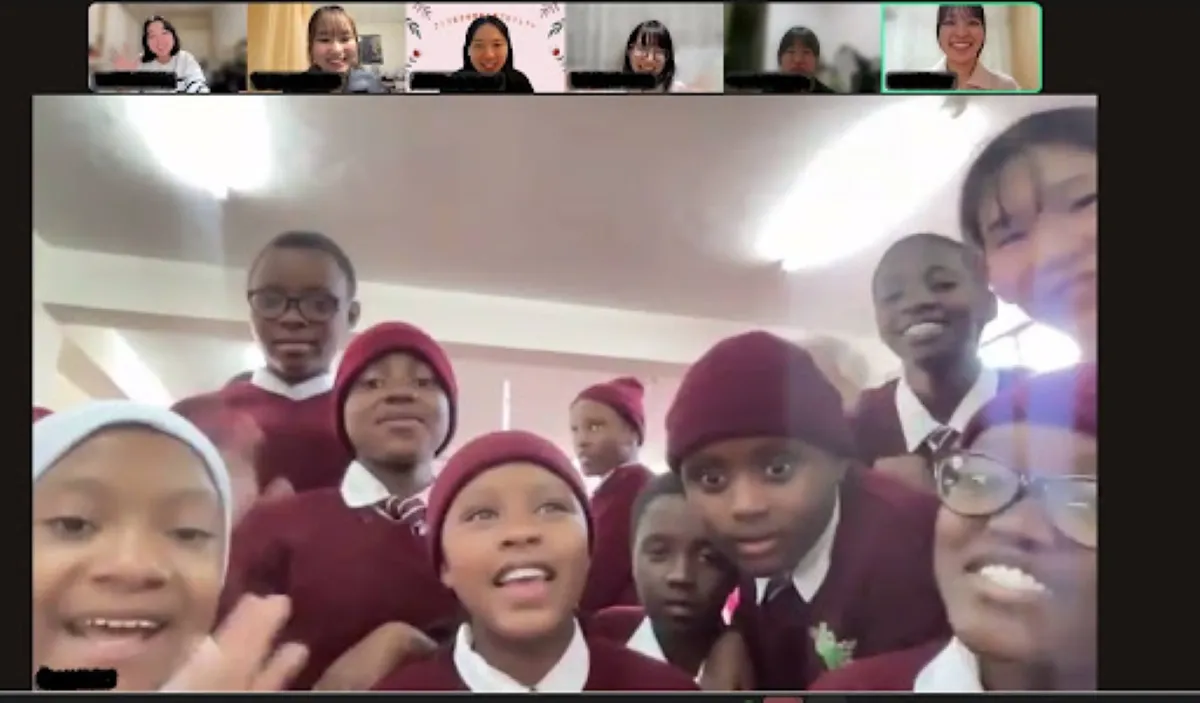
There is one activity that has left a particularly strong impression on us. In the Online Japanese Culture Class, we decide on a theme in advance and give presentations based on that day’s theme. The purpose of this activity is to discover new things through differences in culture, as well as to learn about and develop respect for each other’s cultures.
The theme of our most recent class was “School Uniforms and Fashion.” When we introduced sailor-style school uniforms, stylish denim clothes, and sparkling accessories, the girls listened to us with bright, excited eyes. At the same time, we were also interested in traditional Tanzanian hairstyles and clothes made from fabrics with bright colors and patterns. Although our countries and cultures are different, we found that we share an interest in hairstyles and fashion. As girls of the same generation, this generated a sense of closeness with each other.

After both sides had finished their presentations, something unforgettable happened. The girls surprised us by singing a song for us.
Sakura, sakura, ima sakihokoru
(Cherry blossoms, cherry blossoms,
now in glorious full bloom)
This is the famous Japanese song Sakura. The melody is deeply etched in our hearts. The girls sang the Japanese lyrics fluently and with great feeling, and we could tell that they had practiced hard for us. Tears welled up unexpectedly. Even though we live far apart, we were reminded once again, through this gift of song, that we care about and value each other.


Passion Becomes the Power to Inspire Others.
Participating in TICAD (Tokyo International Conference on African Development) as part of our project activities inspired us to deepen connections with those who provide support. TICAD provided a valuable opportunity to interact with ministers and education officials from African countries, Japan’s Minister of Education, as well as companies and organizations engaged in African development and educational support. Through this experience, we were able to directly share our activities and the significance of the Sakura Girls Junior High School project with many people. We were surprised to find ourselves confidently explaining our work to leaders at the forefront of their respective fields. At the same time, we realized how much we had grown through this project. We had come to love the project and had developed the confidence to speak about its value in our own words.

In addition, we were deeply inspired by the passion of those tackling educational challenges on a global scale. We also realized that when people with the same goals work together, they can overcome even difficult challenges and create positive change. By sharing our activities, we hope to encourage more people to view educational inequality as a personal issue and to spark the development of the capacity to care about others, even those far away.

New Cafe Collaboration
The SGSS Project remains relatively little known among students at Showa Women’s University. To raise awareness of girls’ education in Tanzania and the students studying at SGSS, the project collaborated with CAFE3, an on-campus cafe, to launch a special initiative.

Previously, the SGSS Project raised funds and sold goods sourced from Tanzania at off-campus markets and university festivals. Seeking to bring Tanzania and the issue of girls’ education closer to fellow students at Showa Women’s University, the project spent approximately a year planning this on-campus collaboration.

During the initiative, CAFE3 was decorated with kitenge, a traditional East African fabric widely used in Tanzania, including as table coverings and decorative accents. Tingatinga paintings and photographs of students at SGSS were also displayed, transforming the familiar campus cafe into a space where visitors could experience Tanzanian culture and feel a closer connection to the students of SGSS.
The exhibition was further enriched by items generously loaned by the Embassy of Tanzania in Japan and a representative based at Sakura Girls Secondary School in Tanzania. This allowed the project to create a more comprehensive display.


Hands-On Workshop
The project also organized hands-on workshops where participants created accessories using kitenge, including fabric-covered button hair ties, ribbon clips, and heart-shaped mini cushions. Other activities included the sale of goods sourced from Tanzania, a special collaboration drink called “SAKURA LEMONADE,” and an interactive project inviting visitors to write messages of support on a white tablecloth.
Rather than simply asking students to support the cause, the initiative sought to spark interest in Tanzania and girls’ education through approachable and engaging experiences — from colorful fabrics and charming handmade goods to the joy of creating something by hand.

One of the key messages of this initiative is that getting involved in international cooperation does not have to be difficult or intimidating.
“That’s cute.” “I’d like to make one.” “I wonder where this fabric comes from.”
Such simple moments of curiosity can become an opportunity to learn about girls studying thousands of kilometers away in Tanzania. Everyday actions, such as purchasing an item or taking part in a workshop, can also become a way of supporting girls’ education.
By expanding its activities from markets to an on-campus cafe, the SGSS Support Project gained a valuable opportunity to reflect on the importance of not only increasing the number of people who actively support its mission, but also creating opportunities for people to first learn about it. The initiative also encouraged us to consider the forms of international cooperation that university students themselves can pursue.
Your Actions Become Someone’s Light
Through our activities with the SGSS project, we have come to see educational inequality not as someone else’s issue, but as a personal issue. Furthermore, witnessing the Tanzanian students’ enthusiastic approach to learning, their vibrant school lives, and the earnest gazes of Tanzanian students sharing their dreams has reaffirmed for us just how much education can bring radiance to a person’s life. We are happy to support them as they pursue their dreams and become a light to the world.
Through educational support, we will continue to serve as a bridge between Tanzania and Japan, learning together with children while striving to achieve Universal education for the future.
Asante sana! 🥰


Follow the SGSS Project
Thank you to our partners, Daihatsutokyo Sales Corp, THE SEIBU SHINKIN BANK, Group Kilimanjaro Inc, and Marsh & McLennan Companies, Inc, for their support and advice.
To learn more about the Japan Showa Women’s University Sakura project or to help support girls’ education at the school, please follow the project on Instagram, see the Sakura Vision website, and join Sakura Girls Secondary School YouTube.
Read the Series:
Authors: Honoka Inui and Yuki Mogami
Showa Women’s University students and members of the SGSS Project
このページを
で読む