Landlords trade midnight repair calls for rental income, but there is a way to collect the checks without ever owning a pipe, a tenant, or a water heater that dies on a Sunday night.
This post may contain links from our sponsors and affiliates, and Flywheel Publishing may receive compensation for actions taken through them.
It’s 11 p.m. on a Sunday. Your tenant is texting you a photo of a puddle. Again. If you got into the rental property business for passive income and instead inherited a second job as an on-call plumber, three exchange-traded funds let you keep the rent checks and hand the repairs to somebody else: the Vanguard Real Estate ETF (NYSEARCA:VNQ), the iShares Global REIT ETF (NYSEARCA:REET), and the Real Estate Select Sector SPDR Fund (NYSEARCA:XLRE). Together they give you rental-style income sourced from apartments, warehouses, data centers, cell towers, and hospitals, without a single midnight call.
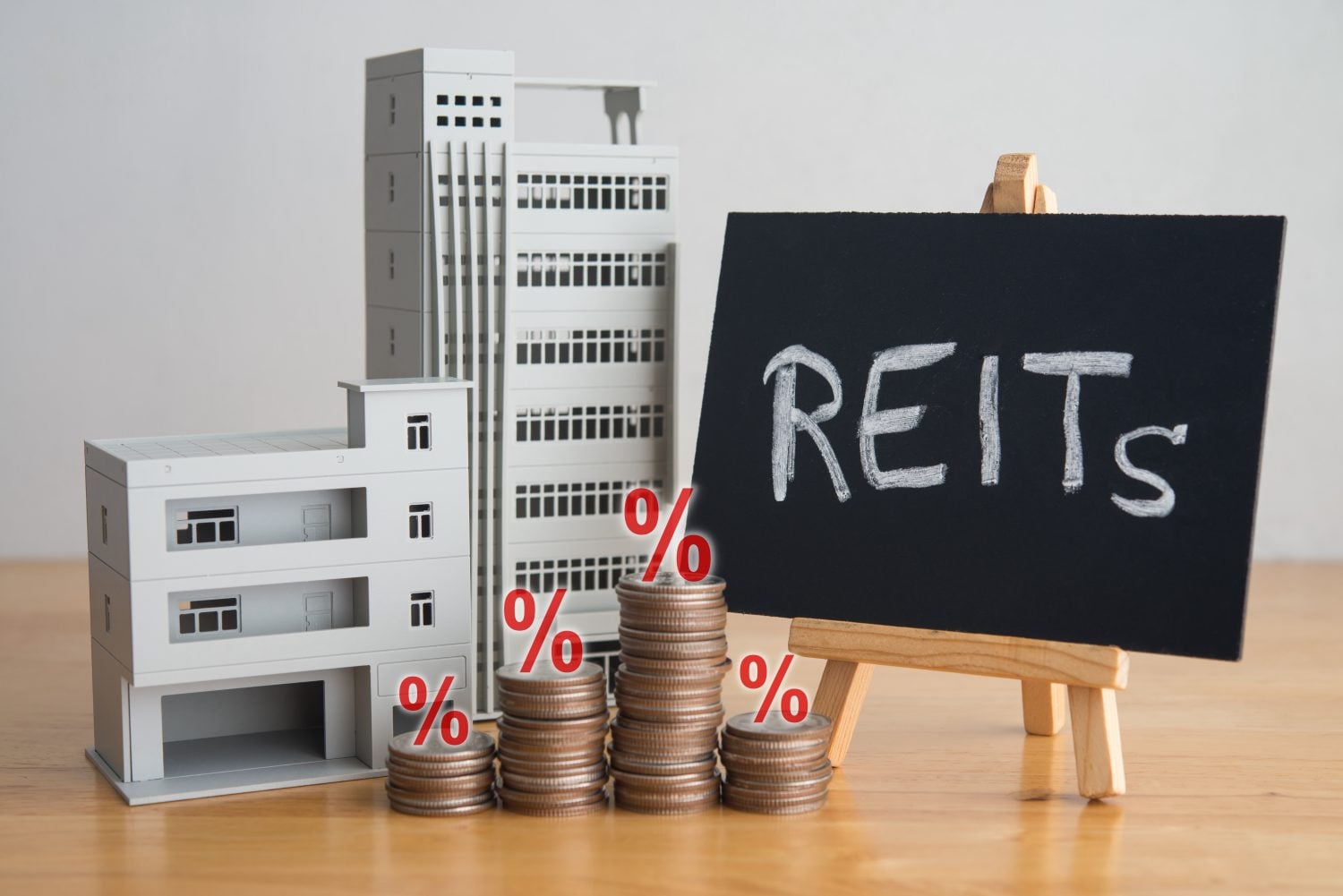
Owning a duplex is active work. A REIT fund is genuinely passive. Real estate investment trusts must distribute most of their taxable income to shareholders, which is why these three ETFs throw off quarterly cash the way your rental throws off headaches. Here is how each one fits a landlord who wants out of the physical business.
VNQ: The Core U.S. Landlord Position
VNQ is the biggest/broadest way to own American commercial real estate in one ticker. Vanguard charges a 0.13% expense ratio, meaning roughly $9,987 of every $10,000 you invest stays working for you each year. It pays quarterly distributions, and the trailing 12-month payout came to $3.4732 per share. Against a recent price of $97.65, that is a rental-like cash yield without the vacancy risk of a single unit.
Returns have followed real estate’s typical rhythm: solid, income-driven, occasionally lumpy. VNQ is up 12.56% year to date and 10.32% over the past year, with a 62.9% ten-year price gain before distributions. If you want one fund to replace the rental portfolio, this is the anchor.
REET: Rent Checks From 20-Plus Countries
REET takes the same idea and stretches it across the globe. Alongside U.S. names like AvalonBay Communities and American Homes 4 Rent, you get landlords in Australia, Japan, the U.K., Singapore, Canada, and beyond. The iShares fact filing lists roughly $4.79 billion in net assets, with heavyweights like Welltower at 8.32%, Prologis at 7.33%, and Goodman Group at 2.39%.
For a landlord whose entire net worth currently sits within one ZIP code, that geographic spread is the point. REET pays quarterly, distributing $0.928632 per share over the trailing 12 months on a $27.89 share price. Payments are lumpy quarter to quarter because foreign REITs distribute on their own schedules. Recently, it has led the three funds discussed here, up 13.11% year to date and 13.39% over the past year.
XLRE: The Cheapest Ticket to Big-Cap Real Estate
XLRE holds only the real estate names inside the S&P 500 (roughly 30 large-cap REITs) at an expense ratio of 0.08%. That is $8 a year on a $10,000 stake, among the cheapest real estate ETFs you can buy. The concentration is real: Welltower at 10.18%, Prologis at 9.07%, Equinix at 7.11%, and American Tower at 5.96% dominate the fund.
Translation for a landlord: your rent now comes from senior-housing operators, e-commerce warehouses, data centers, and cell towers rather than a single-family home. XLRE pays quarterly, delivered $1.405003 per share over the last 12 months on a $44.66 share price, and posted an 87.92% ten-year gain, the strongest price appreciation of the three.
Trade-Offs You Should Know
REIT distributions are taxed at your ordinary income rate, similar to the rental income you already report on Schedule E, rather than at the qualified dividend rate. If you hold VNQ, REET, or XLRE in a taxable brokerage account, the IRS treatment will feel familiar, and it will not qualify for the lower 15% or 20% dividend rate. The workaround is straightforward: hold them inside an IRA or Roth where the distributions compound without an annual tax bill. All three funds are also correlated with interest rates and can drop together, as the 3.24% one-month pullback in VNQ shows. Diversification across property types, not just tickers, is why owning the trio, or a combination, beats picking one and calling it done (we sketched a full plan for turning a mid-six-figure balance into $1,500 a month of income in a free report here). What you gain is the part of being a landlord that pays: recurring income, without the pipes.
Contact [email protected] for any questions or corrections.