Blumenshine, P., Egerter, S., Barclay, C. J., Cubbin, C. & Braveman, P. A. Socioeconomic disparities in adverse birth outcomes: A systematic review. Am. J. Prev. Med. 39, 263–272 (2010).
Herzberg, M. P. & Smyser, C. D. Prenatal social determinants of health: Narrative review of maternal environments and neonatal brain development. Pediatr. Res. 96, 1417–1428 (2024).
Grobman, W. A. et al. Social determinants of health and obstetric outcomes: A report and recommendations of the workshop of the society for maternal-fetal medicine. Am. J. Obstet. Gynecol. 230, B2–b16 (2024).
Gavin, A. R., Nurius, P. & Logan-Greene, P. Mediators of adverse birth outcomes among socially disadvantaged women. J. Women’s. Health (Larchmt.) 21, 634–642 (2012).
Bole, A., Bernstein, A. & White, M. J. Council on environmental health and climate change,section on minority health, equity, and inclusion; The Built Environment and Pediatric Health. Pediatrics 153, e2023064773 (2024).
Matoba, N., Collins, J. W. & Dizon, M. L. V. Fetal origins of health disparities: Transgenerational consequences of racism. Dev. Neurosci. 46, 112–118 (2024).
Barker, D. J. Fetal origins of coronary heart disease. BMJ 311, 171–174 (1995).
King, S. E. et al. Prenatal maternal stress in rats alters the epigenetic and transcriptomic landscape of the maternal-fetal interface across four generations. Commun. Biol. 8, 38 (2025).
Cao-Lei, L. et al. Prenatal stress and epigenetics. Neurosci. Biobehav Rev. 117, 198–210 (2020).
Palma-Gudiel, H., Córdova-Palomera, A., Eixarch, E., Deuschle, M. & Fañanás, L. Maternal psychosocial stress during pregnancy alters the epigenetic signature of the glucocorticoid receptor gene promoter in their offspring: A meta-analysis. Epigenetics 10, 893–902 (2015).
Klerk, D. H. et al. DNA methylation of Tlr4, Vegfa, and Defa5 is associated with necrotizing enterocolitis in preterm infants. Front Pediatr. 9, 630817 (2021).
Dieckmann, L. & Czamara, D. Epigenetics of prenatal stress in humans: The current research landscape. Clin. Epigenetics 16, 20 (2024).
Vincer, M. J., Allen, A. C., Allen, V. M., Baskett, T. F. & O’Connell, C. M. Trends in the prevalence of cerebral palsy among very preterm infants (<31 weeks’ gestational age). Paediatr. Child Health 19, 185–189 (2014).
Ferrer, L., Chambers, C., Katheria, A., Nguyen, A. & Bandoli, G. Prenatal homelessness, food insecurity, and unemployment and adverse infant outcomes in a California cohort, 2007–2020. J. Perinatol. 45, 1528–1534 (2025).
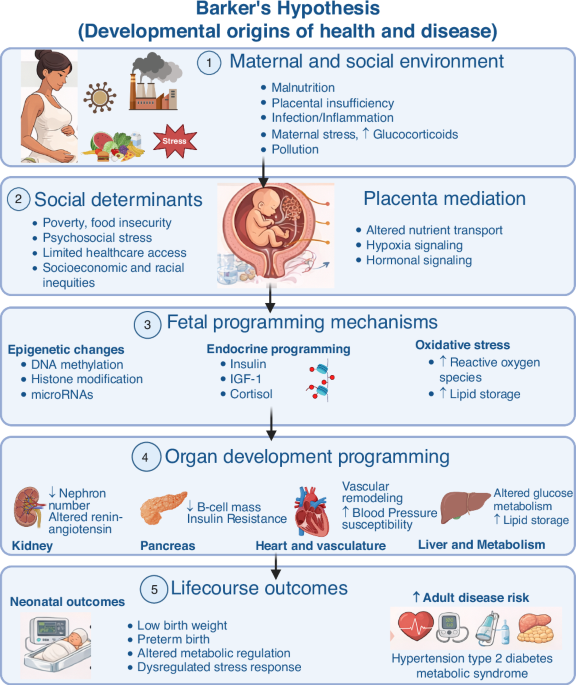
Faa, G. et al. The fascinating theory of fetal programming of adult diseases: A review of the fundamentals of the barker hypothesis. J. Public Health Res. 13, 22799036241226817 (2024).
Collins, J. W. Jr., Wu, S. Y. & David, R. J. Differing intergenerational birth weights among the descendants of Us-Born and Foreign-Born Whites and African Americans in Illinois. Am. J. Epidemiol. 155, 210–216 (2002).
Coutinho, R., David, R. J. & Collins, J. W. Jr. Relation of parental birth weights to infant birth weight among African Americans and Whites in Illinois: A transgenerational study. Am. J. Epidemiol. 146, 804–809 (1997).
Wheelock, M. D. et al. Altered functional network connectivity relates to motor development in children born very preterm. Neuroimage 183, 574–583 (2018).
Brumbaugh, J. E. et al. Early-life outcomes in relation to social determinants of health for children born extremely preterm. J. Pediatr. 259, 113443 (2023).
Krieger, N. et al. Structural racism, historical redlining, and risk of preterm birth in New York City, 2013-2017. Am. J. Public Health 110, 1046–1053 (2020).
Gao, X. et al. Historical redlining, contemporary gentrification, and severe maternal morbidity in California, 2005–2018. JAMA Netw. Open 7, e2429428 (2024).
Kraus, N. T., Connor, S., Shoda, K., Moore, S. E. & Irani, E. Historic redlining and health outcomes: A systematic review. Public Health Nurs. 41, 287–296 (2024).
Nardone, A. L. et al. Associations between historical redlining and birth outcomes from 2006 through 2015 in California. PLoS One 15, e0237241 (2020).
Cook, K. M. et al. Greater neighborhood disadvantage is associated with alterations in fetal functional brain network structure. J. Pediatr. 274, 114201 (2024).
Cook, K. M. et al. Prenatal experience of greater neighborhood disadvantage is associated with altered fetal volumetric brain growth in utero. Cereb Cortex 36, bhag017 (2026).
Abarca-Castro, E. A. et al. Fetal development and the air pollution exposome: an integrative perspective of health pathways. Front Cell Neurosci. 19, 1688437 (2025).
Kral, T. R. A. et al. Intergenerational effects of racism on amygdala and hippocampus resting state functional connectivity. Sci. Rep. 14, 17034 (2024).
Nielsen, A. N. et al. Prenatal social disadvantage is associated with alterations in functional networks at birth. Proc. Natl. Acad. Sci. USA 121, e2405448121 (2024).
Salzwedel, A. P. et al. Prenatal drug exposure affects neonatal brain functional connectivity. J. Neurosci. 35, 5860–5869 (2015).
Demirci, G. M. et al. Superstorm sandy exposure in utero is associated with neurobehavioral phenotypes and brain structure alterations in childhood: A machine learning approach. Front Neurosci. 17, 1113927 (2023).
Hartjen, B. et al. Associations between infant growth and cognitive development: Insights from EEG functional connectivity and power spectral density. Child Dev. 97, 738–754 (2026).
Wilkinson, C. L., Pierce, L. J., Sideridis, G., Wade, M. & Nelson, C. A. Associations between EEG trajectories, family income, and cognitive abilities over the first two years of life. Dev. Cogn. Neurosci. 61, 101260 (2023).
Troller-Renfree, S. V. et al. The impact of a poverty reduction intervention on infant brain activity. Proc. Natl. Acad. Sci. USA 119, e2115649119 (2022).
Otero, G. A., Pliego-Rivero, F. B., Fernández, T. & Ricardo, J. EEG development in children with sociocultural disadvantages: A follow-up study. Clin. Neurophysiol. 114, 1918–1925 (2003).
Noble, K. G. & Giebler, M. A. The neuroscience of socioeconomic inequality. Curr. Opin. Behav. Sci. 36, 23–28 (2020).
Stevenson, D. K. & Goldworth, A. Ethical considerations in neuroimaging and its impact on decision-making for neonates. Brain Cogn. 50, 449–454 (2002).
Ienca, M. et al. Towards a governance framework for brain data. Neuroethics 15, 20 (2022).
Senier, L., Brown, P., Shostak, S. & Hanna, B. The socio-exposome: Advancing exposure science and environmental justice in a post-genomic era. Environ. Socio 3, 107–121 (2017).
Stingone, J. A. et al. Interdisciplinary data science to advance environmental health research and improve birth outcomes. Environ. Res. 197, 111019 (2021).
Çeri, A., Gültekin, N. D. & Keskin, D. M. Neonatal care in the twenty-first century: Innovations and challenges. World J. Pediatr. 21, 644–651 (2025).
Nelin, T. D., Scott, K. A., Just, A. C. & Burris, H. H. Place-based strategies addressing neighborhood environments to improve perinatal and preterm infant outcomes. Children (Basel) 10, 1646 (2023).
Pies, C., Barr, M., Strouse, C. & Kotelchuck, M. Growing a best babies zone: Lessons learned from the pilot phase of a multi-sector, place-based initiative to reduce infant mortality. Matern Child Health J. 20, 968–973 (2016).
MacIver, L. et al. West Oakland’s experience in building community power to confront environmental injustice through California’s Assembly Bill 617. Am. J. Public Health 112, 262–270 (2022).
Jindal, M. et al. Policy solutions to eliminate racial and ethnic child health disparities in the USA. Lancet Child Adolesc. Health 8, 159–174 (2024).
Herrera, M. T., Girma, B., Ghassabian, A. & Trasande, L. Environmental racism and child health. Acad. Pediatr. 24, S167–s172 (2024).
Qattea, I. et al. Disparities in neonatal mortalities in the United States. Children (Basel) 10, 1386 (2023).
Barfield, W. D., Cox, S. & Henderson, Z. T. Disparities in neonatal intensive care: Context matters. Pediatrics 144, e20191688 (2019).
Ji, X. et al. Insights into the chemical exposome during pregnancy: A non-targeted analysis of preterm and term births. Environ. Sci. Technol. 58, 20883–20893 (2024).
Eguchi, A., Sakurai, K., Yamamoto, M. & Mori, C. Elucidation of endogenous and exogenous chemicals in maternal serum using high-resolution mass spectrometry. Ecotoxicol. Environ. Saf. 286, 117256 (2024).
Lin, E. T. et al. Cord blood adductomics reveals oxidative stress exposure pathways of bronchopulmonary dysplasia. Antioxidants (Basel) 13, 494 (2024).
Millen, J. L. et al. Alterations in the placental proteome in association with the presence of black carbon particles: A discovery study. Environ. Res. 263, 120214 (2024).
Smith, G. B. et al. Parental perceptions of early childhood in-home research with monitoring: A qualitative study. J. Pediatr. 278, 114437 (2025).
Alim, A. & Imtiaz, M. H. Wearable sensors for the monitoring of maternal health-a systematic review. Sensors (Basel) 23, 2411 (2023).
Lang, Q. et al. Association of joint exposure to organophosphorus flame retardants and phthalate acid esters with gestational diabetes mellitus: A nested case-control study. BMC Pregnancy Childbirth 24, 736 (2024).
Hu, C. Y. et al. Windows of susceptibility and joint effects of prenatal and postnatal ambient air pollution and temperature exposure on asthma and wheeze in Mexican children. Environ. Int. 193, 109122 (2024).
Fang, Y. et al. Adverse impact of phthalate and polycyclic aromatic hydrocarbon mixtures on birth outcomes: A metabolome exposome-wide association study. Environ. Pollut. 357, 124460 (2024).
Lautarescu, A., Bonthrone, A. F., Bos, B., Barratt, B. & Counsell, S. J. Advances in fetal and neonatal neuroimaging and everyday exposures. Pediatr. Res. 96, 1404–1416 (2024).
England-Mason, G. et al. Using machine learning to investigate the influence of the prenatal chemical exposome on neurodevelopment of young children. Neurotoxicology 108, 218–230 (2025).