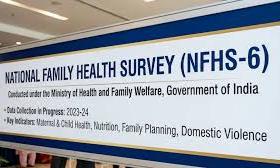
India’s recently released National Family Health Survey (NFHS-6) factsheets, covering nearly 679,000 households across 715 districts, give us an insight into the largest pillar of the global Demographic and Health Survey (DHS) network. Read closely, they also offer an important lesson in how the development sector can move past isolated metrics. For donors and ministries across the 90 countries running similar frameworks, the survey offers a playbook; for planners working on India, it offers an immediate operational guide.
The lesson has become more urgent since the Trump administration dismantled USAID in early 2025. The loss of US funding in February left surveys mid-cycle across much of Africa and South Asia without their principal funder.
The NFHS-6 experience yields two sets of lessons. The first is practical, for analysts and planners: how to synthesise data within and across a large survey. The second is structural, for governments and donors: how to redesign the survey model itself so it can survive the loss of a dominant funder and serve local priorities better.
For decades, the sector has treated large health surveys as standalone report cards. Funds are allocated separately for different health silos, creating programmatic blind spots when fragmented metrics do not match the interconnected realities on the ground. International statistical bodies, from the United Nations Statistics Division to the PARIS21 Secretariat, are increasingly positioning household surveys as core nodes within unified data ecosystems. Colombia has gone furthest in that direction with its Sisbén system. Originally built as a periodic survey to identify social beneficiaries, it evolved into a dynamic social registry. By linking baseline data to live administrative records — across areas such as health, education, employment and tax — eligibility updates dynamically as household circumstances change.
That is the direction the NFHS points towards: a baseline continuously enriched by other public datasets.
Yet for many practitioners tasked with field interventions across large populations, cross-referencing information streams remains a challenge. Overcoming that barrier does not necessarily require a background in analytics. It requires real-world examples of how synthesis is done.
The NFHS-6 offers two key insights. The first is internal: linking variables across the survey’s four core modules (Household, Woman, Man and Biomarker) rather than treating each as a separate piece. The NFHS-6 factsheet for Andhra Pradesh, for example, records female internet usage rising from 21.0% to 63.6% alongside adult female overweight and obesity rising from 36.3% to 47.9%. Cross-referencing these indicators lets planners direct targeted, app-based health alerts to devices already in women’s hands. A similar dynamic plays out in child nutrition, where mapping the mother-child dyad confirms that keeping a girl in school builds health literacy for future generations, framing the classroom as a long-term line of defence against chronic stunting.
Consider also hospital childbirths. With institutional deliveries rising to 90.6% in NFHS-6, closing the remaining gap requires more than adding clinic beds; a health centre can be fully stocked yet empty of patients if the local model ignores local realities. Linking health outcomes with domestic autonomy and safety helps pinpoint the underlying barrier. Planners can distinguish geographic exclusion from household gender constraints, shifting the approach from blanket infrastructure to precision interventions.
The second technique is external: layering specialised datasets over a streamlined baseline. To many experts, the thinner NFHS-6 factsheet feels like it might have dangerous informational gaps. By compressing the framework to 101 core indicators from the 131 tracked in NFHS-5, the survey dropped nearly a quarter of its standard metrics. That anxiety stems from an outdated mindset that expects a single survey to carry the entire weight of national sector planning.
The finger-prick blood method for anaemia was dropped due to accuracy concerns. However, planners can rebuild this picture by overlaying NFHS-6 district metrics on iron-folic acid distribution with venous biomarker data from the ICMR’s upcoming Diet and Biomarkers Survey. To avoid duplicating state records, NFHS-6 omitted the child sex ratio at birth; planners can fill this gap by blending survey baselines with facility-level registries from the Ministry of Health’s Health Management Information System (HMIS), accessed through standard government data-sharing channels. Missing household sanitation metrics can be reconstructed using consumption and health data from the Ministry of Statistics and Programme Implementation. Mapping living-standard deficits alongside health trends produces much clearer vulnerability maps.
However, such layering needs to be handled with care. Data triangulation becomes dangerous when the different speeds at which datasets move are ignored. As recent research on urban planning metrics highlights, overlaying rapid monthly or daily trackers onto sluggish, decadal baseline surveys distorts the strategic picture. If these lifecycles are not harmonised, an integrated view risks masking actual vulnerabilities on the ground.
Internal linking and external layering are techniques an analyst can apply to whatever survey lands on the desk. But their value depends on the survey continuing to exist and continuing to ask the right questions. That is where the NFHS story turns from a manual for planners into a template for the governments and donors that commission surveys. Three shifts in how the NFHS has evolved carry lessons for international stakeholders navigating the Sustainable Development Goals (SDGs).
The first is from international financial dependency to domestic ownership. The global DHS model has long relied on project-based international funding, dominated by USAID at roughly US$47 million a year. When USAID was dismantled, active DHS surveys dropped from 25 to 15 within weeks. This caused cascading disruptions to censuses and health management systems that local ministries rely on. Today, the program continues at a reduced level with stabilisation funding from the Gates Foundation.
India illustrates the alternative: early NFHS rounds were heavily subsidised, but NFHS-6 achieved almost total domestic funding, and the survey has continued uninterrupted while others stalled. Donors should pivot from funding individual survey cycles to helping national governments build permanent statistical budget lines, transforming survey data into a foundational public good.
The second is streamlining in favour of local focus. Many developing nations suffer from survey fatigue, cramming questionnaires to satisfy external donor interests. India’s pruning to 101 core indicators shows that less can be more. By removing metrics better captured via routine administrative data, countries can reduce field fatigue, cut overhead costs and secure the district-level depth needed for sharper local execution.
The third is a move from data standardisation to data customisation. The global DHS architecture prefers rigid cross-country standardisation to facilitate benchmarking. However, forcing diverse economies through the same lens limits local utility. Developing nations should adopt a core-and-globe framework: customising the overall structure to domestic priorities while keeping a select set of parameters aligned with global guidelines for international benchmarking.
Development surveys have long been treated as reporting exercises: periodic snapshots that measure progress and then disappear into archives. They should instead be viewed as public data infrastructure, designed not only to measure reality but to connect it. Better policies emerge when the links between social realities become as visible as the indicators themselves.