Key takeaways:
- The demand for mental health apps is rapidly increasing due to accessibility needs, employer wellness initiatives, and growing public awareness.
- There’s a wide range of app ideas to explore, including AI-guided self-therapy, wearable-integrated stress monitoring, AR-based mindfulness, peer support communities, and workplace burnout prevention.
- Personalization, privacy, and evidence-based features are essential for user engagement and building trust in mental health apps.
- Prioritizing user experience, security, and regulatory compliance is crucial for long-term credibility and success.
- Regular updates and user feedback help your mental health app stay effective and relevant in a fast-evolving market.
Over the past few years, mental health has moved from the margins to the center of public discourse, with mental health app ideas gaining strong attention from stakeholders. Investment in digital solutions has expanded to healthcare providers, investors, and technology firms to increase access to care and develop scalable support systems.
The after-effects of the pandemic, along with changing work and lifestyle patterns, have added to everyday stress levels. Though the level of awareness has gone up, the long-term effects of mental health conditions are yet to be tackled in most parts of the world.
According to the statistics provided by the Anxiety and Depression Association of America, about 40 million adults in the U.S. develop anxiety disorders annually. It also mentions that the percentage of adolescents with anxiety disorders is significant enough, indicating the early development of the disorders and the necessity of early treatment.
With this disparity, the need for digital solutions to mental health is on the rise. The global market for mental health apps is projected to grow to $17.52 billion in 2030, indicating stable investment and uptake across different regions (Source: GVR).
These trends indicate a clear shift toward digital-first mental health, with accessibility and support as top priorities.
In this blog, we are enumerating the various mental health app concepts that you can draw inspiration from to start a business. But, before that, let’s see why it is crucial to make an investment in mental health app development. Let’s begin!
Millions still lack access to timely mental health support
Address this gap with solutions that extend care beyond traditional settings and improve reach.
Why Invest in a Mental Health App?
Mental health app development provide benefits to both patients and healthcare professionals. While patients get timely care even in remote areas, doctors and therapists can reach more patients in less time. Moreover, mobile apps make it easier to obtain data, speed up decision-making and allow doctors to reach more patients in less time.
On that note, we have listed a few benefits of starting a mental health business.
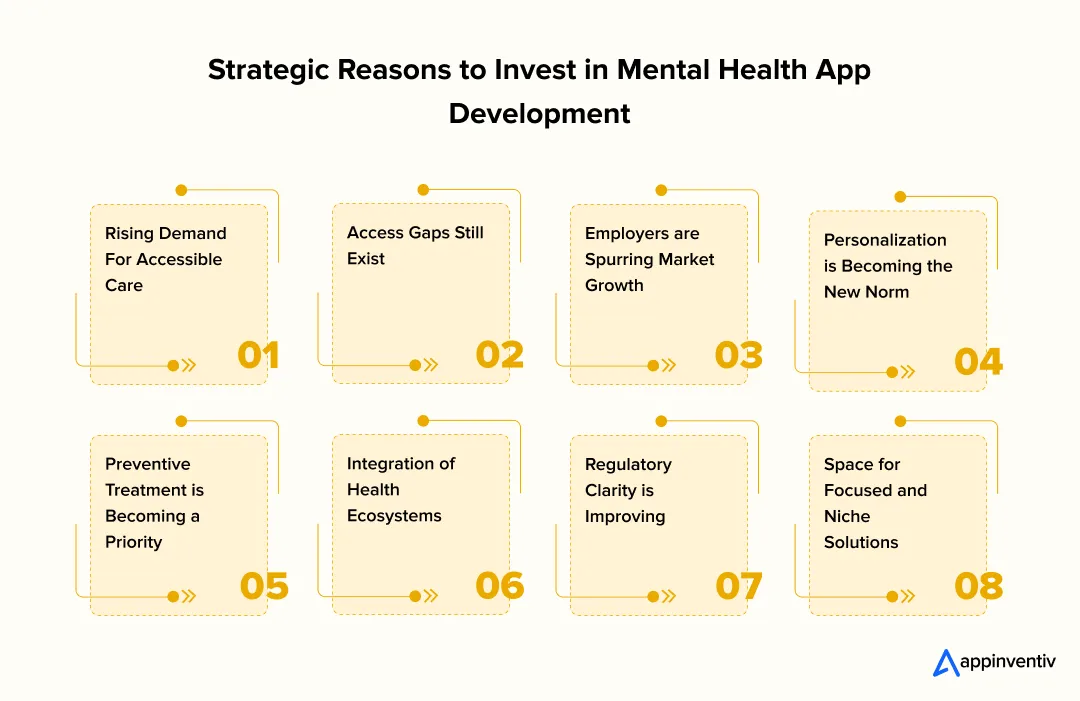
Rising Demand For Accessible Care
Mental health assistance is not exclusive to therapy or clinical environments. Users are now insisting on technology that can be used in everyday life, and that is constantly supported and checked in on. This change leaves space for mental health app ideas that revolve around continuity and sustained use.
Access Gaps Still Exist
Even well-developed healthcare systems cannot cope with the presence of long queues and unequal access to specialists. Applications are useful in narrowing this divide by providing real-time, systematic assistance devoid of geographical constraints. They act as a continuation of care, particularly in mild or moderate cases.
Employers are Spurring Market Growth
Businesses are now investing in mental health app development to enhance productivity and retention. Employee benefit programs are including digital platforms as a norm. To individuals who are starting a mental health business, this provides easy access through corporate alliances and wellness contracts.
Personalization is Becoming the New Norm
Users demand experiences that mirror their actions, likes, and moods. Current applications modify content, recommendations and interventions in real time using data. This enhances the engagement and increases retention over time.
Preventive Treatment is Becoming a Priority
The trend towards the positive control of stress and mental fitness prior to the development of problems can be observed. Habit-building and mood tracking apps, as well as guided exercises, are suitable for use in this strategy. It makes the product appear as an everyday utility as opposed to a reactive solution.
Integration of Health Ecosystems
Wearable apps, sleep trackers, and telehealth services are becoming more and more integrated with mental health platforms. This will form a clearer picture of user well-being and will assist in more effective interventions. It also enhances the app’s applicability across the wider care system.
Regulatory Clarity is Improving
Guidelines on digital health therapeutics are starting to become more defined. This will give credibility and minimize risk among the developers and investors. It is also an indication that the use of apps in care is going to continue to develop within formal healthcare institutions.
Space for Focused and Niche Solutions
Youth mental health, chronic illness support, and culturally aware care are just some of the aspects of the market that are yet to be penetrated. This opens up avenues to new, innovative ideas for healthcare businesses that provide answers to particular problems in a clear, purposeful manner.
15+ Mental Health Business Ideas For Startups & Entrepreneurs
The mental health app industry is quite diverse. There is a gamut of apps that target different people with various issues and disorders. In this section, we’ll cover the most widespread types of mental health apps. So, let’s begin!
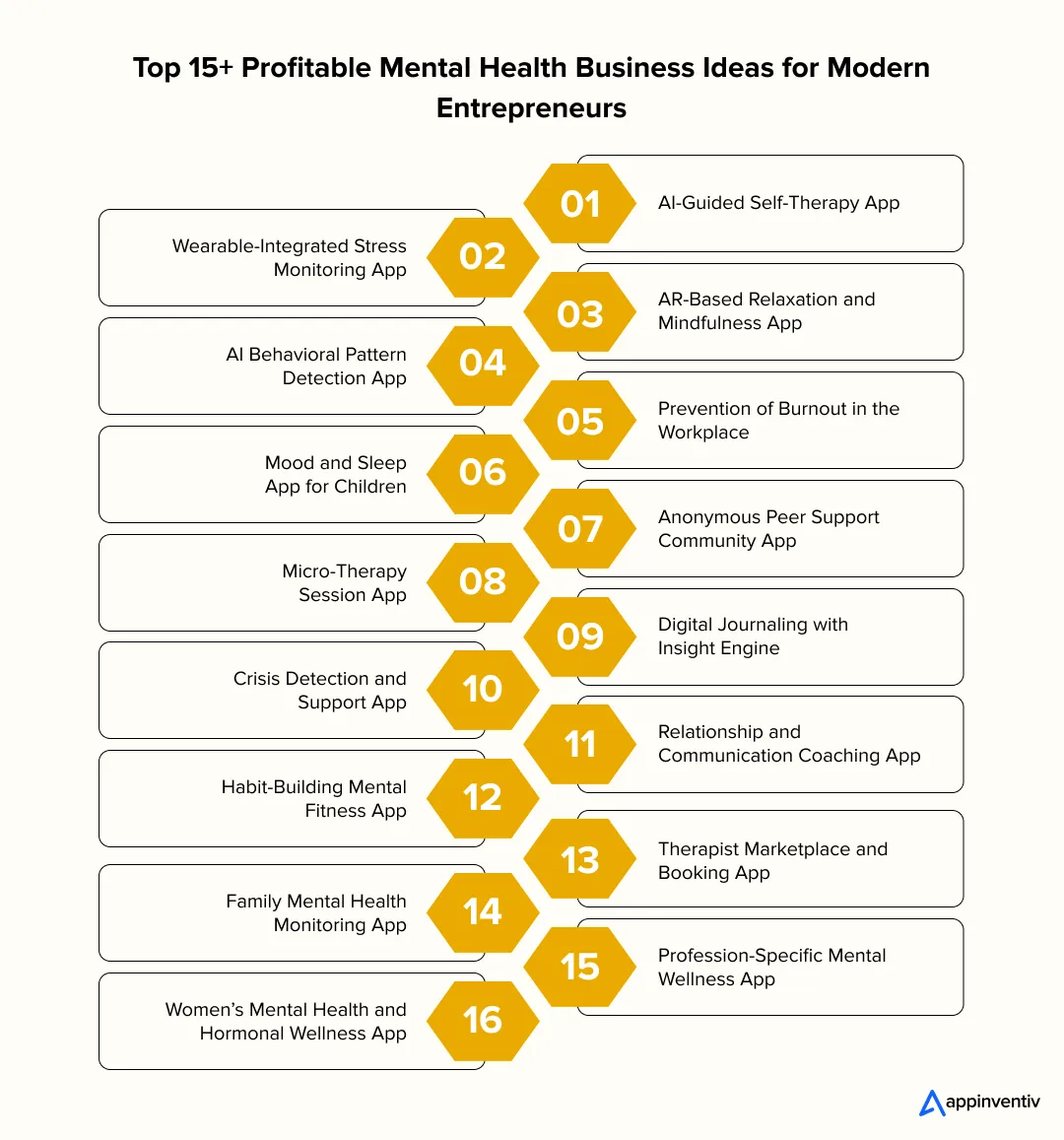
1. AI-Guided Self-Therapy App
This app presents systematic therapy journeys in guided conversations, exercises and reflections. It minimizes the reliance on the ongoing clinician intervention, but adheres to the proven approaches. With time, users develop self-awareness and coping skills.
In the long run, users develop self-knowledge and coping mechanisms. This model is one of the most recent mental health apps on the market that can scale without losing its form. With AI in mental health apps, users can receive personalized therapy recommendations, enhancing adherence and reducing dropouts. The guided path simplifies the process of progress and makes the use long-term. This is especially useful when the user prefers individual, self-service support.
2. Wearable-Integrated Stress Monitoring App
The device is linked to smart objects to monitor heart rate variability, sleep, and movement. It provides early detection of stress patterns and timely interventions like breathing exercises or prompts.
This will change care from preventative to reactive. It aligns well with the emerging AI mental health business ideas of real-time insights. It minimizes the use of manual tracking since data is gathered passively during the day. The alerts are timely, and the users will be able to take action before the stress accumulates. In the long run, the app can customize its recommendations, depending on the individual trends and behavior.
3. VR-Based Relaxation and Mindfulness App
This mental health app uses virtual reality to create relaxing, immersive fields for meditation. The user can transform any area into a guided relaxation space with visual aids and audio support.
It improves the participation of individuals who struggle to employ the conventional meditation methods. The experience is more interactive and abstract. It also assists in minimizing external distractions through the establishment of a concentration space. This facilitates easier engagement and session completion by the users. Using it over time may enhance uniformity in mindfulness activities.
4. AI Behavioral Pattern Detection App
The app analyzes journal entries, voice notes, chats, and interactions with a built-in conversational mental health chatbot to detect negative thinking patterns. It proposes brief CBT-oriented activities tailored to the user’s behavior. In the long run, it develops a feedback loop and enhances emotional awareness.
The idea is a good contender in an AI mental health startup. It enables users to detect the patterns that they would otherwise not notice in real life. The more data is gathered, the more accurate and relevant the insights. This results in a more effective and personalized support system.
5. Prevention of Burnout in the Workplace
This type of mental health app solution is created to track digital activity and engagement indicators in order to identify burnout early on in an enterprise. The app presents brief and formal wellness interruptions and prompts at the workplace.
It is more about prevention and less recovery. It can be associated with the companies that appreciate the well-being of the workforce. The app also provides summarized information to aid organizations in enhancing work patterns. This lessens productivity loss in the long run due to stress and fatigue. The strategy conforms to the increasing corporate interest in employee health.
6. Mood and Sleep App for Children
This application works with games, narratives, and straightforward activities to help children comprehend feelings. It also monitors sleeping habits and develops better routines with relaxing cues. Parents get insights but not too much information. This app bridges an age-specific mental health provision gap.
It makes it easy to learn emotionally in interactive forms that children can easily pursue. The app is also beneficial for developing regular sleep patterns, which are strongly associated with mental health. Safe usage with non-invasive parental controls. This renders it applicable in early emotional development.
7. Anonymous Peer Support Community App
The users will be able to share experiences and get advice without identifying themselves. Discussions can be safe and constructive with moderation and guided prompts. This develops a feeling of trust and makes attending a routine. It is among the more community-centric mental health startup ideas.
It promotes openness through the elimination of barriers related to identity. Moderation will be structured in order to make conversations supportive and relevant. Shared experiences are beneficial to the users and can enhance emotional resilience. This structure allows continual interest.
8. Micro-Therapy Session App
The application provides brief targeted therapy sessions, which target individual problems like anxiety or stress. The sessions will have the ability to accommodate a couple of minutes of daily usage. This facilitates easier maintenance of mental health support. It is effective with those users who like fast, action steps.
It is easy to accommodate busy schedules where a long session is not feasible. It allows one outcome to be followed and accomplished in each session. The concise nature also enhances retention by the user. Such small interventions can result in significant changes over time.
9. Digital Journaling with Insight Engine
The users enter their thoughts and feelings as the system recognizes common themes and triggers. It gives the basic summaries that bring out behavior patterns over time. This makes journaling more of an organized self-reflection tool. It is targeted at users who prefer easy-to-understand information.
It transforms unstructured ideas into valuable information that can be acted on by the users. The summaries are useful to detect common triggers and emotional changes. This enhances the awareness of oneself without necessarily having to analyse. Its ease of use renders it usable by a large group of users.
10. Crisis Detection and Support App
The platform detects high-risk indicators by user input and user behavior. It provides immediate guidance and connects users to helplines or professionals when needed. The aim is to ensure prompt intervention in critical situations. This kind of solution plays an essential role in the larger business ideas in mental health industry.
It is concerned with speed and dependability in times of crisis. The system can escalate support based on urgency and user requirements. It can also be used to minimize the time lag between distress and intervention. This renders it a vital safety-oriented solution.
11. Relationship and Communication Coaching App
This application aims to enhance interpersonal skills through guided scenarios and feedback. It assists users in dealing with conflict, expressing emotions, and developing healthier relationships.
It applies real-life situations to make education more realistic and closer to life. Users can carry these techniques into their daily interactions, both personal and professional. In doing so, the solution addresses a gap in existing tools, which often overlook the need for consistent, real-world communication support.
12. Habit-Building Mental Fitness App
The platform promotes everyday practices like mindfulness, gratitude, and stress management. It has reminders, streaks and progress tracking to keep people engaged. With time, there is a regular habit of mental wellness among users. This model proclaims preventive treatment on a large scale.
It develops regularity through small, repetitive movements. The tracking features encourage users to remain active longer. This decreases reliance on reactive care procedures. In the long run, it promotes long-term mental health.
13. Therapist Marketplace and Booking App
Through the platform, users are able to find, compare and book sessions with therapists all in a single location. The platform simplifies communication and ongoing engagement. It is advantageous to users and practitioners alike in enhancing access/visibility. It is still one of the most feasible mental health app ideas in the market.
It lessens the hassle of seeking professional care. The users are able to make wise decisions depending on availability and specialization. This increases the reach and simplifies the scheduling of practitioners. This enhances efficiency in care provision.
14. Family Mental Health Monitoring App
This app allows families to track shared well-being indicators while maintaining individual privacy. It provides alerts and suggestions when patterns change. The goal is early support within close networks. It is especially useful in caregiving environments.
It strikes a balance between awareness and privacy by sharing data in a controlled manner. Families can respond to behavioral or mood changes early. This reinforces support systems in households. It can be especially applied to long-term care cases.
15. Profession-Specific Mental Wellness App
Designed for high-stress roles such as healthcare workers or remote teams, this app offers tailored guidance. Content is based on real work scenarios and daily pressures. This improves relevance and adoption. It also highlights how diverse the types of mental health apps can be.
It does not provide general advice but deals with issues that are specific to certain professions. This enhances interest and performance. Solutions that are closer to the real environment of the users will be more likely to be adopted. It also opens up the market to specific market segments.
16. Women’s Mental Health and Hormonal Wellness App
The app concentrates on mental health patterns that are connected to the hormonal cycles, life stages, and reproductive health. It monitors mood, energy, sleep, and stress, as well as menstrual or hormonal fluctuations and provides personalized data and expert advice.
It fills a gap in which mental health is typically not linked to biological factors, particularly in women. The app assists users in comprehending trends connected to PMS, postpartum changes, or menopause. Individualized suggestions enhance awareness and early intervention. In the long run, it helps to maintain a more informed self-care and regular mental health.
Wondering which mental health app idea is perfect for you?
Our experts will guide you through your entire app development journey, from ideation to launch!
How to Choose the Right Mental Health App Idea
It is not only about following trends to select the appropriate idea. The mental health space is delicate and controlled, and highly user-oriented and therefore, clarity at the initial levels is important. A clear concept will be simpler to develop, prove and scale without loss of focus, particularly when trying out various mental health app ideas.
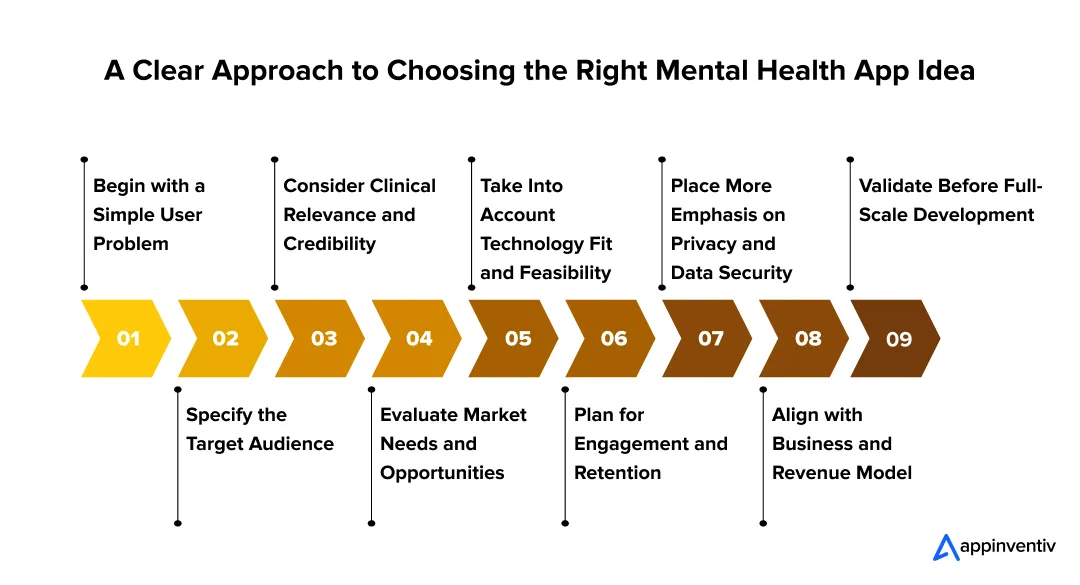
Begin with a Simple User Problem
Start with a specific problem and not a general one. Different approaches are needed for anxiety, sleep disorders, workplace stress, or adolescent mental health. A narrow problem statement assists in the development of mental health app features, content, and user experience. It is also more direct in positioning when considering various app ideas for mental health.
Specify the Target Audience
The needs of mental health differ greatly in relation to the age groups, occupation and illnesses. A teenage application will be very different from one that is created to serve corporate workers or parents. The audience definition aids in the creation of tone, capabilities, and engagement strategies. It also enhances adoption and retention in the long run.
Consider Clinical Relevance and Credibility
Even non-clinical applications ought to be based on accepted frameworks, like CBT or mindfulness exercises. This enhances credibility and makes sure the app has good results. Credibility can be enhanced by consulting the professionals during development. It also assists in aligning with the changing healthcare expectations.
Evaluate Market Needs and Opportunities
Research on mental health app solutions aims to get to know what already exists and what is lacking. Seek unserved niches and not crowded categories. Depth, not breadth, can oftentimes provide differentiation. A significant number of successful mental health startup concepts are based on the solution to a very particular, unmet need.
Take Into Account Technology Fit and Feasibility
Not all ideas will need such developed technologies as AI or AR. Select the tools that can truly enhance the user experience and not complicate it. The idea is to fix the problem, rather than to demonstrate technology. This is particularly concerning when assessing AI mental health business ideas, where excessive reliance on technology may reduce usability.
Plan for Engagement and Retention
Mental health applications require regular usage to be valuable. Long-term engagement can be facilitated by such features as reminders, progress tracking, and personalized content. It must be designed in a manner that promotes frequent usage and does not overwhelm the user. The success of the product is usually determined by retention.
Place More Emphasis on Privacy and Data Security
Mental health apps contain very sensitive information shared by the users. Good healthcare data protection policies are required. A key factor in adoption and continued use is trust. Any watering down in this may impact reputation and compliance.
Align with Business and Revenue Model
Determine at an early stage whether the app will be based on subscription, enterprise relationships, or a free model. The revenue strategy must be in line with the target audience and the value being provided. A vivid model guarantees the long-term sustainability. It also directs product decisions.
Validate Before Full-Scale Development
The concept of testing with a small group of users can determine any gaps early. Real user feedback can be used to enhance features and usability. This eliminates risk prior to making full-scale development. Repetition at this point may yield better results.
How to Build a Mental Health App?
During the development of a mental health application, there must be a balance between product thinking, clinical awareness, and user trust. It is not just a matter of features, but is more about a safe, reliable experience that customers can rely on in the long run. Here are the quick steps on how to start a mental health business:
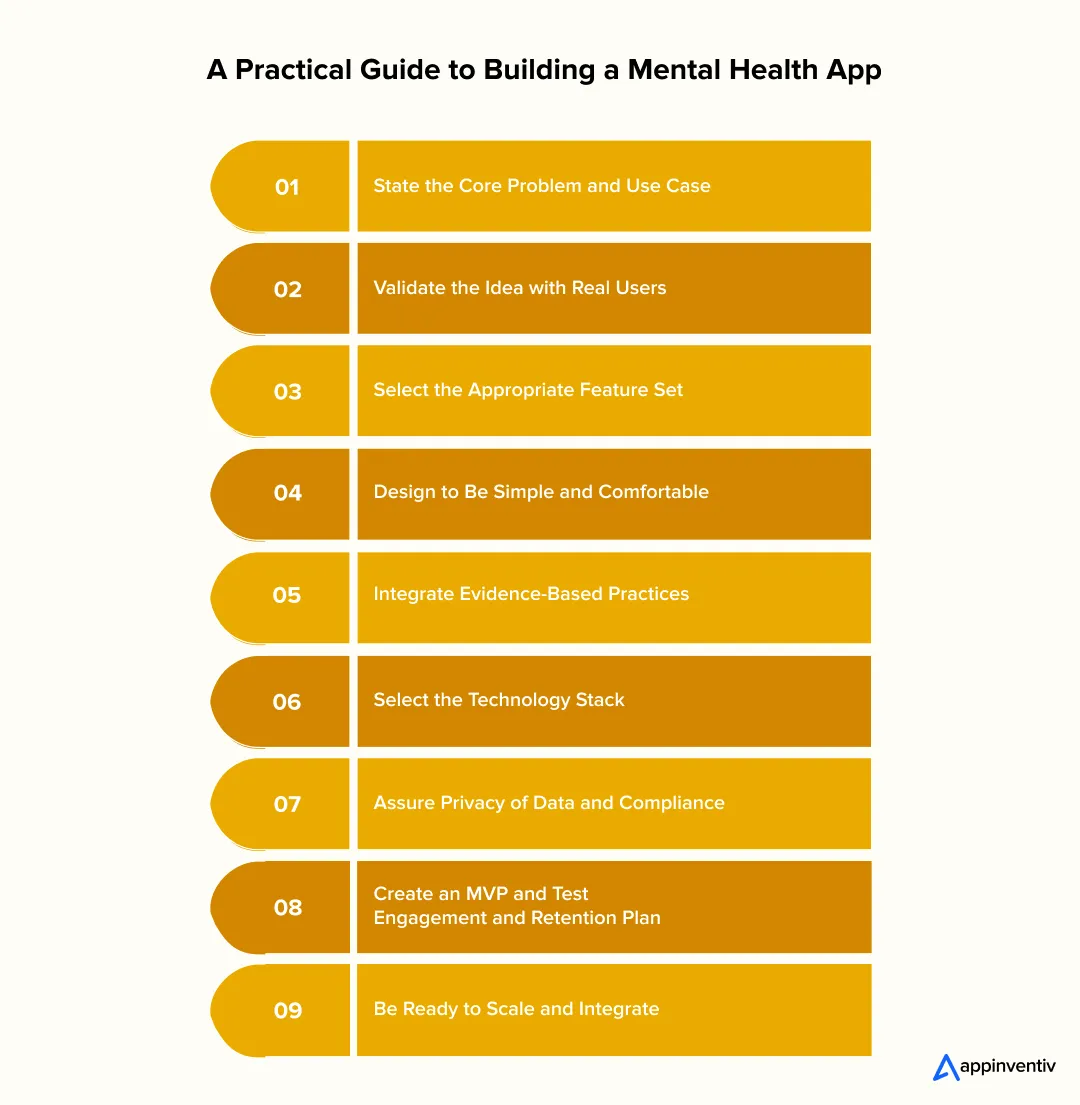
State the Core Problem and Use Case
Begin by defining the problem that the app will address. Do not do general positioning, but concentrate on a specific use case like managing anxiety, improving sleep, or workplace stress. This choice influences all other parts of the product, such as features and design. The scope is also clearly defined, which makes the development more efficient.
Validate the Idea with Real Users
Create a small trial group with the target users before it is fully developed. Attract feedback on usability, relevance and expectations. This step usually assists in narrowing down even the most creative healthcare business ideas into a realistic and user-friendly concept. Validation minimizes the chances of developing features that the users may not need.
Select the Appropriate Feature Set
Pay attention to such important features as mood tracking, guided exercises, journaling or access to the therapist. Do not put many features during the initial stage. Basic and targeted feature set enhances ease of use and expedited development. Other features may be added depending on the response of the users.
Design to Be Simple and Comfortable
The interface is to be intuitive, cozy, and user-friendly. Keep it simple, with no cluttered and complicated flows that can confuse users. Be simple and regular in layouts. The design must facilitate the feeling of safety and comfort, and not be a distraction.
Integrate Evidence-Based Practices
Use proven strategies like cognitive behavioral therapy, mindfulness, or habit-forming strategies. This enhances the functionality of the application and user trust. The quality of the content may be enhanced by working with mental health professionals. It also ensures responsible delivery of support.
Select the Technology Stack
Choose technologies based on the app’s requirements, such as mobile frameworks, backend systems, and data handling tools. In the case of AI or wearable integration, make sure the implementation is meaningful. It should focus on enhancing the user experience rather than making it more complex.
Also Read: Mental Health Technology – Trends & Innovations
Assure Privacy of Data and Compliance
Mental health information is highly confidential, so effective security measures are needed. Use encryption technology, authenticate and keep clear data policies. Adherence to pertinent rules creates credibility. Trust is a critical factor in user adoption and retention.
Create an MVP and Test
Create a basic MVP and launch it to a small group. Track the actions of the users and receive feedback. Apply these understandings to enhance functionality and address problems. Reuse helps develop a better, more efficient product.
Engagement and Retention Plan
Add new functions, including reminders, progress tracker, and recommendations. These assist users to be consistent over time. The idea is to make the app an everyday part of life. Engagement in the long run is essential to the user results and business outcomes.
Be Ready to Scale and Integrate
As the app expands, make sure it can support more users and data. Prepare to integrate with wearables, mental health telemedicine platforms, or other health systems (where necessary). A scalable architecture is favourable to long-term expansion. It also enables the product to evolve in response to user needs.
Top Mental Health Apps and Their Core Real-Life Use Cases
There are several popular mental health apps has made their mark in the global market with innovative features, tech integrations, and a strong focus on user engagement and accessibility. Let’s take a look at a few mental health apps that have impressed users with their innovative features and functionalities.
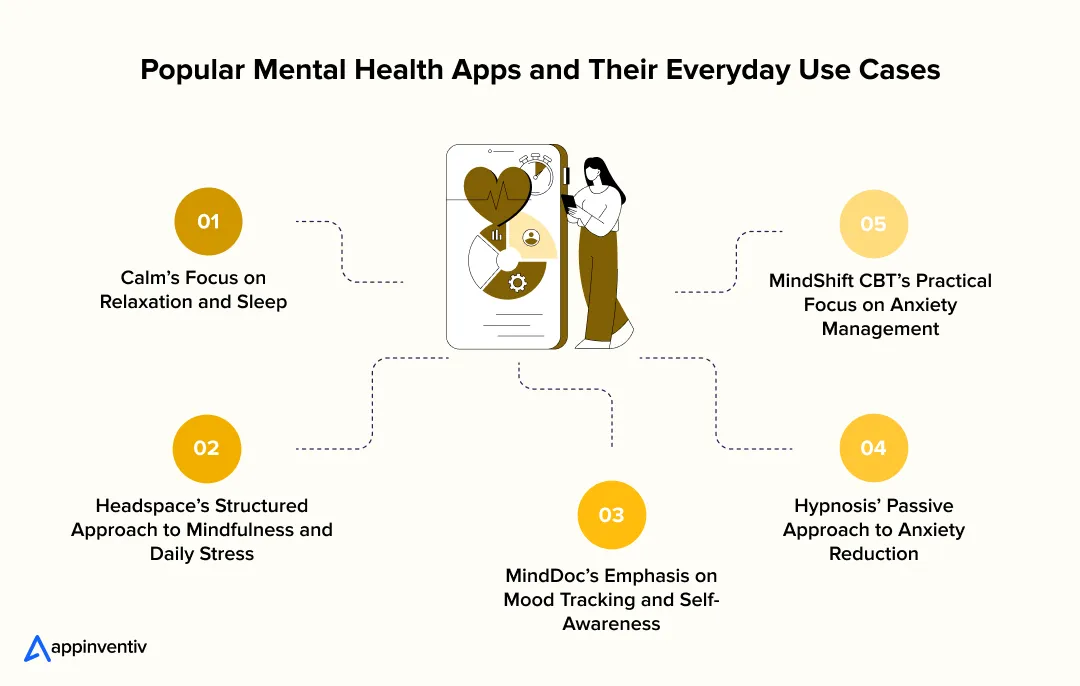
Calm’s Focus on Relaxation and Sleep
Meditation apps like Calm alleviate anxiety and enhance sleep with guided meditations, sleep stories, and calming soundscapes. The app has programs of a couple of minutes and longer programs and is, therefore, accessible to both newcomers and seasoned users.
It has the power to remain focused on rest and recovery instead of venturing into other unrelated businesses. This simplicity enables users to go back to the app as part of a daily practice.
Headspace’s Structured Approach to Mindfulness and Daily Stress
Headspace centers on developing mindfulness practices through meditative programs. It provides guided courses on stress, focus, creativity, and sleep, and theme-based content on various circumstances.
The Headspace app uses a step-by-step process, ensuring consistency among users over the long term. This approach is effective in individuals who would rather be led in learning as opposed to free investigation.
MindDoc’s Emphasis on Mood Tracking and Self-Awareness
MindDoc is based on emotional health monitoring via regular check-ins and prompts. This mood tracking app allows users to record their thoughts and feelings several times a day, and this assists in creating a detailed image over time.
The app subsequently offers mood and behavior insights and patterns. Its emphasis on reflection makes it helpful to users interested in a more in-depth view of their mental condition.
Hypnosis’ Passive Approach to Anxiety Reduction
The app will be useful to users who like relaxation techniques that are low-effort. It provides audio recordings of hypnosis and relaxing background sounds that can be played during rest or sleep.
The experience is not active and thus can be used regularly. It is also unlike more interactive mental health features, such as active listening.
MindShift CBT’s Practical Focus on Anxiety Management
MindShift CBT is designed with the practices of cognitive behavioral therapy to aid in dealing with anxiety. It offers tools and exercises which deal with worry, panic, social anxiety and perfectionism.
The application focuses on real-world techniques, which can be utilized by users. It is particularly effective when applied to individuals seeking practical assistance, as it is structured and technique-focused.
Create a mental health app users rely on every day
Let our experts help you design intuitive experiences and build systems that support long-term engagement and trust.
Turn Your Mental Health App Idea Into a Scalable Product with Appinventiv
The role of mental health applications will continue to expand through 2026 and beyond, supported by advances in data analytics, AI-driven personalization, and closer integration with healthcare systems. The next generation of mental health platforms will go beyond simple tracking to provide a more context-aware assistance based on behavioral patterns, usage cues, and real-time data to inform interventions.
There will be increased focus on privacy, clinical validation, and interoperability, particularly with the increased standards of care required by regulators and healthcare providers.
Meanwhile, the expectations of users will change. Individuals will seek applications that are easy to incorporate into everyday activities, provide a steady level of interaction, and deliver quantifiable results. This will compel developers to give usability, retention strategies, and evidence-based design over feature-heavy builds.
With the maturation of the market, differentiation will be based on an app’s ability to strike a balance between accessibility and clinical relevance.
This is the place where Appinventiv, being a reputable mental health application development company, can assist you. The team collaborates throughout the development process, from refining your idea to defining the architecture and ensuring compliance. It is still about developing solutions that are scalable, secure, and in line with the real healthcare needs, to get you from concept to a product that will work reliably within a competitive environment.
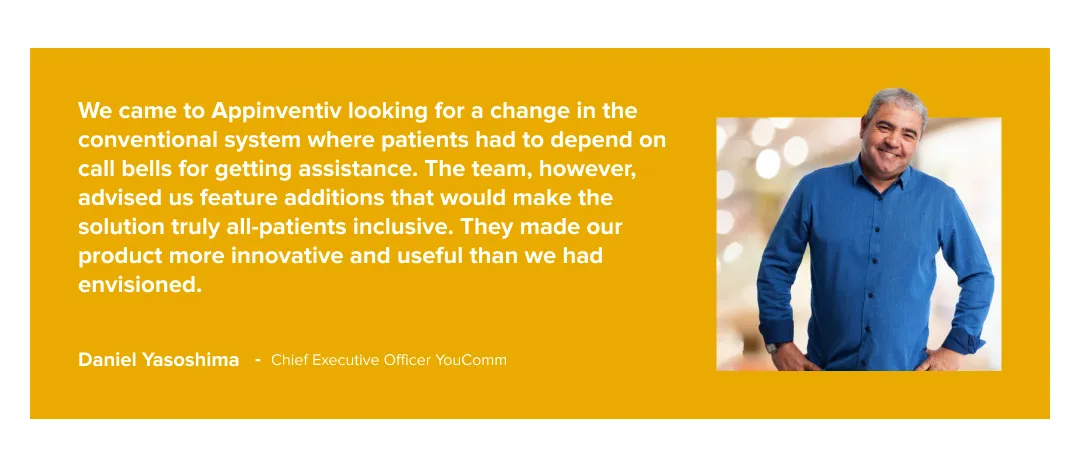
We support you with product strategy, UI/UX design, secure architecture, and end-to-end development, ensuring your mental health app is ready for real-world use and long-term growth. Throughout these years, we have served several clients, including YouComm, Health-e-People, DiabeticU, Soniphi and others with our reliable healthcare application development services, helping them digitally transform in the care domain.
If you are developing a mental health app or thinking about the new directions in this field, contact our team to discuss your needs and take the next step in the right direction.
FAQs
Q. How much does it cost to build a mental health app?
A. The cost of building a mental health app depends on several factors, such as the choice of mental health platforms, the location of app developers, mental health app features, etc. However, the average cost can be somewhere between $40,000 to $300,000.
This range depends on the complexity of the design, the requirements in terms of integration with the third-party system, data security, and maintenance. Applications with real-time communication, AI-based applications, or adherence to healthcare standards tend to cost more to invest in because of the additional development and testing.
Q. How long does it take to build a mental healthcare app?
A. On average, the development of mental health apps can take anywhere between three months and one year, depending on the structure of your project and the complexity of the app.
Factors affecting timelines include feature depth, platform, regulatory approvals, and iteration cycles. Less complicated applications that have fewer features can be installed in less time, and complex platforms that include integrations, data analytics, and user personalization may take more time to develop and test.
Q. What mental health business is the most profitable?
A. Mental health business profitability generally relies on the ability to scale, recurring engagement, and minimal operational overhead. Digital delivery with standardized service models tends to be more profitable.
The stability of revenues is also enhanced when services are subscription-based or when there are long-term client relationships. The overall profitability across various business formats is also influenced by regulatory compliance expenses, practitioner access, and technology investments.
Q. What kind of mental health business can I start?
A. To begin a mental health business, you can consider having a clear model of service, target audience, and channel of delivery. They can include direct care and counseling models, online platforms like therapy applications, meditation and mindfulness applications, mood tracking applications, peer support groups, and mental health coaching websites.
The key to success is licensing, accessibility and trust. A clear niche and a regular service model contribute to long-term growth.
Q. How are enterprises using AI to build new mental health business models?
A. Here’s how enterprises use AI to build mental health business models:
- Personalized Care Delivery: AI interprets user data to customize interventions, enhancing engagement and outcomes at scale.
- Automated Support Systems: Chatbots and virtual assistants undertake the initial contacts, diminishing the reliance on human resources.
- Predictive Risk Assessment: Early indicators of mental health deterioration are detected with the help of algorithms and can be prevented in advance.
- Scalable Digital Platforms: AI enables support for large numbers of users without corresponding increases in cost, enhancing operational efficiency.
- Data-Driven Insights: Analytics help enterprises to continually improve services, prices, and user experience.