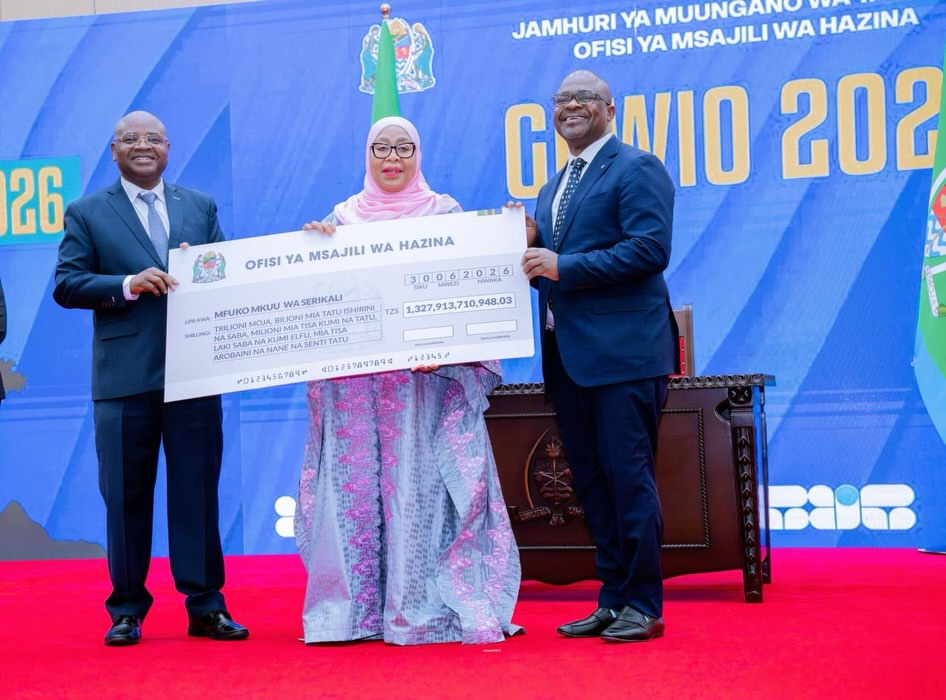
DAR ES SALAAM: THE presentation of a dummy cheque worth 1.327tri/- by the Office of the Treasury Registrar (OTR) to President Samia Suluhu Hassan at the State House in Dar es Salaam on Tuesday, was more than an annual financial ceremony.
It marked another important milestone in Tanzania’s journey towards ensuring that public investments generate tangible value for the people who ultimately own them.
The amount, collected as dividends and other statutory contributions during the 2025/26 financial year, represents a 30 per cent increase from the 1.028tri/- collected in the previous financial year.
Behind this remarkable growth lies an important question that many Tanzanians may ask: Where does this money go, and how does it improve the lives of ordinary citizens?
The answer begins with understanding the purpose of government investments.
Public institutions and companies in which the government owns shares are not established simply to operate.
They are expected to create value by delivering quality services, stimulating economic growth and generating financial returns that support national development.
Once collected, the 1.327tri/- is paid into the Government Consolidated Fund, where it becomes part of the government’s domestic financial resources, used to implement priorities approved through the national budget.
Although the funds are not earmarked for individual projects, they strengthen the government’s capacity to finance development programmes and essential public services while reducing pressure on other sources of financing.
Receiving the dividend, President Samia described the 30 per cent increase as a clear indication that the government’s efforts to strengthen accountability, efficiency and discipline across public institutions and companies are yielding positive results.
She commended boards of directors, chief executive officers and management teams for improving operational performance, strengthening revenue collection and increasing the value generated from public investments.
President Samia, however, cautioned against complacency.
She said public institutions should continue improving their performance and be assessed based on measurable outcomes, including the value they create, the quality of services they provide, their financial sustainability and the revenue they contribute to the government.
“Stronger contributions to the Government Consolidated Fund increase the country’s ability to finance development projects and improve essential public services,” the President underscored.
The more public institutions improve their performance, the greater the government’s capacity to invest in sectors such as healthcare, education, water, infrastructure, agriculture and energy through the national budget.
Her message reflects a broader vision that public investments should not merely preserve public assets but continuously create wealth for the nation.
The significance of this achievement was further underscored by the Minister of State in the President’s Office – Planning and Investment, Professor Kitila Mkumbo, who said the increase in dividends and other government contributions demonstrates that the economic reforms being implemented under President Samia’s leadership are producing measurable results.
According to Prof Mkumbo, the increase in dividends and other government contributions demonstrates that the economic reforms being implemented under President Samia’s leadership are producing measurable results.
He said the progress is being driven primarily by the government’s 4Rs philosophy, particularly its emphasis on Reforms and Rebuilding, which seeks to modernise public institutions, strengthen governance, improve accountability and enhance operational efficiency.
These reforms have enabled public institutions to utilise resources more effectively, improve productivity and generate higher returns from government investments, thereby strengthening domestic resource mobilisation and supporting sustainable national development.
The minister’s observations illustrate that improved dividend collections are not isolated financial achievements.
Rather, they are indicators of broader institutional reforms that are strengthening Tanzania’s economic resilience and creating a stronger foundation for long-term development. The operational dimension of this achievement was explained by Treasury Registrar Nehemiah Mchechu, who attributed the increase to sustained operational, managerial and administrative reforms implemented across public institutions.
According to Mr Mchechu, the reforms have focused on strengthening corporate governance, enhancing accountability, improving efficiency and ensuring that government investments generate greater value for the nation.
These measures have enabled institutions to improve productivity, strengthen business systems and deliver better financial performance.
He explained that the 1.327tri/- collected during the 2025/26 financial year demonstrates that government investments are becoming an increasingly reliable source of domestic revenue.
This, he said, strengthens the government’s fiscal position by providing additional resources to finance development priorities using returns generated from public assets. More importantly, Mr Mchechu observed that stronger dividend collections contribute to reducing fiscal pressure that often arises from dependence on borrowing and external grants.
As public investments generate higher returns, government is able to finance a larger portion of its development expenditure from domestic resources, thereby promoting fiscal sustainability and reducing vulnerability to external financing conditions.
“This achievement demonstrates that public assets can increasingly finance public development,” Mr Mchechu said.
“Every improvement in the performance of public institutions increases the government’s capacity to fund national priorities while easing pressure on debt and unpredictable external financing.”
He added that continued implementation of the government’s 4Rs philosophy— particularly the pillars of Reforms and Rebuilding—has strengthened governance systems, enhanced transparency and promoted a culture of performance across public institutions.
The result has been improved institutional performance, stronger financial sustainability and increased contributions to the government.
The figures themselves reflect this progress. Of the 1.327tri/- collected, 800.5bn/, equivalent to 60 per cent, came from dividends paid by commercial public corporations and companies.
Another 406bn/-, representing 30 per cent, came from the statutory 15 per cent contribution from the gross revenue of non-commercial public institutions, while 121.5bn/-, or 10 per cent, was generated from investment returns and other contributions.
Beyond the numbers lies a much broader national story. Every shilling earned from well-managed public investments strengthens the government’s ability to provide quality services without placing unnecessary pressure on taxpayers or increasing reliance on debt.
As more public institutions become profitable and financially sustainable, they create additional fiscal space that enables government to invest more confidently in programmes that improve the wellbeing of citizens.
For ordinary Tanzanians, this means that improved management of public investments is not simply a matter for accountants, boards or policymakers.
It has practical implications for the country’s development. Stronger public finances support continued investment in health facilities, schools, roads, electricity, water supply, agricultural programmes and digital public services through the national budget.
This growing contribution from Government investments also reflects an important shift in public finance management.
Rather than relying predominantly on taxes, loans and development aids, Tanzania is increasingly strengthening another important source of domestic financing—returns generated from assets owned by the people themselves through government.
As Tanzania embarks on the implementation of Dira 2050, the importance of competitive, innovative and financially sustainable public institutions will become even greater.
Institutions that consistently create value, embrace innovation and maintain sound corporate governance will play a central role in financing the country’s longterm development aspirations.
The 1.327tri/- presented this week, therefore, represents much more than an increase in dividend collections.
It is evidence that reforms are producing results, that public institutions are becoming more efficient and accountable, and that government investments are increasingly working for their true shareholders, the people of Tanzania.
The challenge now is to sustain this momentum. Continued reforms, stronger oversight and a commitment to performance excellence will enable even more institutions to contribute to the Government Consolidated Fund.
In doing so, they will not only strengthen public finances but also help build a more self-reliant, competitive and prosperous Tanzania, where public investments continue to deliver lasting value for generations to come.