KEY TAKEAWAYS
- The nest egg needed to support a comfortable retirement varies widely by state.
- Couples with annuity income need a smaller nest egg, but you first spend part of your savings to buy the annuity.
- Monthly annuity payments of $500 to $2,500 can lower the required invested nest egg by $150,000 to $750,000.
For a typical older couple, an annuity can meaningfully shrink the nest egg needed for a comfortable retirement—but only if the couple spends down their savings to buy the annuity.
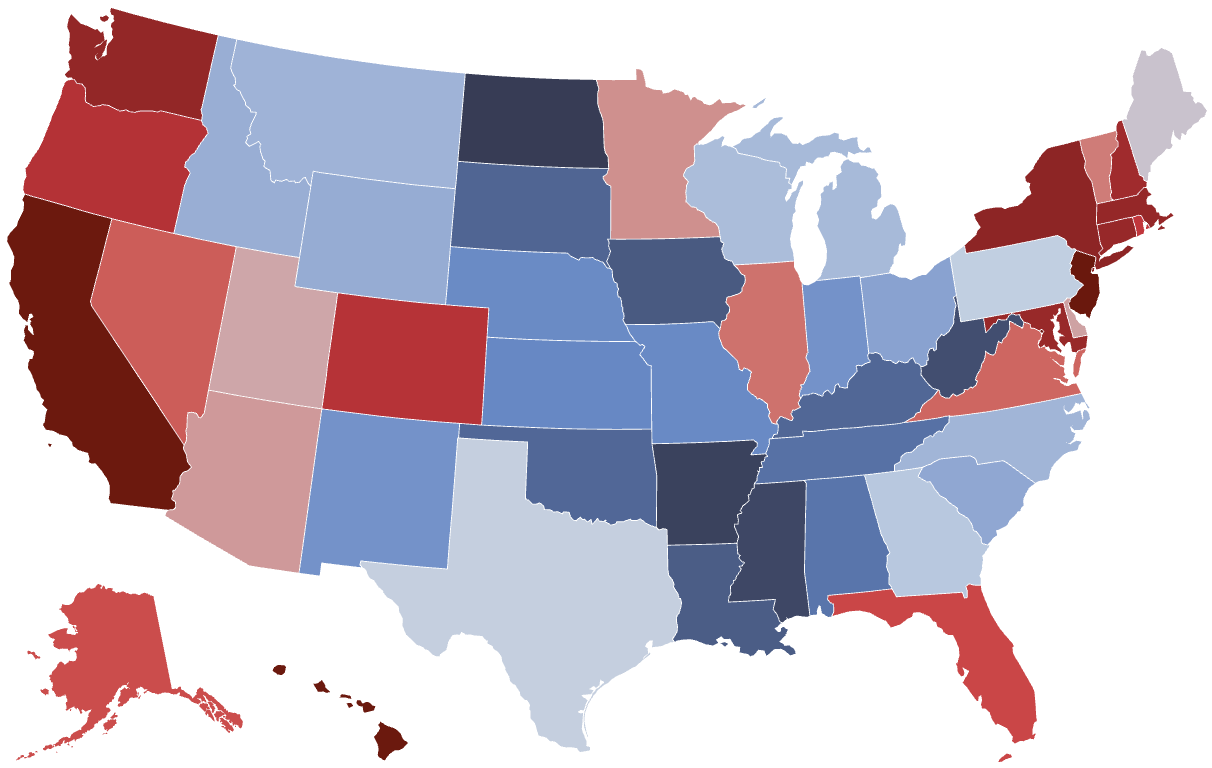
A typical American couple age 65 or older needs about $1.16 million saved for a comfortable retirement after accounting for roughly $37,700 a year in Social Security, according to an Investopedia analysis of federal data. Across the 50 states and Washington, D.C., that figure ranges from about $800,000 to nearly $1.33 million.
Annuity income can reduce how much of that nest egg a couple needs to keep invested. To illustrate the impact, Investopedia calculated the remaining savings required in each state with monthly annuity income ranging from $500 to $2,500.
What Retirement Really Costs the Typical Couple
Based on federal data, the typical retired couple spends about $84,000 a year, including discretionary expenses such as travel, dining out, and entertainment—not just basic needs.
Average combined Social Security benefits of about $37,700 cover roughly 45% of that spending, leaving a gap of about $46,000 to fill from savings, annuity income, or other sources.
Under the 4% rule—a guideline that starts withdrawals at 4% of the portfolio and adjusts them over time for inflation—covering that gap would require a nest egg of about $1.16 million.
But the national average masks a wide geographic spread. Annual spending for a typical couple ranges from roughly $70,000 in the least expensive states to more than $90,000 in the costliest.
An annuity can cover part of that gap with steady monthly income, reducing what you need in savings. The trade-off is that you first must spend some of your original savings to buy it.
Why This Matters
An annuity can reduce how much you need to keep invested by covering part of your monthly spending. The key is making sure you still have enough left over after the purchase to handle expenses that the annuity and Social Security won’t cover.
How Annuity Income Lowers the Remaining Nest Egg—But Comes With an Upfront Cost
An annuity can reduce the amount you need in savings because its monthly payments cover part of the spending gap left after Social Security. Under the 4% rule, every $500 a month in annuity income replaces $6,000 in annual portfolio withdrawals, lowering the required remaining nest egg by $150,000 (0.04 multiplied by $150,000 equals $6,000).
For the typical couple in Investopedia‘s model, that reduces the required invested balance from about $1.16 million with no annuity to roughly $1.01 million with $500 a month in annuity income. Higher monthly payments would reduce the remaining amount needed even further, as shown below.
| How Annuity Income Can Shrink the Nest Egg You Still Need | ||
|---|---|---|
| Monthly Annuity Income | Annual Annuity Income | Remaining Nest Egg Needed |
| None | $0 | $1,158,650 |
| $500 / month | $6,000 / year | $1,008,650 |
| $1,000 / month | $12,000 / year | $858,650 |
| $1,500 / month | $18,000 / year | $708,650 |
| $2,000 / month | $24,000 / year | $558,650 |
| $2,500 / month | $30,000 / year | $408,650 |
But these figures show only how much must remain invested after the annuity has been secured—not everything a couple needs to save beforehand.
Suppose a couple starts with $800,000 and uses $200,000 to buy an annuity. The couple would then have $600,000 left invested, plus the annuity’s monthly income. In this analysis, the relevant nest egg is that remaining $600,000.
This is only an example, not an estimate of what a particular payment would cost. Pricing varies widely based on age, interest rates, payout length, survivor coverage, inflation protection, guarantees, and other contract features.
This analysis is not intended as a recommendation to buy an annuity or a suggestion that an annuity will reduce your overall cost of retirement. It simply shows how a fixed monthly annuity income can change the amount you would need to keep in savings after the purchase.
Not All Annuities Work the Same Way
This analysis assumes lifetime income, but annuities can differ widely in payout length, start date, survivor coverage, guarantees, fees, restrictions, and riders. Because they are complex and may require committing a large share of your savings, review the contract carefully, and consider consulting a qualified financial professional before buying.
The Nest Egg Couples Need in Every State at Different Annuity Income Levels
Where you retire still makes a major difference, even when an annuity covers part of your monthly spending. Without an annuity, the required nest egg in Investopedia‘s model ranges from about $800,000 in North Dakota to nearly $1.33 million in New Jersey—a spread of almost $530,000.
Under the 4% rule, annuity income lowers every state’s required invested balance by the same amount. A $500 monthly payment reduces it by $150,000, while $1,000 lowers it by $300,000 and $2,500 by $750,000.
But each state starts from a different baseline. With $1,000 a month in annuity income, a couple would still need about $1.03 million invested in New Jersey and Hawaii, compared with about $500,000 in North Dakota and $507,000 in Arkansas.
At $2,500 a month, the remaining nest egg ranges from about $50,000 in North Dakota to nearly $579,000 in New Jersey. Arkansas, Mississippi, and West Virginia also fall below $75,000, while California, Hawaii, and Washington, D.C., remain above $550,000.
How We Calculated the Retirement Numbers for All 50 States
Investopedia estimated retirement costs for retirees using 2024 federal data on housing, consumer spending, and regional price differences. We calculated costs for a single retiree in each state, adjusted them for a two-person household, and defined a comfortable retirement as average spending that includes discretionary expenses—not just basic needs.
From each state’s estimated annual cost, we subtracted about $37,700 in combined Social Security benefits and any modeled annuity income, then divided the remaining gap by 4% to estimate the required nest egg. The results exclude the lump sum used to buy the annuity. Readers can review the full methodology in our earlier analysis.