Jharkhand presents a strong case for adopting and institutionalising green budgeting practices, given its resource-rich economy, dependence on fossil fuel, and increasing exposure to climate, environmental, and transition-related risks. As the state seeks to balance economic growth and livelihoods with a gradual shift towards a more resilient, low-carbon, and inclusive development pathway, a ‘green budgeting framework’ can help align fiscal policy with environmental priorities, improve transparency in public expenditure, and strengthen long-term economic resilience.
Green budgeting integrates climate and sustainability considerations into budgetary processes and public financial management, drawing on international practices and frameworks developed by the European Union (EU) and Organisation for Economic Co-operation and Development (OECD), among others. This report proposes a phased framework tailored to Jharkhand’s institutional and development context and aligned with the draft ‘Framework of India’s Climate Finance Taxonomy’, to improve expenditure tracking, identify environmentally relevant and harmful spending, and strengthen access to green and climate finance.
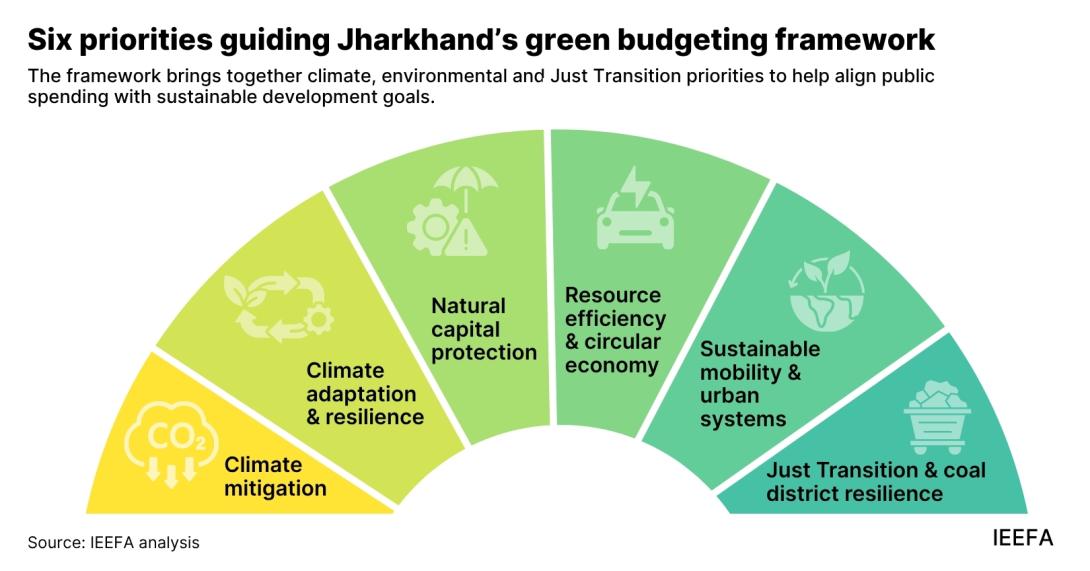
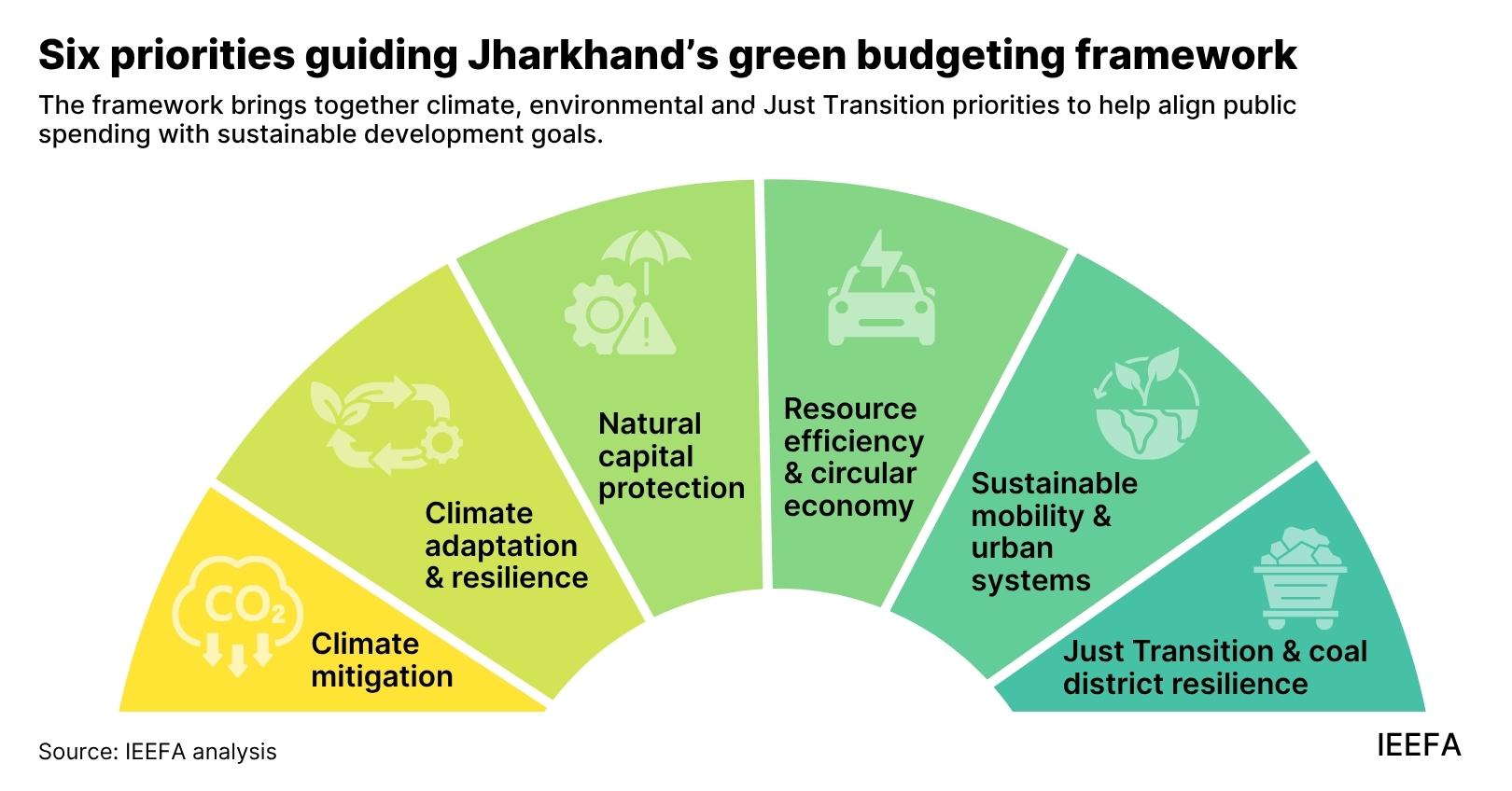
The proposed framework is built around six thematic objectives that reflect both international green budgeting practices and priorities specific to Jharkhand.
Tagging methodology
A key feature of the framework is a budget tagging methodology that classifies expenditures, grouped into four categories, based on their environmental relevance.

Recognising that many public schemes have mixed objectives, the green budgeting framework for Jharkhand adopts a proportional classification approach instead of a binary green/non-green system. Activities are assessed and assigned coefficients across five relevance bands.
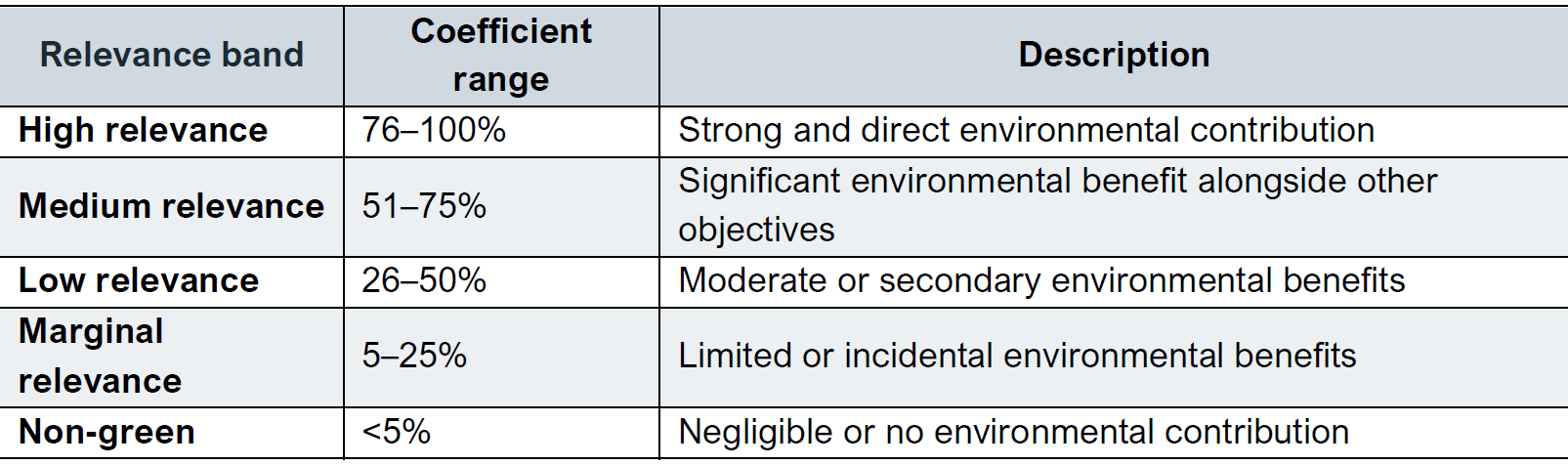
This approach allows departments to more accurately estimate the environmental contribution of individual scheme components and avoids overstatement or understatement of green expenditure.
To further strengthen policy relevance, the framework introduces a “Just Transition flag”, applied in addition to the primary budget tag. This binary flag identifies expenditures that directly support coal districts, fossil fuel-dependent communities, displaced workers, or vulnerable populations affected by structural economic shifts. This additional layer enables policymakers to monitor not only the scale of green expenditure but also the extent to which public finance supports equitable and regionally targeted transition outcomes.
Institutional arrangements and phased implementation
The proposed institutional framework establishes a clear governance structure to embed green budgeting within Jharkhand’s existing public financial management system. The Department of Finance will serve as the nodal agency, leading the implementation of the green budgeting framework through the issuance of budget guidelines, consolidation of departmental submissions, and publication of the annual green budget statement. A dedicated green budgeting cell, functioning as a project management unit (PMU) within the Department of Finance, will provide the technical backbone for implementation by developing the tagging methodology, supporting line departments through continuous handholding and capacity building, managing data systems and the green budget portal, and ensuring the quality and consistency of green budgeting information.
The framework promotes a whole-of-government approach by clearly defining the complementary roles of key institutions. The Department of Planning and Development will integrate green budgeting into state planning and medium-term development strategies, while the Department of Forest, Environment and Climate Change will provide technical guidance to ensure alignment with environmental policies and climate objectives. Line departments will be responsible for scheme-level expenditure tagging, reporting, and monitoring, supported by departmental focal points to strengthen ownership and institutional capacity across government.
The Task Force on Sustainable Just Transition will play a key role in guiding the implementation of the green budgeting framework by identifying priority sectors, promoting capacity building, facilitating stakeholder engagement, and fostering knowledge sharing. To strengthen technical rigour and long-term credibility, the framework also proposes setting up an independent expert panel that will provide technical and strategic support to both the Department of Finance and the task force. The panel will undertake periodic reviews of the methodology, assess the quality and consistency of expenditure tagging, and recommend methodological enhancements and analytical studies to support the continuous improvement of the framework. Together, these institutional arrangements will strengthen coordination, transparency, and evidence-based decision making, enabling Jharkhand to implement a robust, credible, and scalable green budgeting framework aligned with national priorities and international good practices.
Implementation is proposed through a roadmap aligned with international best practices, and structured across three stages: Essential, developed, and advanced. The ‘essential’ stage focuses on introducing basic expenditure tagging, piloting the methodology in four departments, and preparing an initial green budget statement. The ‘developed’ stage expands coverage across 12 departments, refines tagging methodologies, introduces green budgeting portal, and formalises institutional arrangements. The ‘advanced’ stage integrates green budgeting into medium-term expenditure frameworks, investment decision-making and independent evaluation.
Accountability and transparency
Accountability and transparency are embedded as core design principles. The framework recommends the annual publication of a green budget statement alongside the state budget, supported by a green budget portal that would make methodologies, classifications, and nonsensitive datasets publicly accessible. It also proposes an independent expert panel to periodically review methodologies and outputs. Over time, Jharkhand may consider external assurance mechanisms, including audits of methodology and process integrity.
The way forward
Gradually, Jharkhand can move toward a stage where green budgeting is not only a reporting exercise but also one that informs medium-term fiscal planning, public investments, and policy choices. Integrating green budgeting into routine governance processes would improve resource allocation while positioning the state as a leader among Indian states in financing a just and sustainable transition.
The framework is intended as a practical starting point that can evolve with implementation experience, stakeholder feedback, stronger data systems, and national policy developments. With phased implementation and strong institutional ownership, Jharkhand has an opportunity to establish itself as a frontrunner in green public financial management and Just Transition financing in India.