Enterprises Got Introduced To AI in 2022 With ChatGPT
When ChatGPT launched in late 2022, the conversation around enterprise AI focused on one question:
“Which model should we use?”
By 2024, the conversation shifted.
“How do we build AI applications?”
Now, in 2026, another question has quietly become the boardroom discussion.
“How much is this costing us?”
The surprising answer is that GPUs are no longer the biggest concern.
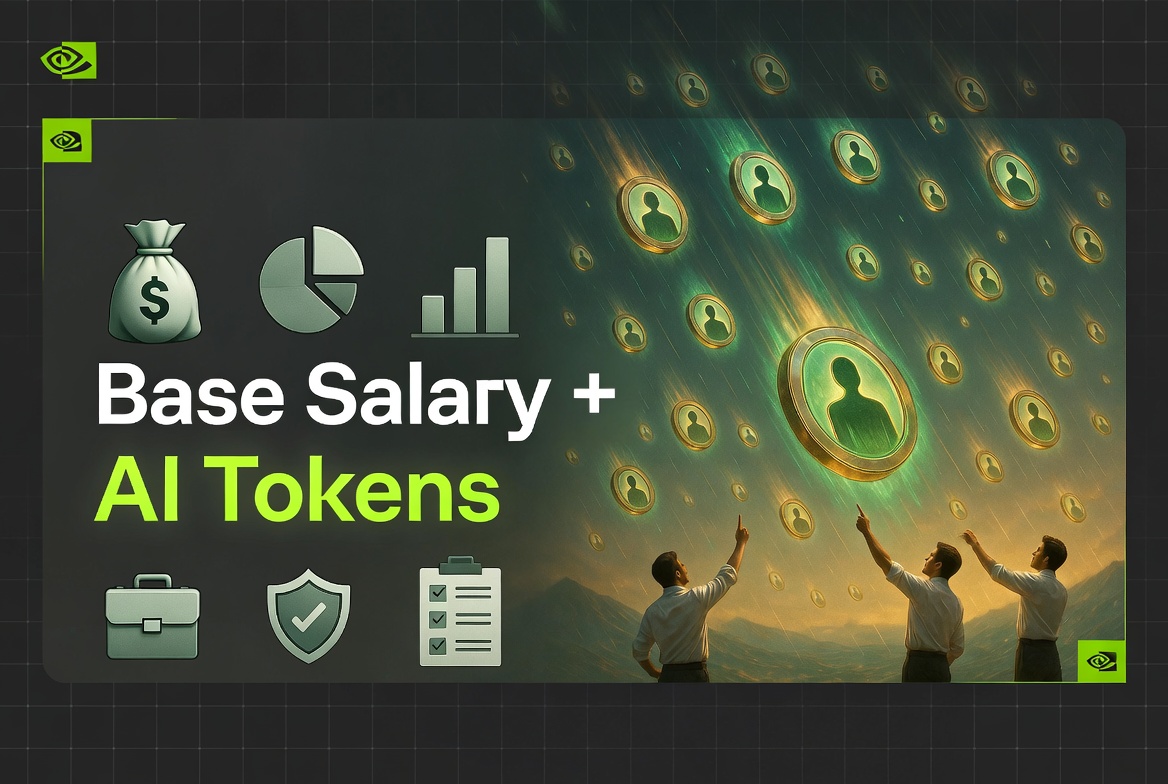
Tokens are.
Every prompt an employee submits.
Every customer support interaction.
Every AI-generated proposal.
Every software engineering agent.
Every retrieval from a knowledge base.
They all consume tokens.
Individually, the cost feels insignificant. At enterprise scale, the economics change dramatically.
An organization with 10,000 employees making dozens of AI requests every day quickly generates billions of tokens every month. Add autonomous agents, Retrieval-Augmented Generation (RAG), software engineering copilots, and customer-facing AI assistants, and token consumption becomes one of the fastest-growing operating expenses in the technology budget.
Many organizations planned for cloud infrastructure. Few planned for AI operating economics.
The challenge is no longer building AI.
The challenge is building AI that scales financially.
This is where a new discipline is emerging: AI FinOps.
Just as Cloud FinOps helped organizations optimize compute, storage, and networking costs over the past decade, AI FinOps focuses on measuring, governing, and optimizing the economics of enterprise AI.
Organizations that master token economics will scale AI responsibly.
Organizations that ignore it risk turning promising AI initiatives into expensive experiments with uncertain returns.
In this article, we’ll explore why token economics has become one of the most important topics in enterprise AI, what drives runaway costs, and how executive teams should prepare for the next phase of AI adoption.
The Enterprise AI Cost Explosion Nobody Planned For
During the first wave of enterprise AI adoption, most CIOs assumed infrastructure would be the primary expense.
The logic made sense.
Training large language models requires enormous GPU clusters.
Running inference requires specialized hardware.
Storage requirements continue to grow.
Cloud providers continue investing billions in AI infrastructure.
Naturally, organizations assumed infrastructure would dominate AI budgets.
Instead, a different pattern emerged.
The infrastructure providers achieved economies of scale.
Meanwhile, enterprise AI usage exploded.
Consider what happens inside a typical Fortune 1000 organization.
One marketing employee generates product copy.
A salesperson creates customized proposals.
Customer support summarizes conversations.
Finance analyzes reports.
Legal reviews contracts.
HR drafts policies.
Software engineers use AI throughout the development lifecycle.
Product managers generate specifications.
Executives summarize board materials.
None of these activities seems expensive individually.
Collectively, they generate millions of AI interactions every day.
Each interaction consumes tokens.
Unlike traditional software licenses, AI costs increase with usage.
The more valuable AI becomes, the more employees rely on it.
Ironically, successful AI adoption often increases operating costs faster than organizations anticipated.
This creates a new leadership challenge.
Success and spending become closely linked.
Without governance, organizations face a difficult tradeoff between encouraging adoption and controlling costs.
Leading organizations are realizing they must optimize both.
What Exactly Is a Token?
For many executives, tokens remain an abstract technical concept.
Understanding them is essential because they have become the currency of enterprise AI.
A token is a unit of text processed by an AI model.
Rather than reading complete words, language models process text as smaller pieces.
For example:
may become several individual tokens.
Longer documents contain more tokens.
Larger prompts consume more tokens.
Longer AI responses generate additional output tokens.
Every interaction includes both input and output tokens.
The larger the conversation, the greater the cost.
Now consider what happens inside an enterprise application.
An employee uploads:
• A 120-page policy manual
• Five previous emails
• CRM history
• Customer notes
• Internal documentation
• Meeting transcripts
The AI now receives hundreds of thousands of tokens before producing a single answer.
If this workflow repeats thousands of times every day, costs accelerate rapidly.
Modern AI applications frequently add even more context through Retrieval-Augmented Generation.
Instead of sending only a question, systems retrieve multiple knowledge documents and append them to the prompt.
While this improves accuracy, it also increases token consumption.
Larger context windows solve one problem while creating another.
Better answers.
Higher costs.
Smarter organizations recognize this tradeoff early.
Why AI Costs Scale Faster Than Traditional Cloud Infrastructure
Cloud computing transformed enterprise technology because costs were relatively predictable.
Organizations budgeted for:
• Compute
• Storage
• Networking
• Databases
Each service had established pricing models.
AI changes the equation.
Every user interaction creates variable costs.
Unlike traditional applications, AI systems perform reasoning on demand.
Costs now depend on:
• Prompt length
• Response length
• Model selection
• Retrieval size
• Number of agents
• Tool usage
• Context windows
• Memory retrieval
• Images
• Documents
• Audio
• Video
A single customer request might trigger:
One orchestrator agent.
Three specialized agents.
Five document retrievals.
Two external API calls.
One summarization.
One quality review.
Each step generates additional token usage.
This phenomenon is often invisible to business leaders.
An employee submits one question.
Behind the scenes, dozens of AI interactions occur.
Without visibility, executives struggle to answer simple questions.
Which department spends the most?
Which workflows generate value?
Which applications waste tokens?
Which teams need optimization?
Cloud computing introduced observability as a standard practice.
Enterprise AI requires the same discipline.
The organizations leading this next wave are treating tokens as carefully as they once managed CPU utilization and cloud spending.
Token dashboards are becoming as important as cloud dashboards.
Cost allocation is becoming as important as performance monitoring.
Governance is becoming as important as innovation.
The next generation of AI leaders will not simply ask whether AI works.
They will ask whether AI delivers measurable business value at a sustainable cost.
That question marks the beginning of AI FinOps.
Key Takeaways
- AI operating costs increasingly come from token consumption rather than infrastructure alone.
- Every prompt, document, agent, and workflow contributes to enterprise AI spending.
- Larger context windows improve quality but also increase costs.
- Successful AI adoption requires financial governance alongside technical excellence.
- AI FinOps is emerging as a critical discipline for CIOs, CFOs, CTOs, and AI leaders.
Why Enterprise AI Costs Spiral Out of Control and How to Prevent It
AI Is Easy to Pilot. It Is Much Harder to Scale.
Most enterprise AI initiatives begin with a small proof of concept.
A chatbot for HR.
A sales proposal assistant.
A software engineering copilot.
A customer support bot.
The pilot performs well. Employees embrace it. Leadership sees productivity gains and decides to expand AI across the organization.
Then something unexpected happens.
Monthly AI spending doubles.
Then doubles again.
No one changed vendors. No new infrastructure was purchased. There was no dramatic increase in headcount.
What changed was usage.
Unlike traditional enterprise software, AI costs are directly tied to consumption. Every interaction consumes compute. Every document retrieval adds tokens. Every agent call increases cost. As AI becomes more valuable, employees naturally use it more often, creating a feedback loop where successful adoption drives higher operating expenses.
Research from Deloitte’s State of AI, PwC’s Global CEO Survey, and McKinsey’s State of AI consistently shows that organizations are moving beyond experimentation into enterprise-wide deployment. At the same time, executives increasingly cite cost control, governance, and measurable ROI as top concerns for scaling AI initiatives.
The lesson is clear.
Scaling AI is not only a technology challenge.
It is an operating model challenge.
The Five Biggest Drivers of Runaway AI Costs
1. Oversized Context Windows
One of the most common mistakes is sending far more information to the model than necessary.
Consider a contract review assistant.
Instead of sending:
- The contract
- Relevant policies
Many applications also send:
- Previous conversations
- Unrelated emails
- Entire company manuals
- Customer history
- Legal templates
- Project documentation
The model receives 150,000 tokens when it only needs 8,000.
This happens because developers often choose the safest option rather than the most efficient one.
“Send everything.”
The result is predictable.
Higher latency.
Higher costs.
No meaningful improvement in answer quality.
Best Practices
- Retrieve only relevant information.
- Use semantic search instead of keyword matching.
- Summarize older conversations.
- Store important facts separately from conversation history.
- Continuously measure average prompt size.
Organizations routinely reduce token consumption by 40 to 70 percent simply by improving context management.
2. Using the Most Powerful Model for Every Task
Many enterprises default to their most capable model because it simplifies architecture.
Unfortunately, it also creates unnecessary costs.
Think about your own workforce.
You would not ask your Chief Legal Officer to schedule conference rooms.
Likewise, not every AI request requires the most advanced reasoning model.
Examples include:
Simple FAQ responses.
Document classification.
Translation.
Grammar correction.
Meeting summaries.
Data formatting.
These tasks perform exceptionally well on smaller, faster, lower-cost models.
Reserve premium reasoning models for:
Strategic planning.
Financial analysis.
Legal reasoning.
Complex software architecture.
Scientific research.
Executive decision support.
Best Practices
Implement intelligent model routing.
Match the model to the complexity of the task.
Doing so often reduces AI costs without affecting user experience.
3. Multi-Agent Systems Talking to Each Other
Agentic AI is transforming enterprise software.
Instead of one model answering a question, multiple specialized agents collaborate.
For example:
Planner Agent
↓
Research Agent
↓
Compliance Agent
↓
Writing Agent
↓
Quality Reviewer
↓
Executive Summary Agent
This architecture produces better outcomes.
It also multiplies token consumption.
A poorly designed workflow often repeats the same information between every agent.
Each agent receives:
The user’s request.
Conversation history.
Supporting documents.
Intermediate outputs.
The total token usage grows exponentially.
Better Architecture
Instead of sharing entire conversations:
Share structured memory.
Pass only relevant outputs.
Avoid duplicate retrievals.
Use orchestration instead of repetition.
The best agent architectures optimize communication, not simply capability.
4. Poor Prompt Engineering
Prompt engineering is often discussed in terms of answer quality.
Its financial impact receives much less attention.
Many enterprise prompts contain unnecessary instructions repeated thousands of times every day.
Examples include:
“You are a world-class AI assistant…”
“Always respond professionally…”
“Think step by step…”
“If uncertain…”
These instructions consume tokens every single request.
Across millions of interactions, unnecessary prompt overhead becomes a measurable expense.
Better Prompt Design
Build reusable prompt templates.
Separate system instructions from user instructions.
Keep prompts concise.
Continuously evaluate prompt effectiveness.
Prompt optimization is one of the easiest ways to reduce enterprise AI costs.
5. Lack of Visibility Into Token Consumption
Ask most CIOs:
“Which AI application generated the highest business value last month?”
Many have an answer.
Now ask:
“Which workflow consumed the most tokens?”
Far fewer organizations know.
Without visibility, optimization becomes impossible.
Organizations need dashboards showing:
- Tokens by department
- Tokens by application
- Tokens by customer
- Tokens by business process
- Tokens by model
- Cost per workflow
- Cost per employee
- Cost per successful outcome
This is where AI FinOps begins.
Measure first.
Optimize second.
Scale third.
Why AI Governance Matters More Than Ever
Every technology wave creates a governance challenge.
Cloud computing introduced Cloud FinOps.
Cybersecurity introduced Zero Trust.
Data introduced Data Governance.
Enterprise AI requires AI Governance.
Governance does not slow innovation.
Good governance accelerates innovation because teams understand the financial boundaries within which they operate.
Executive teams should establish policies around:
- Approved AI models
- Data privacy
- Prompt management
- Agent development standards
- Human review requirements
- Cost monitoring
- Vendor selection
- Model evaluation
- Security controls
- Responsible AI practices
Organizations that establish governance early spend less time fixing problems later.
Introducing the AI FinOps Framework
Cloud FinOps transformed how organizations manage cloud spending.
AI requires a similar discipline.
At ISHIR, we believe AI FinOps rests on five pillars.
1. Visibility
Understand where every token is spent.
Questions to answer:
- Which departments consume the most AI resources?
- Which models drive the highest costs?
- Which workflows produce the greatest ROI?
If you cannot measure it, you cannot optimize it.
2. Optimization
Once spending is visible, reduce waste through:
- Intelligent model routing
- Prompt optimization
- Context compression
- Response caching
- RAG optimization
- Workflow redesign
Optimization should improve both cost and performance.
3. Governance
Define organizational standards.
Examples include:
- Approved foundation models
- Prompt libraries
- Security policies
- Cost budgets
- Approval workflows
- Compliance requirements
Governance creates consistency across teams.
4. Business Alignment
AI success should never be measured only by token usage.
Instead, measure outcomes.
Examples:
- Cost per support ticket resolved
- Cost per proposal generated
- Cost per software defect fixed
- Cost per claims review
- Cost per customer onboarded
Business metrics create executive confidence.
5. Continuous Improvement
AI evolves rapidly.
The most successful organizations continuously improve:
Prompt quality.
Agent design.
Model selection.
Knowledge retrieval.
Architecture.
Cost efficiency.
AI optimization is not a one-time project.
It is an ongoing operational capability.
Executive Questions Every Leadership Team Should Ask
Before approving another AI initiative, leadership teams should ask:
1. Which business processes generate the highest AI costs?
2. What is our average token consumption per workflow?
3. Which applications deliver the highest return on AI investment?
4. Are we routing requests to the appropriate models?
5. How much of our AI spending is avoidable?
6. Are autonomous agents increasing productivity or simply generating more compute?
7. Do we have an AI FinOps strategy alongside our AI strategy?
Organizations that answer these questions early are far better positioned to scale AI responsibly.
10 Practical Token Optimization Strategies Every Enterprise Should Implement
At this point, the conversation shifts from awareness to execution.
Understanding token economics is valuable. Managing it is where organizations create competitive advantage.
The most mature AI organizations no longer ask, “How do we reduce AI costs?”
Instead, they ask, “How do we maximize business value for every token we spend?”
This subtle shift changes every architectural decision.
The goal is not to spend the fewest tokens. The goal is to spend tokens where they create measurable business outcomes.
Below are ten strategies ISHIR recommends to every enterprise building AI at scale.
1. Route Every Request to the Right Model
One of the biggest mistakes organizations make is treating every AI task as equally complex.
In reality, enterprise AI workloads span a wide range of complexity.
Examples include:
Low Complexity
- Grammar correction
- Translation
- Email formatting
- Meeting summaries
- FAQ responses
- Document classification
Medium Complexity
- Proposal generation
- Customer support
- Knowledge retrieval
- Product specifications
High Complexity
- Financial analysis
- Contract interpretation
- Strategic planning
- Software architecture
- Multi-step reasoning
Each category deserves a different model.
Using a premium reasoning model for simple summarization is equivalent to asking your chief architect to reset passwords.
Executive Action
Implement an AI Gateway that automatically routes requests based on complexity, latency requirements, privacy requirements, and cost.
Expected impact:
- 30 to 60 percent reduction in AI spend
- Faster response times
- Improved user experience
2. Stop Sending Everything to the Model
Most enterprise applications send far more context than necessary.
Typical prompts include:
- Entire conversation history
- Complete project documentation
- CRM history
- Product manuals
- Meeting transcripts
- Internal policies
The model spends valuable compute processing information it never uses.
Instead, think like a librarian.
Retrieve only what is relevant to answer the current question.
Executive Action
Adopt retrieval strategies that prioritize precision over volume.
Use semantic search.
Rank documents by relevance.
Limit retrieved context.
Summarize long documents before sending them to the model.
Expected impact:
- 40 to 70 percent lower token consumption
- Better response quality
- Reduced hallucinations
3. Build Enterprise Memory Instead of Conversation Memory
Many AI assistants replay entire conversations with every request.
This approach works for demonstrations.
It does not scale across an enterprise.
Instead, organizations should maintain structured memory.
Store facts such as:
- Customer preferences
- Product decisions
- Project milestones
- User preferences
- Team context
- Organizational knowledge
When needed, retrieve only the relevant memory.
Think of memory as a database rather than a transcript.
Executive Action
Separate long-term organizational memory from short-term conversations.
This improves accuracy while dramatically reducing token usage.
4. Optimize Your RAG Architecture
Retrieval-Augmented Generation has become the foundation of enterprise AI.
Unfortunately, many implementations retrieve too much information.
Examples include:
- Twenty policy documents
- Ten PDFs
- Entire product manuals
- Hundreds of knowledge base articles
The result is expensive prompts with little additional value.
Instead:
Improve chunking.
Improve ranking.
Improve retrieval quality.
Smaller context often produces better answers.
Executive Action
Continuously evaluate retrieval accuracy.
Measure:
- Retrieved documents
- Retrieved tokens
- Answer quality
- Retrieval precision
Treat RAG as a search optimization problem rather than a storage problem.
5. Design Agents That Collaborate Efficiently
Agentic AI represents one of the most exciting developments in enterprise software.
Unfortunately, poorly designed agent systems create enormous hidden costs.
Imagine this workflow.
Planner Agent
↓
Research Agent
↓
Writing Agent
↓
Reviewer Agent
↓
Compliance Agent
↓
Planner Agent
Each handoff includes:
- Original prompt
- Conversation history
- Intermediate results
- Supporting documents
The same information travels repeatedly through the system.
Better Architecture
Instead of passing conversations:
Pass structured outputs.
Use shared memory.
Reuse retrieved documents.
Minimize duplicate reasoning.
The objective is coordination, not repetition.
6. Cache Everything That Does Not Change
Organizations repeatedly ask identical questions.
Examples include:
“What is our travel policy?”
“Summarize our benefits.”
“Explain our product roadmap.”
“What is our return policy?”
Generating a fresh response every time wastes compute.
Instead:
Generate once.
Validate.
Store.
Reuse.
Caching is one of the highest return investments in AI infrastructure.
Executive Action
Cache:
- Frequently asked questions
- Corporate policies
- Product information
- Standard operating procedures
- Internal documentation
Expected impact:
- Faster responses
- Lower costs
- Improved consistency
7. Measure Cost Per Business Outcome
Many organizations monitor:
- Cost per prompt
- Tokens consumed
- Monthly invoices
These metrics matter.
They do not matter to executives.
Leadership cares about outcomes.
Instead measure:
- AI cost per customer onboarded
- AI cost per insurance claim
- AI cost per software release
- AI cost per sales proposal
- AI cost per support resolution
These metrics connect AI investment directly to business performance.
Executive Action
Every AI dashboard should include:
Financial metrics.
Operational metrics.
Business KPIs.
Customer impact.
AI should become another measurable business capability.
8. Build AI Cost Dashboards
Cloud transformed IT because organizations learned to measure infrastructure.
AI requires the same operational discipline.
Every executive should have visibility into:
- Tokens by department
- Tokens by application
- Tokens by business unit
- Tokens by customer
- Tokens by workflow
- Model utilization
- Average prompt size
- Average response size
- Cost trends
- ROI by use case
Without visibility, optimization becomes guesswork.
Executive Action
Treat token dashboards like cloud dashboards.
Review them monthly alongside cloud spending.
9. Establish AI Budgets and Guardrails
Every department receives budgets.
Marketing.
Sales.
Engineering.
Finance.
AI should be no different.
Examples include:
Monthly token budgets.
Project spending limits.
Model approval policies.
Usage alerts.
Cost anomaly detection.
Governance workflows.
Guardrails encourage responsible experimentation rather than unrestricted consumption.
Executive Action
Create AI budgets at:
Department level.
Application level.
Project level.
Business unit level.
This creates accountability without slowing innovation.
10. Design for Business Value, Not Maximum Intelligence
Perhaps the most important lesson of enterprise AI is this:
The smartest model is not always the best solution.
Business leaders should optimize for:
Speed.
Cost.
Reliability.
Accuracy.
Governance.
Maintainability.
The objective is sustainable competitive advantage.
Not benchmark scores.
Every AI initiative should answer three questions.
Does it improve business outcomes?
Does it scale operationally?
Does it scale financially?
If the answer to any question is no, revisit the architecture before expanding deployment.
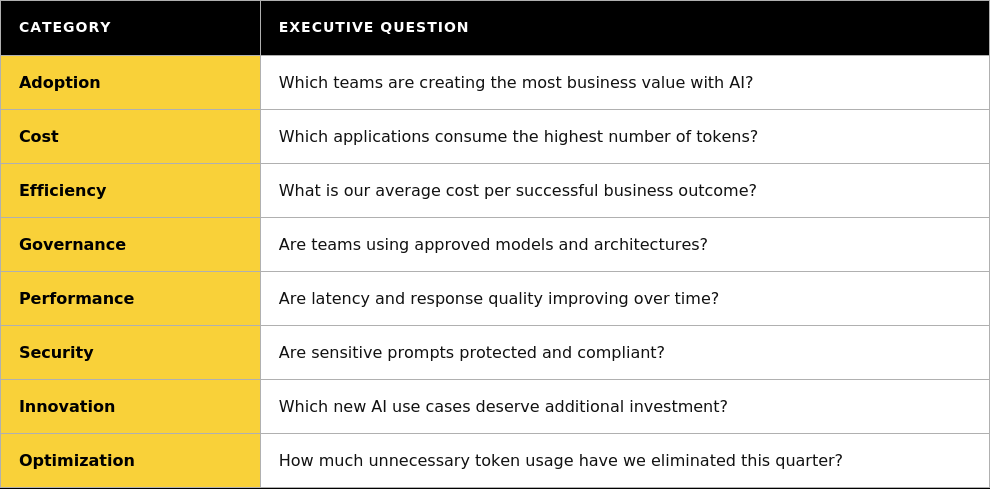
The Executive AI FinOps Scorecard
Every quarter, leadership teams should review the following metrics.
This scorecard helps executive teams shift discussions from AI experimentation to AI performance management.
AI FinOps Is Becoming a Board-Level Discussion
Over the next five years, AI budgets will become a permanent line item alongside cloud infrastructure, cybersecurity, and software licensing.
Boards will increasingly ask questions such as:
- What is our annual AI operating cost?
- Which AI investments produce measurable returns?
- How do we compare with peers?
- Are we exposing the organization to unnecessary financial risk?
- Do we have governance for autonomous AI systems?
- Can our AI architecture scale globally?
Organizations that prepare for these discussions today will be better positioned as AI becomes embedded in every business function.
The next phase of digital transformation will not be defined by who adopts AI first. It will be defined by who operates AI most efficiently, responsibly, and profitably.
How ISHIR Helps Enterprises Scale AI Responsibly
Building an AI prototype is no longer the hard part.
Building an AI capability that delivers measurable business value, integrates with enterprise systems, complies with governance requirements, and scales economically is where organizations need experienced partners.
At ISHIR, we help enterprises move beyond experimentation through an AI-native engineering approach that combines product thinking, modern software architecture, and AI FinOps.
Our services include:
AI Strategy and Readiness
- Executive AI workshops
- AI maturity assessments
- Opportunity prioritization
- Business case development
AI-Native Product Engineering
- Custom AI applications
- Agentic AI platforms
- Enterprise copilots
- AI-powered software modernization
AI FinOps and Governance
- Token cost optimization
- AI architecture reviews
- Model routing strategies
- Cost observability dashboards
- Governance frameworks
- Security and compliance
Enterprise Data and RAG
- Knowledge engineering
- Enterprise search
- Retrieval optimization
- Vector database implementation
- Semantic memory architecture
AI Transformation
- AI Centers of Excellence
- Change management
- Workforce enablement
- Operating model redesign
Whether you’re exploring your first AI initiative or scaling hundreds of AI use cases across the enterprise, ISHIR helps you build AI systems that are intelligent, secure, and financially sustainable.
AI FinOps Maturity Model, Executive Roadmap, FAQs, and What’s Next
AI has reached an inflection point.
Over the next decade, every organization will become an AI organization in the same way every organization became a cloud organization over the past fifteen years.
The differentiator will not be who has access to the best models.
The differentiator will be who operates AI with the greatest discipline.
Just as DevOps transformed software delivery and FinOps transformed cloud spending, AI FinOps will become a core enterprise capability.
Organizations that establish governance, visibility, and cost optimization today will scale faster, innovate more confidently, and generate greater returns from every AI investment.
The AI FinOps Maturity Model
At ISHIR, we believe organizations progress through five stages of AI maturity.
Level 1. Experimenting
Characteristics
- Employees use ChatGPT, Claude, Gemini, or Copilot individually.
- AI adoption is informal.
- No governance.
- No approved models.
- No visibility into spending.
Common Challenges
- Shadow AI
- Data leakage risks
- Duplicate efforts
- Inconsistent results
Leadership Focus
Create enterprise AI policies and identify high value use cases.
Level 2. Piloting
Characteristics
- A handful of AI pilots.
- Department level experimentation.
- Limited executive sponsorship.
- Initial AI budget.
Common Challenges
- Measuring ROI
- Vendor selection
- Integration complexity
- Pilot fatigue
Leadership Focus
Prioritize business outcomes instead of technical demonstrations.
Level 3. Scaling
Characteristics
- AI embedded into multiple business processes.
- Growing AI operating costs.
- Cross functional AI teams.
- Executive oversight.
Common Challenges
- Token consumption
- Governance
- Model sprawl
- Security
- Compliance
Leadership Focus
Implement AI FinOps, establish architecture standards, and measure business outcomes.
Level 4. Optimizing
Characteristics
- AI embedded across the enterprise.
- Cost visibility.
- Model routing.
- Prompt optimization.
- Agent governance.
- AI Center of Excellence.
Common Challenges
- Organizational alignment.
- Workforce transformation.
- Vendor management.
Leadership Focus
Optimize for efficiency, resilience, and competitive differentiation.
Level 5. AI Native Enterprise
Characteristics
- AI integrated into every workflow.
- AI agents collaborate with employees.
- AI budgets managed like cloud budgets.
- Continuous optimization.
- Executive dashboards.
- Governance by design.
Leadership Focus
Innovate faster than competitors while maintaining financial discipline.
A Practical 90 Day Roadmap for CIOs and CTOs
Many executives ask the same question.
“Where do we start?”
The answer is not another pilot.
The answer is building the operating model.
Days 1 to 30. Assess
Objectives
- Inventory all AI initiatives.
- Identify approved and unapproved tools.
- Measure current AI spending.
- Define executive sponsorship.
- Prioritize high value use cases.
Deliverables
- AI strategy
- AI governance charter
- AI maturity assessment
- Executive dashboard
Days 31 to 60. Optimize
Objectives
- Introduce model routing.
- Optimize prompts.
- Improve RAG architecture.
- Reduce unnecessary context.
- Build token monitoring dashboards.
Deliverables
- AI FinOps baseline
- Token optimization report
- Governance policies
- Cost reduction opportunities
Days 61 to 90. Scale
Objectives
- Expand successful use cases.
- Launch AI Center of Excellence.
- Introduce department level AI budgets.
- Train business leaders.
- Measure business outcomes.
Deliverables
- Enterprise AI roadmap
- AI operating model
- Executive KPI dashboard
- AI investment plan
Common Executive Mistakes
Organizations rarely fail because AI technology is weak.
They struggle because they scale faster than their operating model.
Avoid these common mistakes.
Mistake 1
Buying technology before defining business outcomes.
Instead
Start with measurable business objectives.
Mistake 2
Treating every AI workload equally.
Instead
Match models to the complexity of the task.
Mistake 3
Ignoring token economics until invoices increase.
Instead
Measure usage from day one.
Mistake 4
Allowing every department to build independently.
Instead
Create shared governance and reusable components.
Mistake 5
Optimizing for benchmark performance instead of business value.
Instead
Measure productivity, revenue, quality, customer satisfaction, and operational efficiency.
Mistake 6
Assuming AI is only an IT initiative.
Instead
Treat AI as an enterprise transformation initiative involving operations, finance, legal, HR, and every business function.
The Future of AI FinOps
Several trends are likely to define the next phase of enterprise AI.
Intelligent Model Routing
Applications will automatically choose the best model based on cost, latency, privacy, and reasoning complexity.
Smaller Specialized Models
Organizations will increasingly deploy domain specific models for finance, healthcare, manufacturing, and legal operations instead of relying exclusively on frontier models.
Enterprise Memory
Knowledge will become a shared organizational asset rather than remaining inside individual prompts or conversations.
Autonomous AI Agents
Organizations will manage hundreds or thousands of AI agents performing operational work.
Managing those agents will become as important as managing employees.
AI Cost Observability
Token dashboards will become standard alongside cloud monitoring, cybersecurity monitoring, and application monitoring.
AI Budgeting
Finance teams will forecast AI operating expenses alongside software licensing and cloud infrastructure.
AI will become a permanent category in annual planning.
Ready to Control Enterprise AI Costs Without Limiting Innovation?
Build AI systems with AI FinOps, token optimization, governance, and cost observability to scale AI efficiently and sustainably.
FAQs
Q. What is AI FinOps?
AI FinOps is the practice of managing, optimizing, and governing the operational costs of enterprise AI. It combines financial accountability, technical optimization, and governance to maximize business value while controlling AI spending.
Q. Why do AI token costs matter?
Every interaction with a large language model consumes tokens. As AI usage grows across employees, customers, and automated workflows, token consumption becomes a significant operating expense that directly affects profitability.
Q. What are tokens?
Tokens are the units of text processed by an AI model. Both your input and the model’s response consume tokens, making prompt size and response length key drivers of AI costs.
Q. What is AI token optimization?
AI token optimization reduces unnecessary token usage through prompt engineering, model routing, retrieval optimization, caching, and better application design while maintaining or improving output quality.
Q. How does AI FinOps differ from Cloud FinOps?
Cloud FinOps focuses on infrastructure costs such as compute and storage. AI FinOps expands this discipline to include model selection, token consumption, inference costs, agent orchestration, and AI governance.
Q. When should an organization implement AI FinOps?
Organizations should establish AI FinOps as soon as AI moves beyond isolated experimentation. Early governance prevents uncontrolled costs and simplifies future scaling.
Q. What industries benefit most from AI FinOps?
Financial services, healthcare, manufacturing, retail, insurance, logistics, software, telecommunications, and professional services all benefit because they process large volumes of documents, customer interactions, and operational data.
Q. What is the biggest cause of unnecessary AI spending?
The most common issue is sending excessive context to large language models. Oversized prompts increase costs without consistently improving response quality.
Q. Should every workload use the largest AI model?
No. Simpler tasks such as summarization, classification, and translation often perform well on smaller, faster, and less expensive models.
Q. How do AI agents affect costs?
Each AI agent performs reasoning and exchanges information with other agents. Poorly designed agent workflows multiply token usage, making efficient orchestration essential.
Q. What KPIs should executives monitor?
Monitor cost per business outcome, token usage by department, model utilization, latency, adoption, quality, ROI, and governance compliance.
Q. How do Retrieval Augmented Generation systems affect token usage?
RAG systems improve accuracy by retrieving relevant information, but poorly designed retrieval strategies often increase prompt size and costs. Optimized retrieval improves both quality and efficiency.
Q. How do organizations reduce AI costs without reducing adoption?
Optimize architecture instead of limiting usage. Techniques such as intelligent model routing, response caching, prompt optimization, semantic memory, and retrieval improvements lower costs while maintaining productivity.
Q. What skills should executive teams develop?
Leaders should understand AI governance, AI economics, business transformation, data strategy, cybersecurity, and change management. Successful AI adoption depends as much on leadership as technology.
Q. Why partner with an AI-native engineering firm?
AI-native partners bring expertise in architecture, governance, product engineering, security, and operational optimization. They help organizations avoid expensive redesigns and accelerate enterprise-wide adoption.
Enterprises Must Treat AI As A Core Capability
The first phase of enterprise AI was about proving what was possible.
The second phase is about making AI practical.
The third phase is about making AI profitable.
Organizations that treat AI as another software project will struggle with rising costs, fragmented governance, and inconsistent outcomes.
Organizations that treat AI as a core business capability, supported by strong architecture, governance, and financial discipline, will build a lasting competitive advantage.
AI is no longer a technology experiment. It is becoming part of the operating system of the modern enterprise.
The organizations that succeed will not be those that spend the most on AI. They will be those that generate the greatest business value from every token they invest.
How ISHIR Helps Businesses with Enterprise AI Capabilities?
At ISHIR, we help organizations move from AI experimentation to enterprise scale through AI-native engineering, product-led delivery, and AI FinOps.
Whether you are building your first AI application or modernizing enterprise platforms with intelligent agents, our team helps you:
- Define an enterprise AI strategy aligned with business goals.
- Design secure, scalable AI architectures.
- Build AI-powered products and internal copilots.
- Optimize token consumption and AI operating costs.
- Implement governance, observability, and responsible AI practices.
- Accelerate digital transformation with measurable business outcomes.
Our goal is simple: help organizations build AI systems that deliver sustainable value, not just impressive demonstrations.
The post AI FinOps: Why Token Economics Will Define the Next Generation of Enterprise AI appeared first on ISHIR | Custom AI Software Development Dallas Fort-Worth Texas.
*** This is a Security Bloggers Network syndicated blog from ISHIR | Custom AI Software Development Dallas Fort-Worth Texas authored by Rishi Khanna. Read the original post at: https://www.ishir.com/blog/334436/ai-finops-why-token-economics-will-define-the-next-generation-of-enterprise-ai.htm